Archive for the ‘Business Books’ Category
Wednesday, January 23rd, 2013
How To Deliver a TED Talk: Secrets of the World’s Most Inspiring Presentations (© 2012) by Jeremey Donovan, gives you a step-by-step guide to doing your own inspiring TED-style presentation. If you haven’t seen a TED Talk it’s time to start. Click the icon below to purchase this quick, quality read.
Posted in Book Summaries, Business Books, Education Books, Leadership Books | 2 Comments »
Sunday, January 6th, 2013
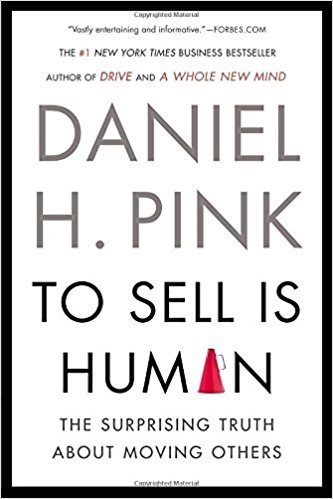
To Sell Is Human: The Surprising Truth About Moving Others by Daniel Pink is a fresh look at the art and science of selling, which is something we all do. If you want to better understand others’ perspectives, make your message clearer and more persuasive. Click below to purchase this book. It is purposeful and practical and may change how you see the world as it transforms what you do at work, at school, and at home.
Introduction
- Over the years, people in sales have often been seen as intellectual lightweights and dodgy characters. Even though 9% of us work in direct sales, some view it as the white-collar equivalent of cleaning toilets. The truth is, however, we are all involved in sales. We are all constantly trying to persuade, convince, and influence others. Studies show that collectively we are devoting 40% of our time on the job trying to move others. Even people in education and medical fields (Ed-Med), which are part of the fastest growing industries, engage in sales-like activities every day. As a result, non-sales selling is far more prevalent than selling in a traditional sense. People also consider this one of the most critical components in their professional success.
Entrepreneurship, Elasticity, and Ed-Med
- Entrepreneurs understand that segmenting job functions doesn’t always work. As small businesses proliferate, more people must have an elastic skill set, which includes a sales component. The U.S. even has more than twenty-one million people who are self-employed and therefore, have to sell themselves, and this number is growing. The Internet has knocked down barriers to entry by small operations. For example, the number of Etsy online shops is approaching one million. Kickstarter has helped people raise over $200 million to get projects off the ground, and smartphones can accept credit cards anywhere. Even bigger businesses are getting flattered with fewer people doing more varied things.
Ed-Med
- Jobs in education and medical care have increased from about 15% to 20% in the last twelve years. In the same time manufacturing jobs have gone from 17% to 12%. Ed-Med jobs are both intent on moving people as in changing what they know, think, and do. Teachers must convince students to part with time, attention, and effort as they sell a lesson. The same happens in health care as practitioners promote healthier behaviors. In any case, you have a better chance of moving someone if the proposed movement is in line with their personal goals. Letting kids choose what to write about and telling patients that you need to tap their expertise regarding their own bodies are examples of ways to move people.
From Caveat Emptor to Caveat Venditor
- Thanks to the abundance of information available on the Internet, today’s buyer has virtually as much information as today’s seller. As a result, sellers are no longer likely to live up to the outdated stereotype that includes terms like pushy, slick, and sleazy. In a world of information parity, the seller (vendor) is more likely to be one who has to beware (caveat). In many cases, the buyer knows more than the seller about a product and pricing. The same thing happens in education and medicine where students and patients can do research and know things that teachers and physicians do not. In the past, smart people were less likely to go into sales. Today, intelligence and creativity are essential.
Tags: Daniel Pink, To Sell is Human
Posted in Book Summaries, Business Books, Education Books, Leadership Books | 2 Comments »
Saturday, December 29th, 2012
The Dragonfly Effect: Quick, Effective, and Powerful Ways to Use Social Media to Drive Social Change by Jennifer Aaker and Andy Smith with Carlye Adler, (©2010, Jossey-Bass: SanFrancisco, CA). will help you harness the power of social media to achieve a single, focused, concrete goal. The authors also hope you will be inspired to use social media for social good. Think of this as your playbook for moving your cause from awareness to action. To be successful, you must translate your passion into a powerful story that generates contagious energy. Jennifer and Andy draw on abundant psychological research to show you how to do this. They also provide many inspiring stories to make their points and inspire their audience. Click the icon at the bottom of any page to purchase this book.
Jennifer Aaker and Andy Smith
- They are a married couple. Jennifer is a Professor of Marketing at Stanford University’s Graduate School of Business where she teaches a course on social media. Andy is a principal of Vonavona Ventures, where he advises on marketing, customer strategy, and operations. The book also contains a forward by Chip Heath, coauthor of Made to Stick, and Switch.
.
The Dragonfly Model
- The Dragonfly Effect, like the dragonfly, relies on four wings that achieve great results when they work together. It starts with focus. This is where you identify a concrete measurable goal. Next you grab attention by telling a personal story with unexpected, visceral, and visual aspects. Then you engage, which is where you empower your audience to care enough to want to do something. Finally, you enable and empower others to take action. To make action easier, you must prototype, deploy, and continuously tweak your approach towards making your audience team members.
Wing 1 – Focus – The HATCH Principals
- There are five design principles associated with the focus wing. First is humanistic. You first need to understand who your audience is. Listen, observe, ask questions, and empathize. Second is to make your goal actionable by breaking long-term goals into a number of short-term goals that are small, actionable, and measurable. Third is to make a goal testable. You need to measure progress and success somehow. Fourth is clarity. Goals need to be highly specific. Failures often involve goals that are vague, conflicting, or too numerous. The final principle is happiness. Your goal must be personally meaningful. The prospect of happiness will serve to motivate.
Wing 2 – Grab Attention – How to Stick Out
- Aaker and Smith suggest four design principles for grabbing attention. First is get personal. This can be a personal hook, using one’s name, or tagging someone’s picture. Second is to deliver the unexpected. The element of surprise can result in viral behavior, and you need to be original. Third is to visualize your message. Pictures trump words in terms of grabbing attention. You can juxtapose two images, combine images, or replace one with another. Finally you want to make a visceral connection. Do what you can to trigger the senses of sight, sound, hearing, or taste. Use music to tap emotions.
Posted in Book Summaries, Business Books, Education Books, Leadership Books | No Comments »
Thursday, December 13th, 2012
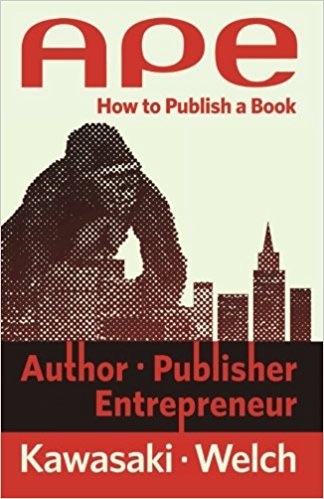
APE: How To Publish a Book by Guy Kawasaki and Shawn Welsh (©2012) As the digital world has created a revolutionary opportunity for writers to become their own publishers, a new self-publishing infrastructure has emerged. This book offers a guide to this new publishing universe with details and inspiration. After you read this you are unlikely to let anyone tell you that you shouldn’t, wouldn’t, or couldn’t write a book. The APE in the title stands for Author, Publisher, and Entrepreneur, and Guy and Shawn devote sections of this book to each part of the process. It makes for a great read and a better reference as you bring your book to life. Be sure to click the icon at the bottom of any page to support this stellar self-published effort.
Guy and Shawn
- Guy Kawasaki is the author of eleven previous books, including What the Plus!, Enchantment, and The Art of the Start. He is also the cofounder of Alltop.Com and the former chief evangelist of Apple. Kawasaki has a BA from Stanford University, an MBA from UCLA, and an honorary doctorate from Babson College.
- Shawn Welch is the author of From Idea to App, iOS 5 Core Frameworks, and iOS 6 for Developers. He is also the developer of several iOS apps. Previously he worked as a senior media editor for Pearson Education. He helped pioneer many of Pearson’s earliest efforts in iPad solutions. Welch has a BS from Kansas State University.
[Author Section] Why should anyone give a shiitake about your book?
- This is the question Guy starts with to help you decide if you should write a book in the first place. Keep in mind that people by books to help themselves, not to further your career. Question two is, will your book enrich your readers with some combination of knowledge, understanding, entertainment, or laughter? If your answer is yes you should write a book. Other good reasons include the value of the intellectual challenge, furthering a cause you believe in, and the therapeutic value of the process. Bad reasons are thinking you are in popular demand and that you will make a lot of money. You just might. but the odds are against you.
Some Publishing History
- While we don’t have to wait for scribes to hand copy books anymore, publishing a book in the traditional way still takes twelve to eighteen months. Authors and readers can’t wait this long anymore. Guy details the steps and the people involved in the traditional approach from agents to editors to copy editors to publicists. He warns about being rejected, and gives examples of many famous writers who had rejection experiences. He notes that traditional publishing is under siege by many forces, and may not be appropriate for writers like you. Self-publishing, on the other hand, is the best thing that has ever happened to writers.
The Self-Publishing Revolution
- Traditional publishing grew up in a world with limits and logistics such as shelf space, access to printing presses, editing and production expertise, and shipping of physical books. The 1980’s brought us laser printers and software that allowed anyone to publish. This was followed by electronic delivery systems that eliminated the need to print physical books. As a result, publishing is more democratic. That doesn’t mean, however, that the quality is any better. Any intermediaries between the author and the reader must add value or face their demise.
- Now authors can control content, design, and how long the marketing effort lasts. With print on demand services, books can stay in print for any length of time and revisions are easy to make. More, if not all, of the profit goes to the author. You can get global distribution, set your own price, cut quantity or license deals, and monitor sales as you wish.
Tags: APE, Guy Kawasaki, How to Publish, Shawn Welsh
Posted in Book Summaries, Business Books, Education Books, Leadership Books | No Comments »
Monday, October 29th, 2012
Linchpin: Are You Indispensable? by Seth Godin (©2011, The Penguin Group: New York, NY) will help you to become indispensable, which Seth sees as a choice you can make. It you are not happy with the impact you are currently making, this book may be the answer. Although written from a business perspective, Seth gives schools some blame for stifling linchpin behaviors. I hope educators can use this book to prepare their students to be linchpins rather than cogs in a machine. Be sure to click the link at the bottom of any page to buy this valuable book.
Tags: Linchpin, Seth Godin
Posted in Book Summaries, Business Books, Leadership Books | No Comments »