Archive for the ‘Business Books’ Category

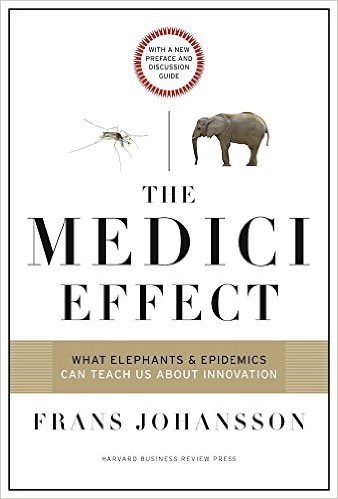
The Medici Effect: What Elephants and Epidemics Can Teach Us About Innovation

Friday, March 18th, 2011
Medici

This book by Frans Johansson looks at breakthrough insights at the intersection of Ideas, concepts, and cultures. He recommends that you expose yourself to a range of cultures, learn differently, reverse your assumptions, and take on multiple perspectives. The tips on brainstorming research are worth the price alone. Johansson is a writer and consultant who lives in New York City.

Cultures Are Different

  • How different cultures view a grasshopper? USA – pest, China – pet, N. Thailand – appetizer
  • How different cultures view the color yellow? USA – cowardice, Malaysia – royalty, Venezuela – lucky underwear

Why Study Multiple Cultures

  • Exposure to multiple cultures gives you more ways to look at an issue. Cultures can be ethnic, class, professional, or organizational in addition to geographic. This promotes open, divergent or even rebellious thinking. One is more likely to question rules, traditions, and boundaries. Languages codify concepts differently. Fluency in another language can promote varied perspectives during the creative process.

Learning Lots on Your Own

  • Broad education and self-education are two keys to learning differently. Most fundamental innovations are achieved by people who are either very young or very new to the field. Learning fields on your own increases the chance of approaching them from different perspectives. Darwin: “all that I have learned of any value was self-taught.”

Prepare Your Mind

  • Louis Pasteur found a forgotten culture of chicken cholera bacteria. When chickens were injected with it they got sick but recovered. These same chickens when injected with a fresh culture survived. Pasteur realized that the chickens had been immunized and that his old culture served as a vaccine.
Share this:
Share this page via Email Share this page via Stumble Upon Share this page via Digg this Share this page via Facebook Share this page via Twitter Share this page via Google Plus

Practically Radical – Not-So-Crazy ways to transform your organization

Monday, February 7th, 2011

Practically Radical: Not-So-Crazy Ways to Transform Your Company, Shake Up Your Industry, and Challenge Yourself, by William C. Taylor lives up to its title. Daniel Pink calls it “the most powerful and instructive change manual you’ll ever read.” Taylor, the cofounder of Fast Company Magazine tells engaging stories of the successful companies he studied and generalizes from their successes. Any leader or aspiring leader should read this book.

Click here for my summary of Practically Radical.

Living Large – Is Bigger Really Better? by Sarah Wexler

Monday, January 24th, 2011

Living Large: From SUV’s to Double D’s, Why Going Bigger Isn’t Going Better by Sarah Wexler, is a well researched, well written, and humorous tale of America’s fascination with all things large. Sarah immerses herself in her subjects and by so doing, gives us an understanding of ourselves that should open our eyes. Topics include: houses, weddings, breast implants, hotels, landfills, churches, shopping, and debt. This book is ideal for leaders, educators, parents, and students from middle school on up.

Click here for my summary of Living Large.

Personality Poker: Driving High-Performane Teamwork and Innovation by Stephen Shapiro

Saturday, December 4th, 2010

Personality Poker: The Playing Card Tool for Driving High-Performane Teamwork and Innovation by Stephen M Shapiro builds on decades of research to offer a simple game that provides deep insights regarding yourself, your coworkers, and your organization. The four personality types are represented by 13 traits on the cards of each suit. You can play a solitaire version or an assortment of versions with others.

Click here for my summary of Personality Poker.

A free online version is available at the Personality Poker site.

Reframing Organizations – Lee Bolman & Terrance Deal

Tuesday, November 9th, 2010

Reframing Organizations: Artistry, Choice, and Leadership 4th Edition by Lee Bolman and Terrence Deal, is the best textbook for a leadership course that I have seen. I use it for a course I teach for educators at the State University of New York at Cortland. The focus deals with the structural, human relations, political, and symbolic frames found in all organizations. If you analyze complex situations using all four, your are more likely to have success leading and managing. The summary includes activities I do with my class. It should be in every library and professional development collection.

Click here for my summary and activities from Reframing Organizations.