Archive for the ‘Business Books’ Category
Saturday, October 31st, 2020
The Educator And The Oligarch: A Teacher Challenges The Gates Foundation by Anthony Cody shows how the Gates Foundations’ efforts to reform education have had a mostly negative impact. By spending a small fraction of the total education budget, people like Gates can buy politicians, muzzle the media, and control many special interest groups and non-profit organizations with grant money aimed at advancing their agenda. Please purchase this book and spread the word. (Note: Like every other book summarized here, this one was written prior to the COVID-19 pandemic.)
Preface and Introduction
- The thrust of this book is that something is seriously wrong with our system when one of the richest men in the world can spend a few billion dollars and seize the reins of education policy. By funding almost everyone who does advocacy, including teacher unions, Gates can call the tune. The tune is Common Core and associated tests that are designed to yield wide-spread failure. Like tobacco companies in the 1960s, their sponsored research tells them what they want to hear. This undermines the public’s democratic control of education and devalues the teaching profession. There is nothing generous in using the power of wealth this way.
- Unlike previous grant efforts by wealthy foundations, the Gates Foundation’s approach was different. Their starting point was “we know what is broken and we know how to fix it.” They invite proposals by directly contacting organizations. They then collaborate with the organizations to develop proposals that align with their agenda. With their vast wealth, an entire sector of organizations became dependent on their funds.
Part I: The Assault on Public Education by Bill Gates
1. Bill Gates’ Big Play: How Much Can Money Buy in Education?
- Gate’s vision starts will the total reliance on standardized tests that were already required by federal law (NCLB). These tests were flawed and NCLB was bound to fail so it was necessary to develop a new generation of tests based on new standards known as the Common Core. It also helped to get staff from the Gate’s Foundation transferred to the Federal Department of Education. Gates held that the field of education didn’t know much about teaching. He started by funding research that defined effectiveness as high test scores. This means that teachers get paid for these results. Next, he donated to advocacy groups to the extent that he became their largest donor. The final step was to donate to the media’s efforts to cover education.
2. Circular Reasoning at the Gates: Education Nation Off to a Confusing Start
- Here are excerpts from a Teacher Town Hall from 2011 on NBC moderated by Brian Williams. He tells the audience that they will be using facts provided by the Gates Foundation as they are the largest single funder of education in the world. (Doug: I think the US government is the largest single funder.) On this show, Melinda Gates claims that there are multiple measures that they are using along with test scores such as administrator and peer observations along with student questionnaires. But, the only models of these other measures that she wants to use are those that improve test scores. Here the author suggests that many of the strategies used to boost scores are harmful to our students.
3. Teachers Face Good Cops or Bad Cops in Push for Evaluations
- The bad cop is the New York Post, which published the names of teachers with the worst scores. The good cops are Bill Gates and Michelle Ree who said this is wrong and that multiple measures should be used in addition to tests. Their other measures, as we have seen, are correlated to test scores. These good cops also push value-added ratings (VAR), which research has shown to be highly unstable for individual teachers. Translation: VARs are garbage and should never be used as part of a teacher rating system. There is also the false assumption that there are a significant number of crummy teachers who need to be weeded out. (Doug: From what I’ve seen as an educator since 1969, crummy teachers weed themselves out as being a bad teacher really sucks.) As it stands, 50% of teachers leave the profession within five years and turnover rates in high-poverty schools are 20% each year.
4. Cui Bono? The Question Rarely Asked, Let Alone Investigated
- Cui bono means who benefits. Journalists should be asking this question, but they don’t seem to be doing so. They are, however, repeating false ideas that the reformers put forward such as our public schools are failing due to the ineffective teachers that need to be fired. They also tout the success of charter schools, which overall is not the case. The winners here are the testing companies, curriculum designers and publishers, consultants, technology and software companies, and various leadership organizations.
5. Bill Gates Discovers Money Cannot Buy Teachers
- The main idea here is that people, in general, can sense when they are being manipulated and coerced. When this happens they resent it and resist. Here we are talking specifically about teachers. They aren’t opposed to being evaluated based on student work such as portfolios, but they resist being evaluated by invalid standardized tests that are closely correlated with the socioeconomic background of their students. Teachers, therefore, are justified in being ungrateful for all the money Gates has poured into education to remake it in his own image.
6. Bill Gates Goes to College. Has He Learned From His k12 Project?
- Gates is also determined to change higher education with a focus on tests that measure specific skills that employers want. His focus is also on online courses, which have been shown to be less effective for all save the brightest. (Doug: We are seeing that now as well with remote learning) The approach sends the message that education is only for job preparation, which the author rejects. Blended learning, which offers a mix of online and in-person instruction appears to be effective, but 100% online doe not appear to be.
7. Is ASCD Embracing Market-Driven Education Reform?
- Organizations like ASCD are being directly paid to support the implementation of Common Core, which converts them into advocates for the controversial standards. Along with it comes “market-driven” systems, which feature a push for charter schools, private schools, and vouchers at the expense of public schools. In 2011, the Gates Foundation awarded ASCD a grant of $3 million to help implement the Common Core. If you just read ASCD’s journal you wouldn’t know that the Common Core is controversial.
8. Is Gate’s Money Going to Influence the National Board?
- While Gates claims that teachers participated in the creation of the Common Core Standards they were not involved. He also tries to convince us that since the schools can create the curriculum, teachers can still teach as they wish. He negates this when he says that he will know that his efforts have succeeded when the curriculum and the tests align with the standards. He pushes for control of schools by mayors as when just one person is in charge, change can be made more efficiently. It also means that he only has one person he needs to influence or buy off. Note that cities, where mayors are in charge, have fared worse. Other organizations know that if they want his money they have to sing this tune.
9. Gates and Duncan Seek to Use Trust in Teachers to Promote Common Core.
- If Gates and the Department of Education under Duncan (appointed by Obama) trusted teachers, they would not have had Common Core standards drafted by test makers instead of educators. They would not have created the pseudoscience of VAM to try to hunt down bad teachers. If leadership organizations were true leaders, they would not have allowed themselves to be co-opted and bought off. Gates seems to operate by bad analogies. One mentioned here is “standardization is important to allow for innovation… like the standardized outlets we have in our houses.” He sees innovation as the domain of the creators of mass-produced tools and the teachers as consumers. He accuses teachers of not knowing much about effective teaching, which is why he came up with the Common Core and its testing to define excellence.
Posted in Book Summaries, Business Books, Education Books, Leadership Books | No Comments »
Saturday, October 10th, 2020
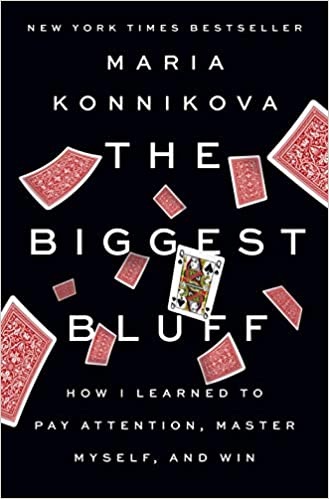
The Biggest Bluff: How I Learned to Pay Attention, Master Myself, and Win by Maria Konnikova chronicles her journey as a PhD psychologist and journalist into the world of professional poker. She starts with zero knowledge and experience and with the help of mentors and lots of hard work becomes a poker champion. While the framework for this book is the game of poker, each chapter features generalizations that we can all draw on to add quality to our lives.
A Prelude – Las Vegas, July 2017
- We start with a story from the World Series of Poker, which is The World Cup, The Masters, and The Super Bowl for poker players. Anyone can enter as long as they put up the $10,000 entry fee. This can be a lifetime dream for many. As play continues Maria’s seat sits empty while the dealer takes the anti for each hand from her piles of chips and tosses her cards into the discard pike known as “the muck.” She is in the bathroom curled up in a fetal position on the floor after barfing her brains out due to eating some bad guacamole. At the time she understood the line between skill and luck. The message is that you can’t calculate for dumb bad luck and you can’t bluff chance.
Ante UP – New York, Late Summer 2016
- Here we meet Erik Sidel, one of the top poker players of all time. Maria approaches him to see if he will mentor her for her experiment, which involves seeing if a psychologist with zero knowledge of poker can have success after spending only a year learning the game. Eric knows that most people who get serious about the game come at it thinking a deep knowledge of math is the most important attribute. He knows that a deep understanding of psychology is more important as the necessary math his not that hard to master. He also sees Maria’s language skills as another key attribute. (She is fluent in English and Russian, was fluent in Spanish and French, and can get by in Italian.) Eric accepts the challenge and it’s game on. You don’t play poker, you play the world.
The Birth of a Gambler – Boston, Fall 2016
- Life is a gamble. It may not seem like playing poker, but in some sense, much of life features less control than you have as a skilled poker player. Here we have a conversation with Maria’s grandmother (Baba Anna) who is very disappointed that Maria is taking up poker rather than a “real job.” Skilled stock pickers do no better than chance in the long run while professional poker players routinely outplay amateurs. In poker, the best hand doesn’t always win. This sets it apart from other games. The process of betting gets your full attention unlike making a decision where no bet is involved. This allows you to benefit from life’s decisions as well. Accurate probabilistic thinking is rare, but it is necessary for success in poker. Like people who predict the weather and horse races, poker players get immediate feedback and have no one to blame but themselves.
The Art of Losing – New York, Fall 2016
- Eric’s step one is to read the poker books by Dan Harrington, cousin to the golfer Padraig Harrington. Next, you need to watch streams with real hands being played by the best players. Sign up for the Run It Once a poker coaching site. Then start playing for real online for tiny stakes that can gradually get bigger. From there you can proceed to small tournaments and then move up to bigger ones. You need a balance between aggressive and conservative playing so that your opponents can’t figure you out. You also need to keep track of everyone’s stack size.
- Here we encounter the importance of learning from losing. (Doug: The concept of learning from failure is found in many of the other books I have summarized.) You have to constantly think, analyze, and stay objective. This is hard to do. This means that you never take things personally as you treat triumph and disaster the same. Disaster can bring true objectivity. Eric teaches Maria that there is no certainty, only thought. There are no right answers regarding any situation without a greater context. Self-awareness and self-discipline should be your twin goals.
The Mind of a Strategist – New York, Late Fall 2016
- Maria starts practicing online, but in order to do so, she has to take a train from Manhattan to New Jersey as online poker is illegal in New York State. She picks a puppy as her avatar and “psychchic” as her screen name. She describes a hand she loses and finds that she made a mistake by trying to copy a hand Eric had once and acted aggressively so as not to look weak. Time is an issue online and in real tournaments as it is in real life. In both cases, you want to use the time you have to think things through, but not act impulsively as time starts to run out. When playing you want to be the last one to act as that will give you maximum information.
- The military analogy applies here. You need to know the enemy and survey the nature of the board in each hand. Like a general, you need to decide just how many of your troops you need to deploy. Everything from a scout to every soldier you have is in play. Your strategy cannot be predetermined. Another analogy is that of a jazz band where once it’s your turn you have to decide what to play.
- If you only bet when you have top cards your opponents will figure that out and you won’t win much. You will lose more as you won’t often have top cards. This is why you have to bluff on occasion. Maria tells the story of getting an offer to write an article about what she was doing. She said no several times until she got an offer of $3/word. Like sometimes in poker, she got more out of her hand then she thought she could.
Tags: Eric Sidel, Maria Konnikova, Phil Galford, Poker, Texas hold 'em
Posted in Book Summaries, Business Books, Leadership Books | No Comments »
Monday, June 8th, 2020
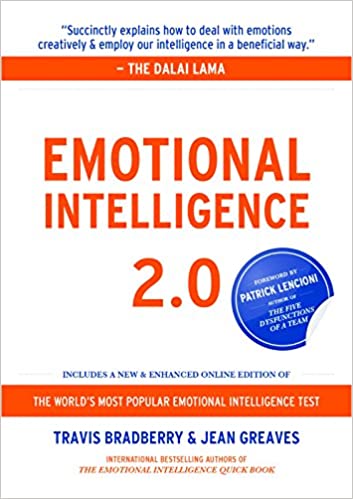
Emotional Intelligence 2.0 by Travis Bradberry & Jean Greaves (the book can be found succinctly explains how to deal with emotions creatively and how to employ your intelligence in a beneficial way. There is strong evidence that EQ can be improved with effort and this book can direct that. Higher EQ leads to success on the job and at home so this is a book that everyone can use to forge a better life.
1. The Journey
- All information from your senses has to pass through the emotional part of your brain (the limbic system) before it gets to the rational or thinking part of your brain (the frontal cortex). It’s the communication between your emotional and rational brains that is the physical source of emotional intelligence or EQ. It is emotional intelligence that explains why people with high IQs don’t consistently outperform people with average IQs.
- The purpose of this book is to help you increase your EQ. You start by taking the Emotional Intelligence Apprasal online. To see your scores you will need the code at the end of the book, which is only good for one person. This appraisal provides a baseline against which you can judge your improvement. This is a new feature in version 2.0. You can also retake the test after you finish the book to see how much you have learned.
2. The Big Picture
- Emotional awareness and understanding are not taught in school, but self-knowledge and emotional mastery are required to make good decisions on the job and in life. We have many words to describe our feelings yet all emotions are derivations of five core feelings: happiness, sadness, anger, fear, and shame. Here we find twenty different words to describe each. When emotions are intense they can highjack your rational thinking and cause you to react reflexively. Your reaction to these trigger events is shaped by your personal history. Enhanced EQ can help you recognize triggers and let you respond in a rational manner.
- We all possess the qualities of personality, EQ, and IQ. Of the three, EQ is the one most amenable to improvement. It is also the foundation of a host of critical skills like time management, decision-making, and communications. It is the strongest driver of leadership and personal excellence. It is highly correlated with high-performance and salary regardless of the job. The rest of the book will help you improve your EQ.
3. What Emotional Intelligence Looks Like: Understanding the Four Skills
- The four EQ skills come in two pairs known as personal competencies and social competencies. The first includes self-awareness and self-management. This is where you stay aware of your emotions and manage the resulting behavior and tendencies. Social competencies include social awareness and relationship management. This is where you work to understand other people’s mood, behavior, and motives. Emotions always have a purpose as they shape your reactions to the world around you.
- Self-awareness is a foundational skill; when you have it the other skills will be easier to use. Self-management is dependent on your self-awareness as it gives you information that you can act on rationally rather than reflexively. Social awareness is also foundational as you need to pick up on the emotions of others so you can better manage your relationships. You need to listen well rather than thinking about what you are going to say next when another person stops talking. Relationships require you to understand others and are based on how you treat them over time. This chapter also contains positive and negative examples of all four skills.
Posted in Book Summaries, Business Books, Education Books, Leadership Books | No Comments »
Monday, May 11th, 2020
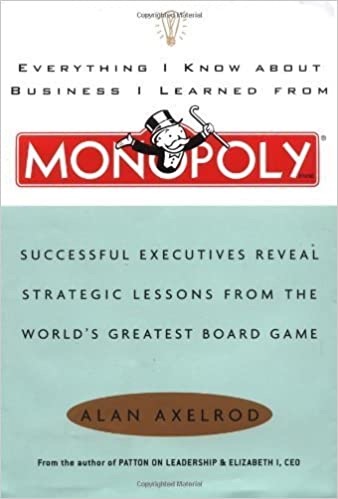
Everything I Know About Business I Learned From MONOPOLY: Successful Executives Reveal Strategic Lessons From the World’s Greatest Board Game by Alan Axelrod is a handbook on how to use the world’s most popular board game to think about, explore, and rethink the nature of business and the doing of business. It offers insight and provocation, which is a good starting place. If you are finding more time for board games, be sure to dust of your MONOPOLY board after you read this book.
Introduction
- Parker Brothers introduced MONOPOLY in 1935 and within one year it became the best seller in the US. This was in the heart of the great depression when business wasn’t working too well. Then a game that modeled capitalism struck a chord. It allowed people to experience success and failure in their own living rooms. The game is just complicated enough to be realistic and fun. It was developed from business school simulations for the general public by Charles Darrow who was turned down the first time it offered it to Parker Bros. He kept selling it himself and Parker Brothers got wind of his success. Ask any business person what got them interested in business and they are likely to say MONOPOLY. Like the rest of the book, this chapter contains quotes from famous business people.
Part I: There Are Rules – 1.The Object of the Game
- The objective of MONOPOLY is to become the wealthiest player through buying, renting, and selling property. You need to be aggressive when it comes to acquiring property. Being cautious might keep you in the game longer before you go bankrupt. Caution is not a winning strategy.
2. All Things Being Equal
- Unlike the real world, each MONOPOLY player starts with the same amount of money ($1,500) at the same place. Beyond that things are unequal based on each player’s abilities. In real life, there are great disparities regarding where we start. A combination of innate ability, ambition, parental wealth and parenting skills, and luck determine where we end up. Like the real world, luck is also a factor in MONOPOLY via the roll of the dice and the luck of the draw (Community Chest and Chance cards).
3. A Roll of the Dice
- Luck implies some controlling power. Chance implies randomness. Confident people anticipate success. If you feel like a winner, you will behave like a winner, you will make moves that winners make, you will, therefore, improve your luck. It’s your attitude and self-confidence that will predispose you to make your own luck. Our lives are full of familiar events mingled with a few surprises. In MONOPOLY there is a lot of familiar territory accompanied by chance. You can’t control the dice, but it’s good to know the odds. Out of 36 possible combinations. Six give you a seven. Five give a six or an eight. Four give you a five or a nine. Three give you a four or a ten. Two give you a three or an eleven, and only one gives you a two or a twelve.
4. Passing GO
- Passing Go and collecting $200 is like working and collecting a salary. Ideally, you make enough to meet your needs and maybe enough to save some. In MONOPOLY you can’t live on your salary alone and you have to put the money you take in at risk. Unless you pull the go-to jail card, collecting your GO salary should be part of your strategy.
5. The Rule of Opportunity
- The big idea here is unless you have a positive, purposeful, affirmative reason to say NO, say Yes to every opportunity that presents itself. In MONOPOLY you need a very good reason not to buy an unowned property you land on. The rules state that if you don’t choose to purchase an unowned property you land on, the Banker is supposed to sell it at auction. Many people don’t follow this rule, but you should as it makes the game much more dynamic.
6. Facing Reality and Paying Your Debts
- The key point is not to learn to avoid risk but to accept risk as necessary to success. Having accepted the necessity of risk the object becomes making a choice of what risks to take and how far to take them. Accepting a risk should not require abandoning fiscal responsibility. Putting all your chips on a single number is a risk, but not a wisely calculated risk. Stretching intelligently but aggressively to the edge of your means is often necessary to win. Aggressive but intelligent risk is part of living, working, doing business, and making deals. In a sense, MONOPOLY is a kind of financial flight simulator that lets you try out the lessons of value, responsibility, and prudence.
7. Mortgaging the Future
- Your only credit option in MONOPOLY is to mortgage properties you own. Doing so you collect half their listed value from the Bank and can no longer collect rent. Ideally, you would mortgage single properties to develop a monopoly you own. Unlike real mortgages, there are no regular payments and you can un-mortgage a property any time by paying back the loan with 10% interest. Don’t do this until you have at least three houses on all of your monopolies. Mortgage single properties first followed by utilities and railroads as the latter command higher rent.
8 Vigilance
- The key rule here is “The owner may not collect the rent if he/she fails to ask for it before the second player following throws the dice.” You have no obligation to remind someone that you have just landed on their property and you shouldn’t. Part of the success in this game is being vigilant throughout. This includes keeping track of who owns what as property deeds need to be clearly displayed in front of each player. Being vigilant for other players doesn’t help them learn vigilance.
9. The Random Walk
- Moves around the MONOPOLY board may seem random, but they are not. Thanks to the probability of rolling different die combinations the moves are just complex. You can consult The MONOPOLY Companion by Philip Orbanes for details. Here you will find a list of the chance of landing on each type of property each trip around the board, and there is a surprising range. The fact that Jail is the most common starting place for a move is part of the reason. The key idea is that knowledge itself is useless unless it is applied.
Posted in Book Summaries, Business Books | No Comments »
Monday, April 27th, 2020
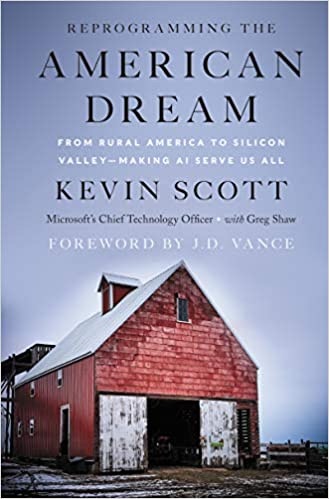
Reprogramming the American Dream: From Rural America to Silicon Valley – Making AI Serve Us All by Kevin Scott finds a balance between “the robots are coming for our jobs” and “AI is great, nothing to worry about.” Like Kevin, I believe that all citizens need to educate themselves regarding the promises and perils of AI. That is clearly the purpose of this book. It won’t make you an expert in AI, but it will give you many clues. In addition to citizens, AI experts, policymakers, and executives are also Kevin’s intended audiences.
Introduction
- There are two prevailing stories about AI. For low and middle-skill workers, we hear a grim tale of steadily increasing job destruction. For knowledge workers, we hear an idyllic tale of enhanced productivity and convenience. But neither captures the whole story. The story we need is AI’s potential to create abundance and opportunity for everyone as it helps solve the world’s most vexing problems. Kevin’s story is based on his upbringing in rural Virginia and his life as executive vice president and chief technology officer for Microsoft.
- We know AI will radically impact economics and employment and we are already seeing it perform very specific, narrow tasks like selecting the ads you see, turning speech to text, and translating languages. He sees a future where workers at all skill levels are served. While AI was invented in the US, China’s goal is to become the leader and thus dictate policy regarding this technology. In order to have a voice in the debate you need to be informed, which is the goal of this book.
PartI: Where We’ve Been – 1. When Our Jobs First Went Away
- Kevin returns to his rural home and visits old friends who are using simple versions of AI to harvest sod, monitor nursing home patients, and manufacture specialized plastic parts. The latter demonstrates how technology is allowing some manufacturing jobs to return to the US. In the case of the sod farmer, drones using AI are saving human jobs. In essence, AI can empower people rather than replacing them. He also visits a large Microsoft data center that replaced an obsolete prison. The local college even started a program to train workers. The challenge is to convince high school graduates that there is a better future in a technology job than in oil and gas jobs which might pay $60,000 to start, but are heavy labor jobs that over time, pay little more than the initial offer.
2. The Career Choice I Made
- This chapter is largely autobiographical. Kevin tells his story from home to college to a small engineering company in Lynchburg, VA, to graduate school at the Univerity of Virginia where he met his future wife. When she was accepted to a PhD program in Götingen, Germany he was able to get a job there too. From there he went from Google to AdMob, to Google, to LinkedIn. LinkedIn was acquired by Google in 2016 and ultimately he was chosen by Saya Nadella the CEO to be Microsoft’s chief technology officer (CTO).
- Along the way Keven stresses the importance of his supportive family and community in rural Virginia. While they were not rich he never lacked for food or housing and hand mentors and role models that supplemented his education. He didn’t have health care until he got to Google but never got sick either. While he doesn’t think you should base all of your career decisions on income, you should consider the economics of the choices you make. Get as much data and good advice as you can and reflect prior to making important life choices. For companies, he stresses the importance of stories. They need to be stories that employees can make their own and they need to be connected to how their work can somehow make the world a better place.
3. Stories of Revival
- The stories here focus on rural life and opportunities. In 2016 75% of venture funding went to Silicon Valley, New York, and Boston. Kevin tells the success story of Memphis that now has the world’s largest cargo airport. AI is making inroads in agriculture with robots that do precision irrigation and drones that apply fertilizer and pesticides in just the right quantities and locations. Kevin offers some ideas of how the government can incentivize rural entrepreneurship. His big idea is to have an Apollo type program for AI. The Apollo program only cost $200 billion in the 1960s to get to the moon so it should be possible to do the same for AI.
- We need a system to make rural people better at tech so they can run and debug drones, robots, and other high tech farm equipment. There is some effort in this direction. We also need to break down the stereotypes that urban and rural people have of each other. The media that people currently consume is part of the problem as many people binge on unhealthy information. He switched his consumption to 75% refereed journals like Science and Nature, 25$ to learning something new and different not related to his job, and 5% for everything else. Doing so made him less anxious, irritated, and much better informed.
Posted in Book Summaries, Business Books, Leadership Books | No Comments »