Archive for the ‘Business Books’ Category
Monday, April 6th, 2020
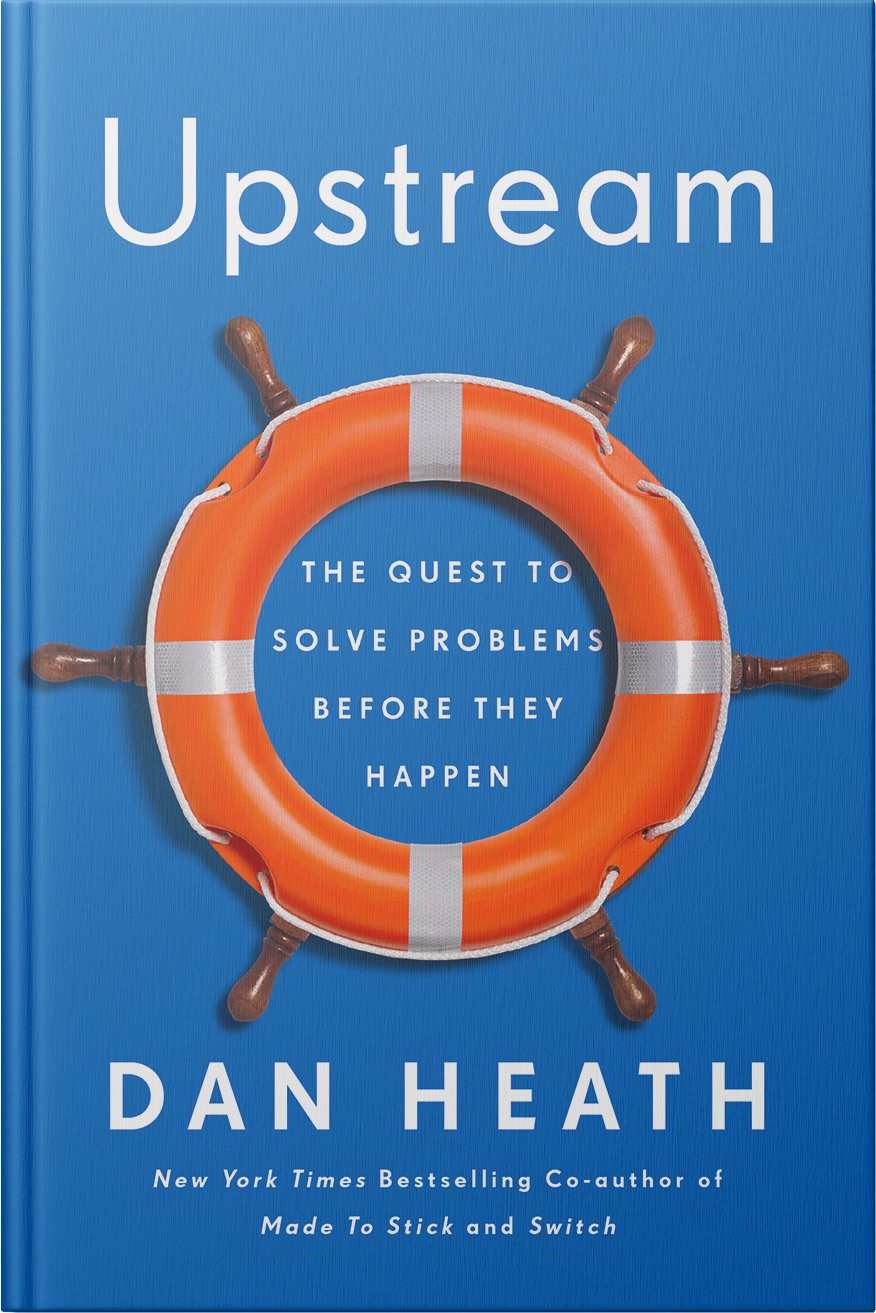
Upstream: How to Solve Problems Before They Happen by Dan Heath deals with the notion of preventing problems before they happen rather than being stuck with constantly fixing things after they break. He discusses barriers to Upstream thinking and offers questions Upstream leaders need to address. Whether you are a leader in your organization or just an ordinary individual trying to reduce stress and live a happier life, this book is a must.
1. Moving Upstream
- The book starts with a parable about two men rescuing drowning children who one after another come past them in a river. When one man stops the effort to head Upstream his friend asks what he is doing. The man says that he is going Upstream to tackle the man who is throwing the kids into the river. The key point is that Upstream efforts are aimed at preventing problems while Downstream efforts react to problems once they’ve occurred.
- An example is Expedia’s 58% call support rate. When they looked at the problem they found that none of their teams were judged on this number. Once they looked at the reasons for the calls it was easy to lower the rate to 15%. Another example compares one police officer who stands on the corner causing people to slow down and preventing accidents to another who hides and gives out tickets. Dan sees health care as one area where the US needs to shift to more Upstream efforts as other developed countries have done. The general goal in this book, therefore, is that we should all shift more of our energies Upstream.
Section 1 – The Three Barriers to Upstream Thinking
2. Problem Blindness
- Problem blindness happens when we believe that negative outcomes are natural and unavoidable. A successful example of fighting this problem happened in the Chicago Public Schools where the graduation rate in 1998 was 53%. They found that the key to graduation was a successful freshman year and a program to attack this problem was put in place. It involved teachers getting to know individual students better, giving more support, and collaborating with each other to help students in need. By 2018 the graduation rate had risen to 78%.
- Sometimes we miss problems because we focus on one thing and miss a problem in our peripheral vision. In the 1960s and 1970s, sexual harassment had been normalized in the workplace to the extent that women were encouraged to embrace it. In 1975 a journalist coined the term sexual harassment. Now that the problem had a name demanding a solution was an implied obligation.
- Another example relates to the extensive use of C-sections for child delivery in Brazil. They increased as they were convenient since they could be scheduled and they resulted in more money for the doctors. They also resulted in more babies ending up in intensive care as they were born sooner than necessary. Thanks to one woman and one doctor who saw the problem and took action, the C-section percentage is now coming way down.
3. A Lack of Ownership
- An example of this issue goes back to the Chicago Public Schools with its dismal graduation rate. It got that way because the adults saw it as the kids’ problem. It was greatly improved when the adults decided to make it their problem. There is a story here about a man who owned a carpet business. When he read about our environmental problems he decided to see what he could do. He motivated everyone in the company to look for ways to do things like recycling old carpets. When a doctor in Tennessee found out that more kids died inside cars than outside cars he went to work in 1976 on legislation requiring car seats for kids. By 1985 all 50 states had car seat laws. In short, upstream work is generally chosen rather than demanded. If you find yourself saying “it’s not my problem,” you are likely living downstream.
4. Tunneling
- When you are reacting to problems it can be like you are in a tunnel just digging forward. You don’t have time to step back and take a system-wide look at why the problem exists. Such time would be slack time and it is smart to build slack time for system thinking into your schedule. Poverty tends to cause more tunneling as it reduces bandwidth and causes stress. People who aren’t poor can solve some of their problems with money, which leaves more resources for the problems that money can’t solve. Dan gives examples of situations where tunneling gets in the way of upstream problem-solving.
Posted in Book Summaries, Business Books, Education Books, Leadership Books | No Comments »
Friday, October 18th, 2019
Leaders Eat Last: Why Some Teams Pull Together and Others Don’t by Simon Sinek tells stories about leaders who found success mainly by putting people first. Seeking short term gains and seeking to serve one’s own selfish interests is short-sighted and sure to fail over time. This book will help leaders in all fields be the type of leader they wish they had. This would be a great textbook for any leadership course. Be sure to get a copy for leaders you know.
Forward by George J. Flynn Lieutenant General, U.S. Marine Corps (Ret.)
- An organization’s success or failure is based on leadership excellence and not managerial acumen. These organizations have strong cultures and shared values and understand the importance of teamwork and trust. They understanding the importance of people and relationships. The true price of leadership is the willingness to place the needs of others above your own. You must know your people and realize that they are much more than an expendable resource. Good leaders truly care. Leaders who take care of their people can never fail.
Part 1 – Our Need to Feel Safe
- 1. Protection from Above: We start with a story about a pilot risking his life to save 22 men in Afghanistan. He said he was just doing his job and that empathy for others is the single greatest asset he had to do his job. “They would have done it for me.” Empathy helps you share your glory and help those with whom you work to succeed. This strong foundation leads to success that no amount of money, fame, or awards can buy. Exceptional organizations have cultures in which leaders provide cover from above and the people on the ground look out for each other thanks to empathy.
- 2.Employees Are People Too: By getting rid of time clocks, bells that signaled breaks and lunch, locks on boxes of spare parts, and replacing free anytime phones with asking for permission payphones one leader used trust to turn his company around. People offered to donate vacation days to an employee with family problems. The workers also took better care of the machines. This happens when leaders listen and avoid coercion. They treat workers like family and realize that everyone is someone’s son or daughter.
- 3. Belonging: The authors use the metaphor of The Circle of Safety. It’s like four oxen standing so that no matter which direction the lion comes from it will always be met be horns. After thirteen weeks of boot camp, Marines know that they can trust every other Marine to protect them. It’s important that everyone in an organization feel that way about every other member so that everyone feels as safe as possible. This will result in better collaboration and problem-solving.
- 4. Yeah, but…: Stress can have negative effects on one’s health so it’s important to avoid it as much as possible. The more control a person has the less likely they are to be stressed. Top leaders, therefore, do what they can to give workers control and to acknowledge their efforts. We also know that coming home angry from a job you hate will have a negative impact on your children. You may be better off with no job rather than one you hate.
Part 2 – Powerful forces
- 5. When Enough Was Enough: In order to survive, humans have had to rely on cooperation and mutual aid rather than competition. If we don’t look out for our group, our group won’t look out for us. Conversely, if we don’t take care of ourselves first, we won’t be of much use to others.
- 6. E.D.S.O: Four brain chemicals help us survive. Endorphins are the brain’s pain relievers. They give us a remarkable capacity for physical endurance. Dopamine causes a feeling of satisfaction when we accomplish something. It makes us a goal-oriented species. Together these two chemicals help us get things done. Serotonin gives us the feeling of pride we get when we perceive that others like or respect us. As social animals we need approval. This causes us to give of our selves. Oxytocin is the feeling of friendship, love, or deep trust. Without it, there would be no empathy. You get it when to do something nice for someone. Such behaviors make us happy and help us live longer.
- 7. The Big C: When something goes wrong or you don’t feel safe your body releases cortisol. It’s the chemical that causes feelings of anxiety, discomfort, or stress. It’s like an early warning system. If you work with a group where members don’t care much about one another’s fate cortisol starts to seep through your veins. It inhibits the release of oxytocin, the empathy chemical. One can adapt to regular doses of cortisol, but it isn’t good for one’s health. Here is a story of a company that adopted a no-fire policy. As a result, people communicated more openly and pointed out problems more quickly. Turnover shrank and people felt safe.
Part 3 – Reality
- 9. The Courage to Do the Right Thing: Here we have a story of an aircraft controller who broke the rules and saved many lives. The point is that you have to know when to break rules and that you need rules to keep things running well. Also, relationships aren’t really based on rules.
- 10. Snowmobile in the Desert: Snowmobiles don’t run so well in the desert. Sometimes amazing humans are like snowmobiles in the desert. Sometimes the harder we try to do things right the worse we feel. We need to get the environment right at work and at home and learn how to work together as nothing great was ever accomplished by a single person.
Posted in Book Summaries, Business Books, Leadership Books | No Comments »
Friday, September 27th, 2019
You Are Awesome: 9 Secrets to Getting Stronger and Living an Intentional Life by Neil Pasricha offers excellent advice that we can all use to have a more fulfilled and productive life. The advice here is appropriate for people in business, educators, and students alike. In short, everyone. Be sure to get some copies for your professional development library and get one for yourself.
Introduction: You Need to be More Resilient
- It starts with a very cool fable that demonstrates the notion of resilience. The key is to not let defeats define who you are. Every end is a beginning. Resilience seems to be in short supply, which is why Neil wrote this book. He offers nine research-backed secrets, shared through personal stories on how we can move from shattering to strengthening. If you find yourself off course, this book is for you.
Secret #1 – Add a Dot Dot Dot
- The dot dot dot here is known as an ellipsis which marks incomplete utterances in plays. Compare this to a period known as a full stop, which marks a finished sentence. Neil uses the ellipsis as a metaphor for life were everything is unfinished until you die. He uses the inspirational story of his mother, born the fifth girl in Kenya to a family who wanted a fourth boy. She was self-taught and got the highest score in the nation’s standardized test, which earned her a full scholarship to a white prep school. She just kept going like an ellipsis and looked past the periods.
- The other key lesson here is that like Neil’s mom, the one word you should use over and over at the end of your sentence is yet. As is “I don’t have any better options…yet.”
Secret #2 – Shift the Spotlight
- It’s egotistical to think that “it’s all about you.” It’s foolish to think that people are constantly looking and you and judging you. It’s folly to think the spotlight is on you because it isn’t. Stop caring with other people who are self-absorbed think of you. There is so much beyond your control that you need to simply learn from your failures and move on. Share your failures with others as it will help you seem more human. You will seem more normal, real, and relatable, which will help improve your relationships. If you make self-harming statements you are likely to believe them. Also, avoid exaggerating the size of your problems.
Secret #3 – See It as a Step
- If you think of life as a long stairway you need to realize that you can see the steps taken but the upcoming steps are invisible. Also, realize that we are all really bad a predicting the future. People think that they have changed a lot in the past, but won’t change much in the future. This is probably wrong. When people are down, they often think they will probably stay there. This is the wrong way to think. See failure as a step towards a future that you will be happy with. Neil also recommends that you avoid the endless reports of bad news that our modern media doles out. It’s largely a machine-gun barrage of superficial negativity. He also found that writing a blog was cathartic as it helped him swap dark thoughts for lighter ones. For him, it was the dot dot dot, a shift of the spotlight, and the next step. When you fail, just prepare for this next step, which might be positive.
Secret #4 – Tell Yourself a Different Story
- Shame is an intensely painful feeling or experience that we are flawed and unworthy of love or belonging. It plays a role in how we think of ourselves. Your problem is the story you are telling yourself and you can choose another story like you can choose your attitude. Three questions can help. 1. Will this matter on my death bed? 2. Can I do something about this? 3. Is this a story I am telling myself?
Secret #5 – Lose More to Win More
- Some good things just take time. They take lots of failure, lots of loss, and lots of experience. Wanting to get better is a real gift. It means you keep trying, failing, and learning. If your number of failures exceed those of most people you should be proud of that. Cy Young had the most wins and the most losses. Nolan Ryan had the most strikeouts and the most walks. The more times you step to the mound the more chances you have to win. Go to parties where you don’t know people. Have a failure budget. Can you afford to lose hundreds on something that fails? How about thousands or more? More losses give you more chances to win. If you want good pictures, take more pictures.
Secret #6 – Reveal to Heal
- Physical releases are easier than mental releases. Take time to let go of something and take time to feel grateful and write down at least five gratitudes a week.
Secret #7 – Find Small Ponds
- Would you rather be a big fish in a small pond or a small fish in a big pond? If you choose the former your self-esteem will go up and stay up. Neil got this advice from a dean so instead of applying to a top company he looked for ones that were broken in some way. He got a job where he was a big deal and could make a difference. This concept applies to life. Rather than chase the hot person on the beach, look for the nerd in the library. Just don’t be arrogant or act boastfully while you are in the small pond.
Secret #8 – Go Untouchable
- It seems that every day there are more distractions in our lives. Cellphones are a big culprit while things like meetings at work and a barrage of emails also contribute. When Neil quit Walmart to become a full-time writer he found that he didn’t have the amount of time he anticipated to do creative work. His solution was to create weekly UNTOUCHABLE days where he unplugged and just focused on creative activity. He found his productivity skyrocketed so he now schedules two such days a week sixteen weeks into the future. If he has to shift one of these days he keeps it in the same week.
Secret #9 – Never, Never Stop
- This chapter could have been called “what I learned from my dad.” He emigrated from India to Canada, worked hard, and never gave up. He kept things simple and when he made a decision he didn’t waste time rethinking it. The big idea is that you can only go forward so start going that way and never stop. Thanks, Neil.
Neil Pasricha
- Neil is a New York Times bestselling author of six books including The Book of Awesome and The Happiness Equation. His podcast 3 Books is his quest to uncover the most formative books in the world. He gives 50+ speeches a year including TED Talks and SXSW. He has degrees from Queen’s University and Harvard Business School and lives in Toronto. Reach him on Twitter as @nielpasricha, visit his blog at Neil.Blog, and drop him a line at neil@globalhappiness.org.
Posted in Book Summaries, Business Books, Leadership Books | No Comments »
Monday, July 15th, 2019
The Happy Mind: A Simple Guide to Living a Happier Life Starting Today by Kevin Horsley and Louis Fourie offers a common-sense approach to living a happy life. As a very happy person, I find their advice right on the money. Please share this with people you know who aren’t happy enough. Also, share with young people so they can learn how to be happy for the rest of their lives. Here is
the link to the book and
the link to their website.
1. The Search For Happiness
- Start by taking some time to write down your definition of happiness. This is something you will come back to later in the book to adjust as you gain perspective. Since happiness is so subjective there is no one definition that applies to everyone. None the less, everyone agrees that it is important to be happy.
- Next we look at different ways that people approach happiness. For some wealth is the driving factor even though it doesn’t guarantee happiness. These folks usually also seek status to make them happy. Some people think they will be happy only if they can change their location. Many seek happiness as they strive to improve their physical appearance. This may seem vain, but there is nothing wrong with caring for yourself. Many people see happiness sometime in the future or even the afterlife while others fondly recall the good old days. Happiness can also result from social activity and may rely to a great extent on a life partner. Social dynamics in the workplace bring happiness to some. All of these happiness influencers are external.
2. Happiness Is
- 1. Thinking In a Different Way — Happiness exists in your mind so it is important how you think. If your thoughts aren’t making you happy you need to think differently.
- 2. Assuming Full Accountability for Your Circumstances — You have to own your life and be responsible for what happens. That means you have to manage circumstances and not just let them happen to you. Your attitude is a choice and it can support or obstruct you.
- 3. Enjoying Simple Things More — Small joys are endless as long as you look for them. Nature’s beauty can make you happier if you take the time to enjoy it. You also need to have gratitude for all the little things that make you happy as you push anger, arrogance, desire, indifference, regret, resentment, and guilt away.
- 4. Owning Your Own Future — You need to own the situations you are in and don’t settle for helplessness. Adjust to new conditions and change the things you can change. Planning must be a priority if you want to accomplish your goals.
- 5. Being Engaged In What You Do for a Living
— A job you love or at least enjoy most of is vital to a happy life. You should also look to make changes so that you like it even more.
- 6. Invest in Your Overall Wellness — Taking care of yourself involves a healthy diet and exercise. Surround yourself with constructive people and reflect on good things. Stay curious and learn something new each day. Pay attention to your finances and spend less than you make. Be sure not to make any enemies.
- 7. Having Constructive Relationships — Happy people get along with others. They also enjoy their own company as being alone isn’t being lonely. Carefully select the people you develop relationships with.
- 8. Having an Optimistic World View — Optimistic people are happier. Leave the past behind and be quick to forgive others. Carrying grudges and being judgmental won’t make you happy. Try to see the funny side of life and be sure to laugh at yourself.
- 9. A Day-to-Day Effort — Happiness is work. It’s easier to be miserable. You need to be committed and make a constant effort. (Doug: After a while, it will become second nature.)
3. The Origin Of Unhappiness
- If you do the opposite of what is discussed in the previous chapter you are bound to be unhappy. Unhappy people freeze when they face challenging situations. They look for culprits rather than solutions. They don’t take responsibility for their fate and constantly blame others. They neglect their health and their finances and fail to build solid relationships. They focus on what they don’t have and haven’t done.
- At the heart of this is the failure to use the thinking brain also known as the neocortex. Instead, they are likely to rely on the primitive part of the brain that makes knee jerk decisions and reactions. For more on this see my summary of Thinking Fast and Slow: How the Brain Thinks by Daniel Kahneman.
4. Practical Guideline, Thoughts, Suggestions & Reminders in the Interest of Happiness
- Happiness is work, at least for a while until it becomes second nature. It should also be personal as you strive to find just what makes you happy. So make your plan and review and modify it from time to time. Learn to appreciate what you have along with the small things. Be sure to look for ways to spice up your plan and take advantage of situations that aren’t planned for. Keep it simple and travel light. A mindset of modest expectations fuels calmness.
- The only life you can direct is your own. You can try to change others, but don’t count on it. (Doug: Don’t marry someone thinking you can fix the characteristics you don’t like after you are married.) Make sure the information you take in is nutritious. Try to focus on one thing at a time as multitasking is inefficient and leads to more errors. Be serious about your job and proud of what you do. Above all keep looking until you find a job you enjoy. Forgive quickly as you do so for your own happiness, not the happiness of those you forgive, and don’t carry grudges. Judging others can result in endless mental effort.
- Sleep is when the brain repairs itself. Try to get seven or more hours and sleep the same hours every day. Be good to people in need. Performing an unexpected act of kindness and make you happier. Be cheerful and make time for laughter. The present is the only real tense. What you do and think now is what matters. It’s hard to be happy if your diet is bad for your body. Everyone wants to live in a neatly organized space so be responsible for yours. Craft loving relationships starting with your immediate circle. Take time enjoying being with just yourself. Try to make small daily shifts in the directions described in this book. Be frugal with your finances and decide that you are going to be happy.
5. A Few Last Words
- Learn from hurtful events and you will probably have fewer of them. Workaround your weaknesses and optimize your strengths. Enjoy your own company and look after your body. Keep your word and know when to say no. Never blame, even yourself. Live every day as if it’s your last as one day it will be. Laugh a lot more than you cry and remember, you don’t have to be happy for the rest of your life, only now.
Kevin Horsley and Louis Fourie
- Kevin is a lifelong student in the field of neuroscience. He is a World Memory Championship medalist and a two-time World Record holder for The Everest of Memory Tests. He is an international speaker, trainer, and consultant who helps organizations improve their thinking, creativity, motivation, and learning
- Louis started as an economist in the South African financial industry and was one of the first winners of South Africa’s Economist of the Year award. He founded a leading South African wealth management business and acted a chairman for twelve years. He then founded The Logic Filter a consultancy group that mentors young professionals and advises emerging business leaders.
Posted in Book Summaries, Business Books, Education Books, Leadership Books | No Comments »
Monday, April 8th, 2019
The Leadership Mind Switch: Rethinking How We Lead In the New World of Work by D. A. Benton and Kylie Wright-Ford makes an excellent textbook for any modern course on leadership, including educational leadership. It deals with how our modern culture impacts how leaders need to think and operate and it also deals with leadership qualities that never change. Get a copy for any aspiring leader you know.
Introduction
- The leadership game has changed over time and continues to do so. The book’s premise is that a mind switch is needed now to be ready for the future that will be vastly different. This book offers tools and information that you will likely need to lead in the future. You will need skills to understand and relate to people of all kinds. The more human aspect of leading is emphasized here. Leadership is everything in business and schools and since someone is going to lead it might as well be you.
Part One: Leading Today and Tomorrow 1. The Changing World of Leadership
- We know that information is rapidly expanding and that there will be welcome and unwelcome consequences. Technology is ever expanding and robots may soon join your staff. Telecommuting is on the increase so you need to be able to communicate with others from almost anywhere in the world. Office spaces and hours are changing and some people, even leaders, don’t have desks. Leadership today is about character and communication. They will have more daily contact with everyone and must be able to connect with all types of people.
- Leaders will have to understand and use technology and decide how it will be used. Leaders must decide the rolls that things like virtual reality, augmented reality, artificial intelligence, and the Internet of things will have. Worker turnover has increased so it’s up to leaders to be the kind of people who can persuade workers to stay. The workplace will be more diverse so the leader needs to be able to relate to everyone. They must understand who they are speaking to, tell stories, and know that feelings count. They also must avoid generation gap issues. A description of the generations is included here.
2. Rethinking Our Leadership Qualities
- Leadership is ever evolving. After setting a course (vision) a leader needs to develop a team that collaborates, cooperates, and enjoys each other. They need to be informed, curious, stable, positive, and accountable. They need to be able to relate to all generations and with people from all cultures. The one thing all followers want is trust and loyalty. Without them, nothing else matters. You must be accessible and not play loose with the facts. Speak frankly but be discreet.
- Keep in mind that older workers are more likely to be cynical. Clear the air when you slip up with something you said, done, or implied. Do it privately on the phone or in person, not via email or text. Project confidence, which is a combination of courage and curiosity. Show that you are continuously learning and willing to try new things. Know your limitations and ask for help.
- Know when it’s time to change course rather than being stubborn. When it comes to technology lean towards early adoption. As a leader, you need to have a wide range of interests. This is where being curious helps. Be open-minded and nonjudgemental. Learn to ask good questions and listen well to the answers. The concept of grit is covered here. See my summary of Angela Duckworth’s book Grit: The Power of Passion and Perseverance.
3. Developing Our Leadership Behaviors
- You need to be consistent and set an example every day. Don’t be moody. Everything you say and do communicates a message. In addition to words, things like posture, clothes, tone of voice, body language, facial expression (smile), and energy level communicate. When you do talk, don’t talk too fast. With younger people, you may find yourself texting more. Tell staff to only send emails that they would put on the wall for everyone to see and not to read between the lines. Some people are comfortable with physical contact, but not everyone.
- Stories are important and powerful. You need to set the scene, explain what happened, and wrap it up with a moral or key takeaway. Keep current and interesting, which will make you dynamic. Dynamic leaders introduce new ideas, are creative, bring energy and focus, change with the times, consider all situations, and model confident behavior. They enable change they don’t just manage it. They adapt to new technology, make course corrections when needed, and model the right attitude. They make work fun, interject humor, and accept and embrace all team members. They constantly recognize the actions they want to see.
Posted in Book Summaries, Business Books, Leadership Books | No Comments »