Archive for the ‘Business Books’ Category
Tuesday, March 12th, 2019
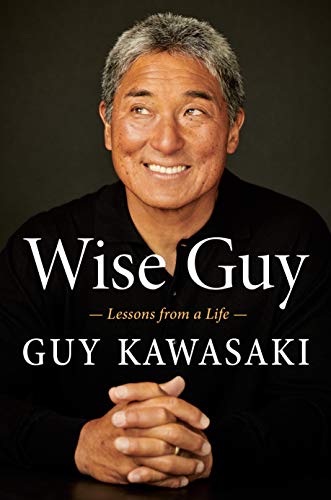
Wise Guy: Lessons From a Life by Guy Kawasaki uses his unique experience with Apple and other tech companies along with his life beyond work to distill wisdom he has gathered to date. His stories are engaging and this book can save you a lot of pain as you strive to be a better leader and a better person. It may well help you have a happier life. As a devoted parent, he has created a valuable book for parents. I strongly recommend it.
Preface
- Rather than an autobiography or a memoir, this book is a compilation of the most enlightening stories of Guy’s life. It’s lessons, not history. Perhaps Guy’s stories can help you live a more joyous, productive, and meaningful life. If Wise Guy succeeds, that will be a pretty good story.
1. Immigration
- Guy’s great-grandparents from his father’s side emigrated from Hiroshima, Japan to Hawaii to avoid military service during the Russo-Japanese War. They worked on farms for $1 a day. Guy’s maternal grandfather also immigrated from Japan where he met his wife. Guy got his name from Guy Lombardo, a famous bandleader from Canada who his father knew. While his parents didn’t go to college they read a lot and were very fond of music. After three tries his father was elected to the state senate where he served twenty years.
- Guy grew up in a poor section of Honolulu. His neighborhood was a melting pot at the time, but Japanese-Hawaiians were looked down on. His parents worked hard and placed a high value on education. Guy believes that by living in America, he was able to accomplish a great deal more than if he grew up in Japan, which wasn’t likely in Hiroshima. The wisdom here is to change a losing game or one that is going nowhere. This might require moving like Guy’s family did.
2. Education
- Guy believes that education is the great catalyst and equalizer. He credits his sixth-grade teacher for telling his parents that he shouldn’t take the typical path through Hawaii’s public schools. This meant great personal financial sacrifice for his parents. Guy found that his best teachers were also the toughest in that they always had high expectations. The advice here is to seek out people who will challenge you. If you are a teacher or the boss, you aren’t doing any favors by lowering your standards. The future cost of short-term kindness is great.
- Guy suggests that you also teach respect for authority and avoid trying to overprotect children. Sometimes being scared can teach an important lesson. Kids should know that people aren’t good or bad. Most of us have done good and bad things. Life offers a lot of contradictions. When it came time to go to college Guy wanted to go to Occidental where he could play football. His father told him no and that if he was going to pay for college Guy was going to Stanford. Guy got into Stanford even though his grades and SATs were not so great because at the time his Asian heritage made him a desirable minority. Guy recommends going away to college so you can meet people from different backgrounds.
3. Inspiration
- Guy was motivated to work hard so he could afford a nice car. He believes that it doesn’t matter what motivates you as long as you are motivated. He also recommends If You Want to Write: A Book About Art, Independence, and Spirit by Brenda Ueland for inspiration even if your goal is to do something other than writing. After getting robbed twice in high school Guy vowed to work hard so he could avoid public transportation and high crime neighborhoods.
- When he told his father that a passerby thought he was a gardener because he looked Japanese his father told him to get over it. Don’t look for insults and don’t let other people get to you. Condoleezza Rice told him “don’t ever see yourself as a victim because then you will start acting like one.” You must believe that you control your own fate. Be sure to read Mindset by Carol Dweck. You can do some unbelievable things, but you have to use the right tool. It’s ok to quit something as long as you reboot and restart. This chapter ends with the text of the speech he gave to the graduates at Menlo College in 2012. It’s full of good advice.
4. Apple
- Guy worked at Apple from 1983 to 1987 and from 1995 to 1997. These two “tours of duty” made him what he is today. When he first saw MacWrite and MacPaint he was dumbfounded by how cool the Macintosh was. His job was to convince software companies to produce products for the Mac. He was an evangelist. Guy felt that the cool aspect of the Mac made his job easy, but he worked hard and was smart enough to succeed. There are no perfect candidates for a job, only successful candidates who make their shortcomings irrelevant. A lot of people get jobs because they know someone. Don’t worry about that, just deliver.
- Working for Steve Jobs required that you prove yourself every day. He demanded excellence and kept you at the top of your game. It was sometimes unpleasant and always scary, but it drove you to do your finest work. Steve demanded honesty and saw it as a test of competence and character. It’s also easier than lying. Trust but document. It’s good to cover your ass when you are bending the rules. Guy recommends Drive: The Surprising Truth About What Motivates Us by Daniel Pink. Pay and perks are nice but look for a job where you can learn new skills, and work autonomously towards a meaningful goal. This chapter concludes with the top eleven lessons Guy learned at Apple.
Tags: Guy Kawasaki, Wise Guy
Posted in Book Summaries, Business Books, Education Books, Leadership Books | No Comments »
Sunday, January 27th, 2019
The Formula: The Universal Laws of Success by Albert-László Barabási explains how his team discovered these laws and how they can apply to your life and the lives of those you touch. While successful people throughout the ages had no idea of why they succeeded, you don’t have to. This is certainly one of the most important books I have summarized to date. Be sure to get a copy for your school.
Introduction
- Albert and his team gathered data on people who achieved success in as many fields as possible. The assumption is that success leaves a trail of data points behind it such as publications, museum exhibits, sales, and even sports statistics. The idea was to find a series of recurring patterns that drive success in most areas of human performance. This is not about success as judged by the individual as that leaves no trail. As a result of this effort, we have the universal laws of success..
1. The Red Baron and the Forgotten Ace
- This starts with the story of Manfred von Richthofen, Germany’s ‘Red Barron’ who shot down eighty allied planes during World War I. His success was magnified by the German government and he did what he could to blow his own horn. His fame lives on thanks to Charles Schultz and Snoopy. Contrast him to René Fonck, a French pilot who may have shot down as many as 127 German planes. Fonck is an example of outstanding performance without success. He is like the opposite of Kim Kardashian. This reminds us that success and fame are very different. Albert tells stories of other people who did something first only to see a latecomer get the credit. Success, therefore, is about how you and your performance is perceived by others.
2. Grand Slams and College Diplomas
- The First Law: Performance drives success, but when performance can’t be measured, networks drive success. It’s time to see the largely invisible networks that shape our success.
- First we see that some areas like academic performance with metrics like SAT scores and GPAs and tennis with its precise ranking system are much different from most fields where accurate performance metrics don’t exist. The interesting finding here is that ambition along with performance seems to be important. Students who are rejected by top colleges like Harvard do just as well as students who go there due to their ambition. This suggests that the schools don’t really matter. It’s the student who matters.
3. The $2 Million Urinal
- Now we look at a field where there is no easy metric to judge performance, the field of fine art. Here what matters most is your network. This network is composed of curators, art historians, gallery owners, dealers, agents, auction houses, and collectors. At the center of the story is a toilet simply signed by Marcel Duchamp that sold for $2 Million dollars. Albert also points out that the Mona Lisa didn’t become the world’s most famous painting until it was stolen and wasn’t found for two years. This shows the importance of context. There is a trove of data here that contains information about where artists have shown their works. Again we see that the ambition to have your works shown in top galleries along with persistence and expanding your network are key attributes. Like students ambitious enough to apply to Ivy League schools, artists ambitious enough to promote their works to top galleries are the ones more likely to succeed.
Posted in Book Summaries, Business Books, Education Books, Leadership Books | No Comments »
Monday, December 24th, 2018
Get It Done: The 21-day Mind Hack System to Double Your Productivity and Finish What You Start by Michael Mackintosh offers sound advice for people prone to procrastination and who suffer from the endless disruptions that exist in our hi-tech world. If this sounds like you be sure to get a copy along with one for your school’s professional development library.
Introduction
- This book is aimed at creative entrepreneurs but I believe that educational leaders can learn from it as well. It makes very big promises, but depending on where you are it should help you focus on what’s important, increase your productivity, and finish your most important projects. It also reminds us all to build in time for rest, relaxation, and celebrating our accomplishments.
Part I – 11 Essential Mind Hacks to Make Things Happen
- 1. The Prolonged Pain or the Short-Lived Pain: If you continue doing things that are inefficient and less effective you are inviting long-term pain. Change in the near term can be painful too, but if it leads to success you won’t have to deal with it in the long-term.
- 2. The Defining Choice: Acting differently and thinking differently is a choice. Keep in mind it is the only way you are likely to get different results.
- 3. The 80/20 Rule: This rule states that 80% of your input or effort leads to 20% of your outputs or results. Therefore, the opposite has to be true that 20% of your effort leads to 80% of your results. The trick is to identify the activities that produce 20% of your output and either do them less or do them when you are not so sharp.
- 4. Good is Good Enough: The old saying “the perfect is the enemy of the good” applies here. It is important sometimes to stop when you have reached the good enough point in a job unless it’s a job that has to be perfect like a computer program.
- 5. The Delusion of Time Management: The idea here is that you only have NOW in terms of doing something. Even if you are thinking about the future you are doing it NOW. Trying to micromanage your schedule is not likely to lead to great productivity. Rather than thinking about managing time, think about managing your thoughts, words, actions, energy, and focus. As you move through the day ask if what you are doing is moving directly toward your goals. Make your most important work a priority. Organize your day to make the most of your energy. If you are a morning person like me, save the most important work for the morning. (Doug: Yes, I’m writing this in the morning.) Recognize when you are a tired, hungry, or distracted and do what it takes to recharge. It’s not how much time you put into something, it’s how much high-quality energy you invest.
- 6. The Resistance: You can’t do something new, significant, and meaningful without resistance so get ready for it. Some can come from your lower self that is comfortable with the status quo. Be alert and look for it within and without so you can take it on.
- 7. Fears and Hallucinations: Fears can be real or irrational. They can be healthy and necessary for success. They can also arise when it’s not required. Unconscious fears include the unknown, failure, and not being good enough. Once you identify them you can accept that they only exist in your mind. This should help prevent the destructive worry that come with them.
- 8. Focus: You don’t want to try to make all of your dreams come true at the same time. The idea here is to bring one idea to completion before you begin another one. Fear could be part of the problem for people who try to do too many things at once.
- 9. How to Overcome Self-Doubt: This can sabotage you before you begin. Michael suggests that you focus on the people who will be helped if you complete what you are doing and realize that self-doubt, like most fears, is also irrational.
- 10. Do It Now: Everything happens in the now, and now won’t last forever. This should help you get going and avoid procrastination.
- 11. Do Less Work to Get More Done: You don’t do your best work when you work too hard. You are more likely to make mistakes and quality is likely to go downhill. Be sure to build rest and recharge into your game plan. Sleeping on a problem or just taking a walk can help you solve it. You are also more likely to screw up your family life and other important relationships. You still have to work hard, but working too hard can even make your sick.
Posted in Book Summaries, Business Books, Leadership Books | No Comments »
Thursday, November 22nd, 2018
Outliers: The Story of Success (©2008, Little Brown: New York, NY) is Malcolm Gladwell’s third mega best seller after The Tipping Point and Blink, both of which are summarized here. Gladwell looks at many notable situations where people or populations stand out from the crowd. He finds that circumstances and effort are more important than talent. There are many lessons here for educators and parents.
The Secret of Roseto
- Roseto is a town in Pennsylvania populated by immigrants from a village in Italy. Although the residents do not have a healthy diet or lifestyle, they do have a very low incidence of heart disease. The entire town is an outlier in this respect. After a great deal of study, it was determined that it was the supportive town culture that helps keep the residents so healthy.
The Importance of Birthdays
- A study of birthdays for stars in hockey, baseball, and soccer shows that players born earlier in the year are more likely to stand out and qualify for better coaching and more playing time. At a young age there is a significant advantage to being born earlier in the year of eligibility. In preadolescence, a twelve-month gap in age represents an enormous difference in physical and mental maturity.
- The birth order effect also operates in schools where the older students in a grade level tend to do better and get placed in higher ability groups. Older children scored up to 12 percentile points higher on the Trends in International Mathematics and Science Study (TIMSS). Teachers seem to sometimes confuse maturity with ability. Schools could put all the students born in the first quarter of the year in the same class and do the same with children born in other parts of the year of eligibility. As it is, many educated parents hold their kids back to insure that they will be older than their classmates which gives them a better chance in education and school sports that are based on grade level rather than age.
Time Trumps Talent-What Really Made the Beatles Great
- Psychological studies have demonstrated that all great artists and people with great expertise got there only after putting in at least 10,000 hours of effort or practice. Even Mozart didn’t make great music until he hit this number at the age of 21. It takes the brain this long to assimilate all that it needs to know to achieve true mastery.
- A club owner from Hamburg went to London looking for bands to play in this club. By pure chance he met an agent from Liverpool who booked the Beatles in his club. Unlike English gigs which seldom lasted more than an hour, the club had the Beatles play for five hours or more a night. All told they performed 270 nights in just over a year and a half. By 1964 they had performed about 1200 times. They were no good on stage when they went to Hamburg and they were very good when they came back.
Tags: Bill Gates, Malcolm Gladwell, Outliers, The Beatles
Posted in Book Summaries, Business Books, Education Books, Leadership Books | No Comments »
Monday, February 12th, 2018
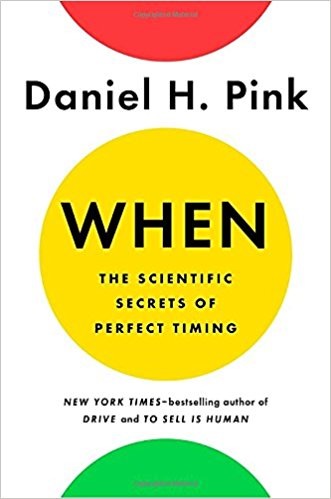
When: The Scientific Secrets of Perfect Timing by Daniel H. Pink takes on the hidden science of timing and how it impacts our lives. There is solid advice here that applies all of us at work, in school, and in our leisure time. Be sure to get your own copy and consider giving one or more as gifts. Also see my summaries of Dan’s other fine books Drive: The Surprising Truth About What Motivates Us and To Sell is Human: The Surprising Truth About Moving Others.
Introduction
- We all know that timing is everything, but we don’t know much about timing itself. Our lives present us with a never-ending stream of when decisions. Rather than being a how-to book, this is a when-to book. For content, Daniel and two other researchers analyzed more than seven hundred studies in the fields of economics, anesthesiology, anthropology, endocrinology, chronobiology, and social psychology to unearth the hidden science of timing. Get ready for a lot of science.
Part 1. The Day – 1. The Hidden Pattern of Everyday Life
- This chapter focuses on our biological clocks or circadian rhythms. The research assembled here shows that about two-thirds of us are morning people (larks), while the rest are more productive later in the day (owls). There is a test here that can help you figure out which one you are. The message here for bosses and teachers is that the type of work or problems you expect workers and students to engage in should be dependent on their chronotypes and the time of day. No matter which type you are, you are likely to experience peaks and troughs. At the end of this chapter is the first Time Hackers Handbook. Each chapter has its own version. Here Dan discusses when to exercise based on your goals and tips for a better morning.
2. Afternoons and Coffee Spoons: The Power of Breaks, the Promise of Lunch, and the Case for a Modern Siesta
- There is a lot of research that shows that we perform worse just prior to lunch or near the end of the day. The answer is to take periodic breaks away from your desk. This is especially true for low performing students. Breaks should involve movement and detachment from your work or study. Having conversations about non-work topics with others helps as does walking outside.
- Although we often hear that breakfast is the most important meal, it is not well supported by research. There is evidence that how you do lunch can make a difference. Unfortunately, too many people eat lunch at their desks. Like other breaks, your lunch break should involve moving to somewhere else and detachment from your job. Naps are also an excellent way to ramp up productivity, but not just any nap will do. The optimum length is between ten and twenty minutes. One way to promote this is to take caffeine in some form prior to your nap. It won’t kick in for about twenty-five minutes so it will help you get back in the game. Innovative companies are creating nap spaces for their employees.
- The hackers handbook here offers advice for schools. 1. Schedule recess before lunch. 2. Don’t structure recess. Let kids negotiate it themselves. 3. Include mid-morning and mid-afternoon breaks where students move about. 4. Make sure teachers get breaks too. 5. Do not deny recess as a consequence of bad behavior.
Posted in Book Summaries, Business Books, Education Books, Leadership Books | No Comments »