Archive for the ‘Business Books’ Category
Monday, November 9th, 2015
Staying Sharp: 9 Keys for a Youthful Brain Through Modern Science and Ageless Wisdom by Henry Emmons and David Alter offers advice that all of us can use to live a longer, healthier, and more fulfilling lives. Use this summary to see how you are doing and where you might need to improve. Then click at the bottom to purchase the book for the necessary details.
Henry Emmons and David Alter
- Henry is a psychiatrist who integrates mind-body and natural therapies, including mindfulness and compassion practices into his clinical work for Partners in Resilience in Minneapolis. He is also the author of The Chemistry of Joy and The Chemistry of Calm, and a popular workshop and retreat leader for both healthcare professionals and the general public.
- David is a psychologist with thirty years’ experience in health, psychology, neuropsychology, and clinical hypnosis, which he integrates in his work. He is a sought-after speaker, teacher, and trainer offering talks, workshops, and retreats to general and professional audiences. He is a cofounder of Partners in Healing, a center for holistic health in Minneapolis, and conducts his practice there.
Introduction
- Before the authors get to their Nine Keys to a Youthful Brain, they offer three chapters that discuss how the brain works and what happens as it naturally ages. Even though it does slow down, new neurons do form and new connections can be made. We also have less ability to pay attention, find learning more challenging, and take longer to retrieve information.
- They also focus on the concept of mindfulness, which deals with what you consciously do with your brain as you navigate your environment. This is called purposeful attention. There is nothing to stop you from being emotionally aware and cultivating a more joyful life. In addition to mind, we are also body and spirit.
The Nine Keys to a Youthful Brain
- 1. A Youthful Brain Loves Movement. Lack of movement is a strong reason behind many modern chronic health problems. Movement exercises the body and the brain. Exercise also helps reduce stress. There is lots of specific advice here and it’s never too late to start.
- 2. A Youthful Brain Is Well Rested. It is well established that sleep and other forms of rest are good for brain health. It also promotes good mood, memory, and healing. Short naps during the day also seem to be beneficial as long as you are sleeping well at night. If you are having trouble sleeping you might find the cause here along with tips for improving your sleep experience.
- 3. A Youthful Brain Is Well Nourished. This should be obvious. We generally eat too much, not enough fiber, and too much sugar. The authors suggest you try to eat unprocessed foods, emphasize plants and healthy fats, shift some protein away from meats, reduce sugars, drink more water, get more fiber and probiotics, and drink alcohol in moderation. There are good specifics on each of these issues along with tips to eat more mindfully.
- 4. A Youthful Brain Cultivates Curiosity. Curiosity activates the reward centers deep within the brain. It is a whole brain exercise that integrates the knowledge circuits of the left brain with the pattern-seeking circuits of the right brain. It will keep you fresh and lead to a longer, healthier, and more fulfilling life. If you cultivate your own curiosity, the world will be a more beautiful place and boredom will fade. If you seek out novelty you will become a constant learner. Get the book to learn how.
- 5. A Youthful Brain Stays Flexible. This runs counter to nature’s design, but has more to do with fear than destiny. If you respond more flexibly to change, life can become more enjoyable, rewarding, and fulfilling. One way to do this is to spend more time thinking about thinking (metacognition). The other keys contribute to your flexibility as will advice in this chapter.
- 6. A Youthful Brain Is Optimistic. Our brains are hardwired to be optimistic and you can increase your optimism with practice. It evolved to keep us engaged when logic suggests we give up. It’s benefits can be measured in terms of physical and mental health criteria. It will certainly make you more resilient as you age.
- 7. A Youthful Brain Is Empathic. Empathy arises from brain regions that regulate the quality of our relationships. You should practice empathy to help regulate your mind and behavior. This is how you influence the brains you interact with. Practicing empathy can make you more calm, content, and satisfied. Parents need to promote this quality in their children. One focus here is active listening, which is an important leadership skill.
- 8. A Youthful Brain Is Well Connected. The brain needs connection to others. Forming strong bonds early has a lasting impact. We need to learn how to create, grow, and maintain healthy social connections. This is very important as we age. Physical and mental health are necessary for positive social connections. If you do this right you will feel loved, respected, and listened to. This relates to Howard Gardner’s inter-personal intelligence. Even if you aren’t a natural connector, you can become one.
- 9. A Youthful Brain Is Authentic. No one wants to live someone else’s life. This key requires that you listen to yourself and live a life true to who you are. If you pull this one off, you should feel more confident and self-assured. This relates to Howard Gardner’s intra-personal intelligence and it can be increase with intent. Meditation can help.
Conclusion
- Even though I strongly suggest you purchase and read this entire book, this summary can act as a self-test that can help you see where you stand. While I’ve read most of this advice elsewhere, this book does a great job of pulling it all together. I was happy to see that I have already been following these keys. In my case, this book served to reinforce my approach to life, which has served me well. I’ve never missed a day of work due to illness, and don’t find life stressful. I enjoy the world and the people I meet, and people often tell me that I don’t look like I was born in 1947. I hope you are in the same boat, but if not, see what you can do to take the advice given here. You will also find tips here you can share with others at work or in your personal life. Good luck.
Posted in Book Summaries, Business Books, Education Books, Leadership Books | No Comments »
Monday, September 21st, 2015
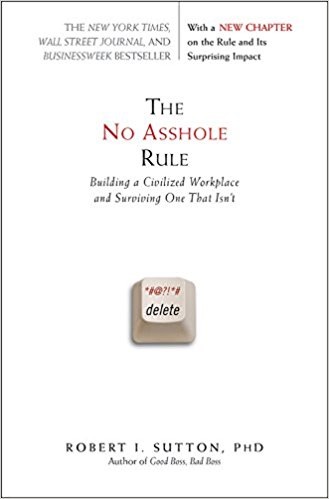
The No Asshole Rule: Building a Civilized Workplace and Surviving One That Isn’t by Robert I. Sutton ©2007 & 2010 should help organizations of all kinds make their cultures less toxic and more productive. Click at the bottom of any page to get a copy so you can get started dealing with jerky behavior where you live and work.
Robert I. Sutton
- Robert is Professor of Management Science at the Stanford Engineering School and researcher in the field of evidence-based management. He is a popular speaker and the author of two other best sellers Good Boss, Bad Boss: How to Be The Best…And Learn From The Worst and Scaling Up Excellence: Getting to More without Settling for Less with Huggy Rao.
1. Asshole Defined
- With a title like this, it is essential to define what one means by the term asshole. Robert offers two tests we can use to spot this type of person. Test one: After talking to the person, do you feel oppressed, humiliated, de-energized, or belittled? Test two: Does this person aim venom at people who are less powerful rather than at people who are more powerful? He also gives us a list of actions that assholes use. They include personal insults, uninvited contact, threats and intimidation, sarcasm, two-faced attacks, dirty looks, and ignoring people. We are cautioned that there is a difference between a temporary asshole and a certified asshole, as nearly all of us act like one at times.
- Just because you want to avoid hiring assholes, neither do you want to hire spineless wimps. What is needed is for teams to engage in conflict over ideas in an atmosphere of mutual respect. Robert even suggests taking classes in constructive confrontation. When he studied this topic, Robert found that just about everyone he talked to volunteered stories about abuse in their work environment. While every work environment has a significant problem with this, some are worse. It seems that nurses may lead the league when it comes to taking abuse from doctors, along with patients, their families, fellow nurses, and supervisors. Men and women are victimized at about the same rate and the lion’s share of abuse is within gender. What you want are people who are consistently warm toward people who are unknown or of lower status.
Posted in Book Summaries, Business Books, Leadership Books | 1 Comment »
Monday, August 17th, 2015
Wired to Care: how companies prosper when they create widespread empathy by Dev Patniak with Peter Mortensen ©2009 explains the importance of empathy and how to spread it around. While written for businesses, this is a book that all school leaders should read and act on. Click at the bottom of any page to by copies for leaders you know.
Dev Patniak and Pete Mortensen
- DEV is the CEO of Jump Associates, a strategy and innovation firm. Jump helps companies create new businesses and reinvent existing ones. Jump works with some of the world’s most admired companies, including GE, Nike, Target, and Virgin. Jump has become particularly well-known for its pioneering culture. Dev is a frequent speaker at business forums and his articles have appeared in numerous publications, including BusinessWeek, Forbes, and Fast Company. He is an adjunct professor at Stanford University, where he teaches a course called Needfinding. Contact Dev at dpatnaik@jumpassociates.com and follow him on Twitter at @devpatnaik.
- Pete is the communications lead for Jump Associates. A journalist by training, he has written for and edited numerous monthly, weekly and daily publications, including Spin Magazine, nyou, the Holland Sentinel, the Windsor Times, and Wired News.
Part I: The Case for Empathy Introduction
- As the title says, we are wired to care. Unfortunately, that instinct seems to get short-circuited when we get together in large groups. Real empathy can ensure more ethical behavior in a way that no policies and procedures ever could. The trick is to encourage everyone to walk in other people’s shoes. This book is packed with great stories that demonstrate how some companies strive to really understand their customers and meet their needs. If you want people to be interested in you and what you do, you should be genuinely interested in the people you are dealing with.
2. The Map Is Not the Territory
- Reports are abstractions and often lose touch with reality. A plan is only a map that doesn’t know the territory. In organizations, decision makers often find themselves working with simplified data that lacks context. This makes it easy to digest but can’t tell the whole story. There is a great story here about how Lou Gerstner turned IBM around by sending his people out to meet with customers and develop more empathy. As a result, support and service became a major growth area for the company. His mantra was “what are you hearing from our customers?” Empathy helps people see the world as it really is, not how it looks on a map. (Doug: I have long thought that it is important to view parents and students as customers, listen to them, and try to meet their needs. As a principal, I also viewed teachers and other staff members as my customers.)
3. The Way Things Used to Be
- The longer a team knows each other, the better they tend to do. This is something Dev discovered while teaching at Stanford. For thousands of years people made things for people they knew. Thanks to industrialization, a rift grew between producers and consumers. Is something lost when snowshoes are made by people who have never seen snow? Dev believes that it is much harder to succeed when you create things for people you don’t know. I love the story of the Zildjian Cymbal Company used to reinforce this concept. Their secret was keeping close relationships with drummers. Unfortunately, most companies don’t work this way and lose the ability to meet face to face with ordinary people. Such face to face meetings forms empathic connections.
Posted in Book Summaries, Business Books, Leadership Books | No Comments »
Monday, June 2nd, 2014
Think Like a Freak by Steven D Levitt & Stephen J. Dubner (©2014, Harpur Collins: New York, NY) offers to retrain your brain. This book follows Freakonomics and Super Reakonomics that were both best sellers. This claims to be the most revolutionary book yet. It features captivating stories and unconventional analysis that should help you think more productively, creatively, and rationally. Click at the bottom of any page to purchase this very cool book.
Levitt and Dubner
- Steven D. Levitt is the William B. Ogden Distinguished Service Professor of Economics at the University of Chicago, where he directs the Becker Center on Chicago Price Theory. He is the 2003 John Bates Clark Medal winner, an award that recognizes the most outstanding economist in America under the age of 40. In 2006, he was named one of Time magazine’s 100 People Who Shape Our World. Levitt received his B.A. from Harvard University in 1989, his Ph.D. from M.I.T. in 1994, and has taught at the University of Chicago since 1997.
- Stephen J. Dubner is an award-winning author, journalist, and TV and radio personality. His solo books include Turbulent Souls and The Boy With Two Belly Buttons. His journalism has been published in The New York Times, The New Yorker, and Time./li>
Posted in Book Summaries, Business Books, Education Books, Leadership Books | No Comments »
Tuesday, April 8th, 2014
The Sports Gene: Inside the Science of Extraordinary Athletic Performance by David Epstein (© 2013, Penguin Group: New York, NY) may not sound like a book for general educators and parents, but it is as it explores the messy relationship between biological endowments and the impact of training. You don’t need to be a sports fan to appreciate this look at modern genetic research that should apply to any kind of human accomplishment. Be sure to click at the bottom of any page to purchase this captivating book.
David Epstien
- David is an award winning senior editor for Sports Illustrated where he covers sports science, medicine, and Olympic sports. He was a track start at Columbia University and has a master’s degree in environmental science.
Innate or Will to Train
- The book opens by wondering how much of an athlete’s success is based on innate genetic composition (nature), and how much is a function of the will to train and time spent doing so (nurture). The first story deals with how a top flight women softball pitcher can routinely strike out the top men baseball hitters. How is it possible that girls can hit this stuff while top men can’t.
- In addition to action sports, David looks at how chess masters can reconstruct a chess game in progress after a quick look. This is where chunking theory came from. It was discovered that what the chess masters remember were clusters of pieces rather than each individual piece. Others also discovered that elite players of action sports need less time and less visual information to know what will happen in the future. Top tennis players, for example, can discern from the minuscule pre-serve shifts of an opponent’s torso whether a shot was going to their forehand or their backhand. No one is born with such anticipatory skills. Such skills are analogous to software, while genes are analogous to hardware.
Posted in Book Summaries, Business Books, Education Books, Leadership Books | 2 Comments »