Archive for the ‘Education Books’ Category

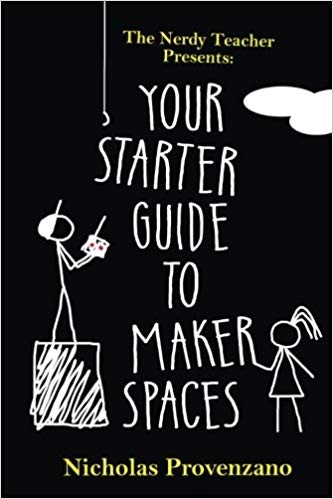
Your Starter Guide to Maker Spaces by Nicholas Provenzano

Monday, December 3rd, 2018
Maker Spaces

Your Starter Guide to Maker Spaces by Nicholas Provenzano tell the story of how he started and built a successful maker space at his school. His guidelines explain what one is, who can help you build one, where it should go, and what to put in it. He explains how it can promote project-based learning and turn failure into a positive thing. Every school should have a copy.

Introduction

  • Since making doesn’t have a set curriculum, it should be no surprise that this book is written by an English teacher. The goal is to have students use different tools to demonstrate understanding. You don’t have to be an expert to turn your students lose and it’s ok to fail. This book features Nick’s experiences rather than a pile of research. He claims to be a tinkerer rather than an expert and hopes that you can draw on his work to help jump-start your own and the work of your students.

1. So, What is Making?

  • Nick’s definition of making is that it is the creation of something new that was not there before. By being broad and vague it is not constrained. This definition also makes it more inclusive so the everyone can make with anything you can find along with computer code. It is also vital that you ditch the idea that making is for STEM classes. You need to add the arts (STEAM) as the arts bring everything together. You want students to be creators, not just consumers.
  • Since some students don’t have a supportive making environment at home, schools need to provide one. They all need to experience problem-based lessons to prepare for life after school. Another key is that teachers have to see themselves as makers. At the least, they make lesson plans. They also make other things and need to be role models when it comes to making. There is also an element of storytelling as just about anything you make has a story associated with it.

2. I Know What Making Is, but Why Should I Care?

  • In many schools students don’t have much choice about what they do or study. A maker space gives them choice and freedom if they are making what they want. Creativity and innovation are also often eliminated from the curriculum. Not so in a maker space. You should also design your maker space to support collaboration. Businesses want all of these things and many schools don’t try to build them into students’ lives. Finally, a maker space should be a fun place for students to be. There is no reason why school can’t be more fun than it already is and maker spaces can help.
Share this:
Share this page via Email Share this page via Stumble Upon Share this page via Digg this Share this page via Facebook Share this page via Twitter Share this page via Google Plus

Outliers: Gladwell’s 3rd Mega Hit – Revised Summary

Thursday, November 22nd, 2018

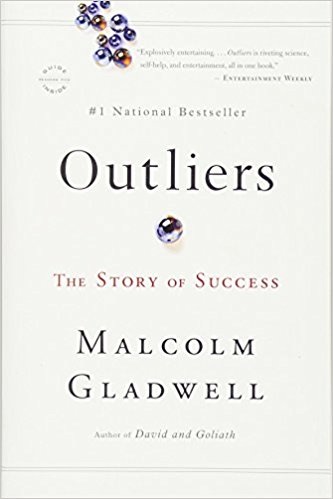
Outliers

Outliers: The Story of Success (©2008, Little Brown: New York, NY) is Malcolm Gladwell’s third mega best seller after The Tipping Point and Blink, both of which are summarized here. Gladwell looks at many notable situations where people or populations stand out from the crowd. He finds that circumstances and effort are more important than talent. There are many lessons here for educators and parents.

The Secret of Roseto

  • Roseto is a town in Pennsylvania populated by immigrants from a village in Italy. Although the residents do not have a healthy diet or lifestyle, they do have a very low incidence of heart disease. The entire town is an outlier in this respect. After a great deal of study, it was determined that it was the supportive town culture that helps keep the residents so healthy.

The Importance of Birthdays

  • A study of birthdays for stars in hockey, baseball, and soccer shows that players born earlier in the year are more likely to stand out and qualify for better coaching and more playing time. At a young age there is a significant advantage to being born earlier in the year of eligibility. In preadolescence, a twelve-month gap in age represents an enormous difference in physical and mental maturity.
  • The birth order effect also operates in schools where the older students in a grade level tend to do better and get placed in higher ability groups. Older children scored up to 12 percentile points higher on the Trends in International Mathematics and Science Study (TIMSS). Teachers seem to sometimes confuse maturity with ability. Schools could put all the students born in the first quarter of the year in the same class and do the same with children born in other parts of the year of eligibility. As it is, many educated parents hold their kids back to insure that they will be older than their classmates which gives them a better chance in education and school sports that are based on grade level rather than age.

Time Trumps Talent-What Really Made the Beatles Great

  • Psychological studies have demonstrated that all great artists and people with great expertise got there only after putting in at least 10,000 hours of effort or practice. Even Mozart didn’t make great music until he hit this number at the age of 21. It takes the brain this long to assimilate all that it needs to know to achieve true mastery.
  • A club owner from Hamburg went to London looking for bands to play in this club. By pure chance he met an agent from Liverpool who booked the Beatles in his club. Unlike English gigs which seldom lasted more than an hour, the club had the Beatles play for five hours or more a night. All told they performed 270 nights in just over a year and a half. By 1964 they had performed about 1200 times. They were no good on stage when they went to Hamburg and they were very good when they came back.
Share this:
Share this page via Email Share this page via Stumble Upon Share this page via Digg this Share this page via Facebook Share this page via Twitter Share this page via Google Plus

After the Education Wars: How Smart Schools Upend the Business of Reform by Andrea Gabor

Monday, November 19th, 2018
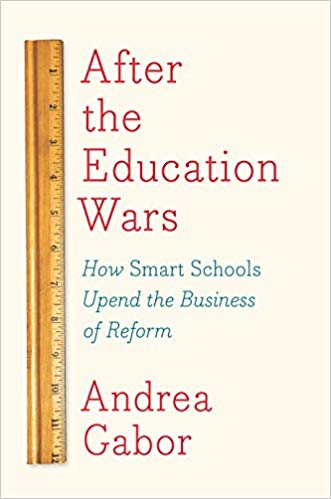
After the Education Wars

After the Education Wars: How Smart Schools Upend the Business of Reform by Andrea Gabor uses examples of successful and failing schools to demonstrate how the principles promoted by W. Edwards Deming can lead to school improvement. She provides extended histories of reforms in New York City, Massachusetts, Texas, and New Orleans to show how democratic grassroots reforms are more likely to work than the top-down approaches used in most states and cities. Everyone with the power to impact school reform needs to read this.

Introduction: The Quiet Revolution

  • Andrea starts by reviewing the work of W. Edwards Deming and how he helped Japanese and then American companies modernize and improve. He found the blame to lie with top management and the answers to come from bottom-up reforms as employees closest to problems were in the best position to solve them. Unfortunately, the corporate-reform industry that has gained ever-increasing influence on how American schools educate children has largely ignored the strategies they used to improve production as they tinker with school reform.
  • Business reformers came to the education table with belief in market competition and quantitative measures. Expertise from corporate boardrooms is favored over experience gleaned in classrooms. They also distrust of the education culture. It also came with arrogance, suspicion, and even hatred of organized labor. What is needed, however, is democratic collaboration, iterative improvement, and grassroots participation that is protected from bureaucratic meddling. We should value data as we understand its limits.
  • Schools have different goals and cultures than businesses. This makes them less suited to being run like businesses. Three decades of top-down, corporate-style education reforms have proven deeply unpopular and have reaped few benefits. The number of bad teachers is also overestimated by reformers, but efforts to punish low performers has lowered morale and increased turnover. Other business practices like incentive pay have also had a negative impact. The only winners have been the testing and technology industries at the expense of a narrowed curriculum. This book will reveal what has worked, which should guide the next reform effort.

1. Big Dreams, Small Schools, How Entrepreneurial Rebels Built a Movement in New York City

  • This chapter takes us through some history of New York City Schools from the 1960’s to relatively recently. It tells of how a number of schools gained success by being small and at the same time allowing teachers to pretty much run the schools. In a sense, they used Deming’s grass-roots ideas to interest students in the learning and act as role models. They shunned standardized testing and looked at other performance indicators. A sense of creative non-compliance pervaded these schools as they bent the rules and looked for cracks in the system. Classrooms were more open and curricula less fixed. There was lots of learning by doing, art, music, and field trips.
  • A new generation of educational leaders arrived who had no experience teaching. Rather than learn Deming’s principles like industry, they instituted top-down reforms. Even though they saw the success of small schools, they missed the rest of the factors that lead to success. This also included those involved with funding like the Gates Foundation. Unfortunately, the De Blasio administration has increased bureaucracy and shunned the flat organization models of successful schools.

Share this:
Share this page via Email Share this page via Stumble Upon Share this page via Digg this Share this page via Facebook Share this page via Twitter Share this page via Google Plus

Code Breaker: Increase Creativity, Remix Assessment, and Develop a Class of Coder Ninjas! by Brian Aspinall

Tuesday, October 16th, 2018
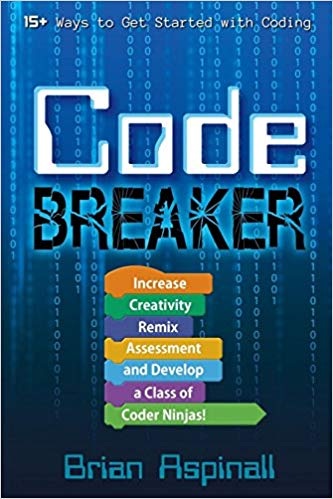
Code Breaker

Code Breaker: Increase Creativity, Remix Assessment, and Develop a Class of Coder Ninjas! by Brian Aspinall shares his experiences and those of some colleagues in the process of teaching coding from kindergarten to high school. It deals with computational thinking which is a fundamental skill at the heart of engineering and mathematics. It includes coding and much more, and can even happen without technology. Make sure your school has a few copies.

Preface

  • We live in an era of access as answers to knowledge-based questions can be quickly retrieved. As for coding, we have been teaching that in many forms since the 1960s. Like many, Brian is a self-taught coder. He offers ten reasons for teaching coding. They include building self-confidence, allowing students to create, self-expression, teaching storytelling, opportunities for risk-taking, reinforcing math principles, and teaching problem-solving. It is required for many future jobs, developing teamwork, and helping humanity.

1. The Clarity of Poop

2. A Wing and a Papert

  • Here we get some learning theory. Assimilation happens when you incorporate new things into your current understanding. Accommodation happens when you learn new things and have to change what you currently understand. People learn best when they are involved in making or constructing things in the real world. To do this you need some control over your own learning. Learning should be concrete and computers are a good way to teach this. Computational thinking is a fundamental skill and it is at the heart of engineering and mathematics.
  • Coding Rock, Paper, Scissors to Teach Probability
  • Indigenous Trail: Trees and Coding a Micro:Bit Compass
  • What Is Computational Thinking? Computational Thinking can take on a variety of forms.
Share this:
Share this page via Email Share this page via Stumble Upon Share this page via Digg this Share this page via Facebook Share this page via Twitter Share this page via Google Plus

Hacking Project-Based Learning: 10 Easy Steps to PBL and Inquiry in the Classroom by Ross Cooper and Erin Murphy

Wednesday, October 3rd, 2018
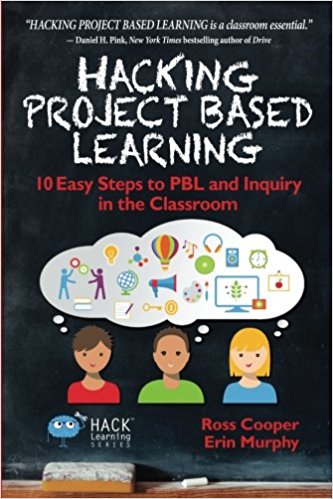
Hacking PBL

Hacking Project-Based Learning: 10 Easy Steps to PBL and Inquiry in the Classroom by Ross Cooper and Erin Murphy is a must read for any teacher interested in this mode of teaching. Their ten hacks provide a path for more student-centered learning in any classroom. Be sure to get some copies for teachers you know.

Introduction

  • Project-Based Learning (PBL) is messy. The authors have done everything in their power here to de-clutter and tidy up the mess to make it as approachable as possible. PBL may not happen overnight in you classroom or school, but it won’t happen if you don’t get started. Ross and Erin started doing PBL as teachers and now support it as administrators. They will help you set the stage for students to thrive in a culture of inquiry and creativity with these ten hacks. Keys are to make student work public and for them to reflect on their work. The role of feedback is also vital.

Hack 1: Develop a Space That Promotes Risk-Taking

  • Schools are designed to fill kid’s heads with information. Student questioning diminishes. The assembly line is populated by robots. We need students who can think and solve problems. They need to be driven by their curiosities. Teachers need to do what they can to bring in materials from garage sales or anywhere. They should post failed ideas. They also need to develop relationships. Make sure that things are designed for student learning rather than teacher convenience. The walls should contain student work. Bring in the real world.

Hack 2: Teach Collaboration Skills

  • Starting group work without first teaching collaboration skills is a mistake. Working with others requires dialog and productive struggle. Students should know this. They should understand that collaboration is working with others in order to achieve or do something. A good way to teach collaboration is to search the Internet for collaborative experiences. Look for discussion skills, body language, transitions, and organization strategies. Students can also visit other classrooms and watch collaboration in action.
  • A big focus should be on the idea that it’s possible to not like someone else’s idea without disliking the person. After early collaboration activities, students should debrief and discuss what went well and what didn’t.
Share this:
Share this page via Email Share this page via Stumble Upon Share this page via Digg this Share this page via Facebook Share this page via Twitter Share this page via Google Plus