Archive for the ‘Education Books’ Category
Monday, August 7th, 2017
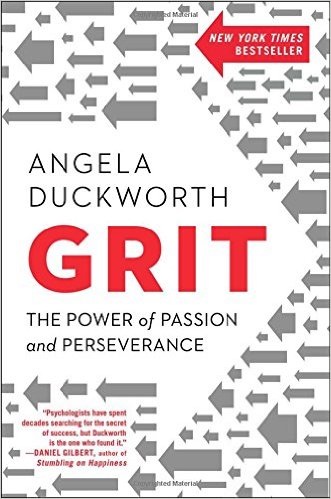
Grit: The Power of Passion and Perseverance by Angela Duckworth shares her research and the work of others on the subject and explains that what we eventually accomplish depends more on our passion and perseverance than on our innate talent. This work can help you find your own passion and develop it. This is a vital book for parents, teachers, and human beings in general. Make sure your school library has at least one copy for starters.
1. Showing Up
- Angela starts with the story of her visits to West Point’s summer session for incoming freshman known affectionately as Beast Barracks. Due to the high dropout rate of plebs, the question was: what qualities are the best predictors of who makes it and who goes home early? The only metric the Army had was the Whole Candidate Score. It combined SAT/ACT scores, class rank, an expert appraisal of leadership potential, and performance on objective measures of physical fitness. The problem was that this score had no predictive value when it came to surviving the first summer or the full four-year program.
- What candidates needed it seems, was a never give up attitude, which had nothing to do with ability. When Duckworth heard this she decided to create an instrument to measure it. She then created the Grit Scale, which is included on page 55. She found that it was a good predictor for West Point. It also turned out to be a good predictor for other accomplishments such and earning college degrees. She found that there was no relationship between IQ and grit.
2. Distracted By Talent
- As a teacher early in her career Duckworth discovered that talent for math was different from excelling in math. She also found that her weakest students sounded smart when talking about things that interested them. She found that Americans endorse hard work five times more than intelligence. However, teachers are more likely to lavish attention on students they think are talented. Another problem is associated with tests for talent, which like tests for grit are imperfect.
3. Effort Counts Twice
- After being chided by her advisor while working on her PhD in psychology, Duckworth came up with two equations. Talent x Effort = Skill, and Skill x Effort = Achievement. Note that effort is included in both equations. While this theory does have a place for natural ability, it shows how effort is more important. This chapter gives examples of famous people who felt they succeeded thanks to their compulsive effort. In addition to talent and effort, there is also a place for opportunities and luck on the road to success. Encouraging parents with money are a prime example of opportunities.
Posted in Book Summaries, Business Books, Education Books, Leadership Books | No Comments »
Tuesday, July 4th, 2017
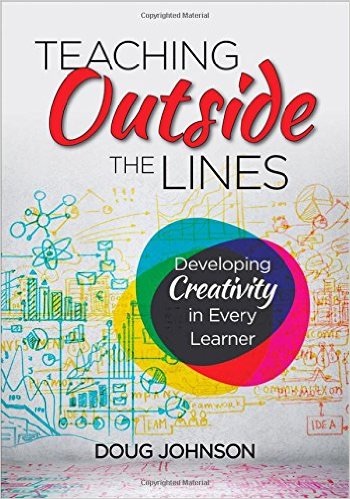
Teaching Outside the Lines: Developing Creativity in Every Learner by Doug Johnson encourages teachers to believe that all students can be creative and gives specific advice for how to allow for it in schools. Be sure to get one for every teacher you know.
Introduction: How Did Vasco da Gama Spark My Interest in Creativity?
- Why do educators not only fail to encourage creativity, but also seemingly discourage it? If you agree with Doug you see creativity as important in education as literacy. While we accept creativity in art class and on the athletic field, we discourage it with stay-within-the-lines rules, one-right-answer tests, praise for conformity, and using tests to judge school and teacher effectiveness. Teachers often see that creativity has no roll in core subjects. It’s also important to realize the creativity without skills, knowledge, discipline, hard work, and practice isn’t worth much. Doug also sees that just like there are multiple types of intelligence, there are also multiple types of creativity. And don’t think that just using technology allows for creativity. Creative people can make others nervous or upset, which explains why it is often discouraged in schools. If problem solving is important, we need to realize that higher levels of problem solving give creativity full reign.
1. The Rise of the Creative Classroom: Why is Creativity No Longer a Nice Extra in Education?
- Creativity may be the only way people can stay employed in good jobs in a postindustrial, automated, global economy. Jobs that require complex communication and expert thinking have increased since 1969. Since then jobs featuring routine cognitive or manual work have been decreasing. If machines or people in developing nations can do a job, they soon will. A poll of 1,500 CEOs identified creativity as the number one leadership competency for the future. It’s not hard to find creativity in the standards promoted by many organizations, but studies show that schools in the US have not succeeded in fostering creativity. In fact, they are doing just the opposite. The obvious culprit, of course, is our obsession with testing.
2. I Can’t Define It, But I Know It When I See It: What is Creativity Anyway?
- After looking at many definitions, Doug sees that creativity has an element of the new, the innovative, the original, and something not yet done or done in a new way. Definitions also include the notion that creativity adds value to the task or objective to which it’s applied. Craftsmanship is also essential. That is why it is important for schools to also work on skills and knowledge acquisition. Craftsmanships is what separates scribbles from art and cacophony from music. As craftsmanship gets stronger, the creative process is enhanced.
- It is important that teachers and parents believe that all students have the capacity for innovation. There are also several other characteristics that promote creativity. Girt, which is more highly correlated with success than IQ, is necessary. Empathy also helps as does the courage to take risks. You certainly need a growth mindset so you believe that your metal and physical capacities are not fixed. (See my summary of Carol Dweck’s Mindset to review this concept. One needs self-esteem and confidence along with lots of curiosity. Finally, you need to realize the you might be fighting people and establishments that want to keep things just the way they are. A creative idea can undermine the status quo.>/li>
Posted in Book Summaries, Education Books, Leadership Books | No Comments »
Monday, May 8th, 2017
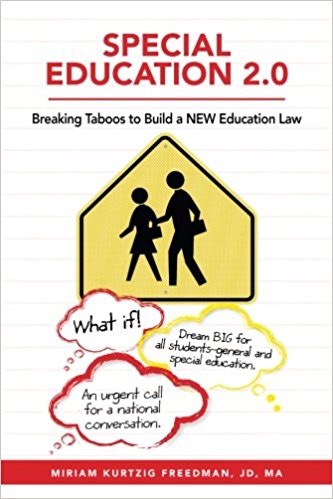
Special Education 2.0: Breaking Taboos to Build a NEW Education Law by Miriam Kurtzig Freedman points out the successes and flaws of the 1975 law that established federal control of public school special education programs. It argues against labeling students and for giving all students what they need without wasting money on bureaucracy and litigation. Share this with policy makers you know.
Preamble and Guiding Principles
- The main idea is that public education needs to meet the needs of all students and that there should be no individual entitlement. Strangling paperwork and compliance requirements need to be streamlined. There is a focus on home-based, parent engagement learning environments along with preschools to close language and other gaps. Adaptations should be aimed at improving learning, not just getting kids through. We should learn from other countries like Finland and fund research-based programs. Early interventions for struggling students is key. Least intervention needed should replace least restrictive environment and strengths should be highlighted along with weaknesses. Teacher preparation should be strengthened. There should be a focus on student engagement and student responsibility to be motivated and present. Due process rights should be the same for all.
Why a NEW Law
- The current special education law (IDEA) was first passed in 1975 and tweaked several times since. Prior to that, many children with special needs were barred from public schools or served poorly. While the law has had some positive impact, it has also had a number of unintended consequences. They include the rampant fear of litigation, too much bureaucratic regulation paperwork, excessive cost, and input-driven requirements far removed from improving outcomes for students. While Congress is expected to reauthorize the law again, all we can expect is that they will change discipline policies, add and/or subtract assessments, reemphasize inclusion, and perhaps reallocate more resources. What Miriam sees is a 20th-century law that isn’t working well in the 21st century. This is the foundation for her belief that lawmakers should start from scratch.
Posted in Book Summaries, Education Books, Leadership Books | 1 Comment »
Saturday, April 1st, 2017
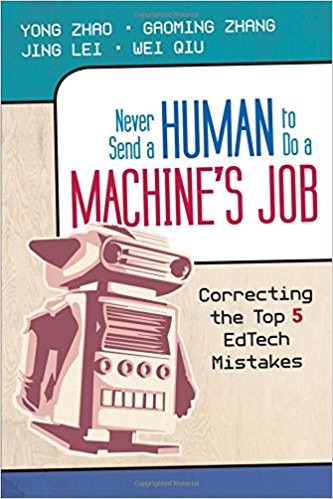
Never Send a Human to Do a Machine’s Joe: Correcting the Top 5 EdTech Mistakes by Yong Zhao, Gaoming Zhang, Jing Lei, and Wei Qiu explores the fact that technology hasn’t transformed education as much as it has transformed other sectors. Here the authors point out the reasons and suggest a new approach.
Introduction
- The authors have recognized five basic mistaken approaches and devote a chapter to each. The first is that technology could replace teachers rather than replace just certain functions. The second is the focus on using technology to consume information rather than as a tool for creating authentic products. Third is the focus on using technology to prepare students for standardized tests. Next is using the technology as curriculum rather than teaching digital competence. Finally, professional development usually focuses on teaching teachers how to use new tools rather on the needs of students. In the final chapter the focus is on redefining the relationship between humans and machines with a thoughtful analysis of what humans do best and what should be relegated to technology.
1. The Wrong Relationship Between Technology and Teachers: Complementing in an Ecosystem Versus Replacing in a Hierarchy
- In a hierarchy approach, one looks for something better to replace the status quo. In education, there have been hopes that emerging technologies could replace teachers. In an ecosystem approach, the effort is to see what each component does best. In other words, teachers need to find their niche doing things they do better than technology. Teachers can solve unstructured problems, work with new information, and carry out non-routine tasks. They can also deal with social and emotional interactions. The big role for technology is to help the teacher personalize instruction. This involves using technology to assist in diagnosis and to provide a pallet of tools they can prescribe to each student. One-to-one computer initiatives make this kind of personalization possible as do flipped classroom approaches.
2. The Wrong Application: Technology as Tools for Consumption Versus Tools for Creating and Producing
- Technology can be used to consume information or it can be used to create, communicate, and collaborate. For teachers who live by doling out information and expecting students to regurgitate it back, technology looks like an excellent knowledge provider. The standardized tests feed the consumptive use. To take better advantage of technology teachers have to shift their role from provider to facilitator and many aren’t interested.
- If you believe that students construct knowledge as they navigate a learning environment, using technology to do projects and make things should accelerate learning over the passive consumption approach. But many schools don’t allow students to bring devices to class and many also block sites such as YouTube that offer many opportunities. Innovative schools have students blogging and creating their own YouTube videos. The rise of Maker Spaces has also allowed for more creativity and creation. Students who put their work online can also get more feedback than any teacher can provide.
Posted in Book Summaries, Education Books, Leadership Books | No Comments »
Friday, March 3rd, 2017
What works may hurt: Side effects in education by Yong Zhao tells about an important lesson that education needs to borrow from medicine. That is the study of side effects. Educational research tends to focus only on proving the effectiveness of practices and policies in pursuit of what works. It has generally ignored the potential harms. This article presents evidence that shows side effects are inseparable from effects. Journal of Educational Change
Download the pdf here. ISSN 1389-2843, J Educ Change, DOI 10.1007/s10833-016-9294-4
Introduction
- Medical research is a field education should emulate. Education researchers have been urged to adopt randomized controlled trials (RCT), a more ‘‘scientific’’ research method believed to have resulted in the advances in medicine. As a result, the RCT is now the gold standard in educational research. The What Works Clearinghouse as of 2015 accepts only studies using RCT as meeting its Group Design Standards without Reservations. The difference is that in education there is less effort to weigh the risks against their effectiveness. In medicine, even after a drug is approved, research on side effects continues.
What Are Side Effects?
- Side effect is defined as ‘‘an unwanted or unexpected result or condition that comes along with the desired effects of something.” In medicine side effects are expected and looked for. Studying and reporting side effects in trials has saved lives. Once side effects are known, effort is placed on finding treatments that are as effective with fewer side effects. In education, however, it is extremely rare to find a study that evaluates both the effectiveness and adverse effects of a product, teaching method, or policy in education. Don’t expect to see warnings like ‘‘this program will raise your students’ test scores in reading, but may make them hate reading forever” on any education product. The only people looking for negative effects in education are those that disagree with a product or policy.
Direct instruction: Instruction that stifles creativity
- Despite the vast amount of research, there is no general agreement whether direct instruction (DI) is an effective approach. Rather than continuing the argument between supporters and detractors of direct instruction, a more rational and productive approach would be for both sides to acknowledge that DI, like all medical products has effects and side effects. With direct or traditional teaching, students tend to do slightly better on achievement tests, but they do slightly worse on tests of abstract thinking, such as creativity and problem solving. When children are shown exactly how to do something, they are less likely to explore and come up with novel solutions. Students who receive instruction first tend to produce only the correct solutions they were told. It is possible for students to show high performance on memory tasks or carrying out problem-solving procedures without a commensurable understanding of what it is that they are doing. As educators we need both effective ways to transmit knowledge and foster creativity. Thus DI has its place. Its side effects, however, need to be minimized.
The best or the worst: The conflicting evidence of performance
- Due to their results on international tests, East Asian education systems have become the object of idolization and a source of ideas for improving education. These systems, however, have somehow made a large number of students lose confidence and interest in math, science, and reading, while helping them achieve excellence in testing. Yong notes that this evidence is still preliminary, but there is a negative correlation between test scores and confidence. The same trend is observed for the United States. If indeed the policies and practices that raise test scores also hurt confidence and attitude, we must carefully weigh the risks against the benefits. Do we care more about test scores or confidence and attitude?
When risks outweigh benefits: Test-based accountability
- America could have avoided the significant damages caused by test-based accountability if side effects had been taken seriously. High stakes testing has been associated with the distortion of instruction, turning teaching into test preparation, cheating, preventing some students from taking the tests, and narrowing of the curriculum among others. States and districts have manipulated drop out rates and misrepresented test results, and both teachers and students have been demoralized. All of this harm has not resulted in closing achievement gaps or improving achievement.
A call to study side effects
- There is no regulation that asks developers of education interventions to study and disclose potential side effects when providing evidence for their effectiveness. The focus, therefore is exclusively on marshaling evidence to show benefits and effects. Consumers only have information of what works, without knowledge of the potential costs. The negative effects of educational products, when occasionally discovered, are not considered an inherent quality of the product or policy. The collateral damages of NCLB could have been anticipated based on Campbell’s Law, which states: ‘‘The more any quantitative social indicator is used for social decision-making, the more subject it will be to corruption pressures and the more apt it will be to distort and corrupt the social processes it is intended to monitor.’’ Reported side effects are often brushed aside as lacking objectivity, scientific rigor, or motivated by ideology.
Recommendations
- 1. Research organizations and academic journals can require research articles to include both main effects and side effects.
- 2. Federal clearing houses such as What Works should include information about the negative effects of educational approaches, methods, products, or policies.
- 3. Education researchers, policy makers, and product developers should voluntarily study side effects and disclose such information.
- 4. Consumers of educational research, policy, and products should ask for information about both effects and side effects.
- 5. Program evaluation should include investigating both effects and side effects.
- 6. Reports of side effects after the implementation of interventions should be considered seriously, instead of discarding them as unintended consequences, improper implementation, or simply complaints by unhappy parents, students, or teachers. It is the responsibility of the policy and product developers’ to investigate and respond to such reports.
Yong Zhao
- Yong Zhao is a Foundation Distinguished Professor in the School of Education at the University of Kansas. He is also a professorial fellow at the Mitchell Institute for Health and Education Policy, Victoria University in Australia. He previously served as the Presidential Chair and Director of the Institute for Global and Online Education in the College of Education, University of Oregon, where he was also a Professor in the Department of Educational Measurement, Policy, and Leadership. His works focus on the implications of globalization and technology on education. He has published over 100 articles and 30 books, including Counting What Counts: Reframing Education Outcomes(2016), Never Send a Human to Do a Machine’s Job: Correcting Top 5 Ed Tech Mistakes (2015), Who’s Afraid of the Big Bad Dragon: Why China has the Best (and Worst) Education System in the World (2014), Catching Up or Leading the Way: American Education in the Age of Globalization (2009)and World Class Learners: Educating Creative and Entrepreneurial Students (2012). He is a recipient of the Early Career Award from the American Educational Research Association. He is an elected fellow of the International Academy for Education. Check out his website and follow him on Twitter @YougZhaoUO.
Posted in Book Summaries, Education Books, Leadership Books | No Comments »