Archive for the ‘Education Books’ Category

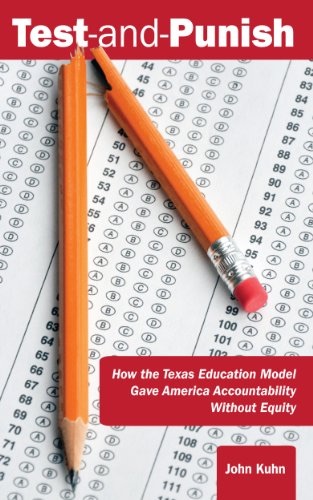
Test-and-Punish: How the Texas Education Model Gave America Accountability Without Equity by John Kuhn

Thursday, January 8th, 2015
Test-And-Punish

Test-and-Punish: How the Texas Education Model Gave America Accountability Without Equity by John Kuhn follows the history of the modern education reform movement from its roots in Texas. While the tone is strongly one-sided, John makes a compelling case for reforms that diagnose-and-support and finds a way to finance schools in a more equitable manner. If you haven’t joined his battle, it may be time. Click at the bottom of any page to purchase this powerful argument.

John Kuhn

  • John Kuhn is a public school administrator in Texas and a vocal advocate for public education. His Alamo Letter and YouTube videos of his 2011 speech at a Save Texas Schools rally went viral, as did his 2012 essay The Exhaustion of the American Teacher. He has written two education-related books, 2013’s Test-and-Punish (Park Place Publications) and 2014’s Fear and Learning in America (Teachers College Press).

Prologue

  • Although this book talks a lot about Texas, it is actually a book about national education policy. It’s focus is the test-and-punish craze that has dominated education policy-making in the United States since former Texas governor George W. Bush worked to introduce No Child Left Behind legislation. John sees this law and subsequent iterations as a series of big mistakes. This would include the use of data to punish schools, teachers, and students; the reduction of school quality to a simple menu of labels; vacating the concept of supports in favor of consequences; the misuse of test scores to force privatization; the implementation of accountability algorithms to attain political goals; the increasing investment of limited funding and time for the sake of standardized tests; and the sidelining of teachers in favor of lobbyists and politicians in designing accountability legislation. He takes heart in the fact that a band of passionate parents and feed-up teachers, board members, and administrators are fighting back, and he sees this push back to the reform movement spreading to other states.
Share this:
Share this page via Email Share this page via Stumble Upon Share this page via Digg this Share this page via Facebook Share this page via Twitter Share this page via Google Plus

The Innovators: How a Group of Hackers, Geniuses, and Geeks Created the Digital Revolution by Walter Isaacson

Tuesday, December 30th, 2014

The Innovators: How a Group of Hackers, Geniuses, and Geeks Created the Digital Revolution by Walter Isaacson tells the stories of the people most responsible for getting us to where we are in terms of technology. Each chapter focuses on a different innovation that made today’s world possible. It starts in the mid 1800’s when computers were just ideas and takes us to the present time. Click at the bottom of any page to get this very cool history book.

Walter Isaacson

  • Walter is the CEO of the Aspen Institute, has been the chairman of CNN, and the managing editor of Time magazine. He is the author of Steve Jobs; Einstein: His Life and Universe; Benjamin Franklin: An American LIfe; and Kissinger: A Biography. He is also the coauthor of The Wise Men: Six Friends and the World They Made. He lives in Washington, DC.

Introduction

  • The computer and the Internet are among the most important inventions of our era, but few people know who created them. These and other key inventions of the digital age were done collaboratively by many fascinating people who are featured in this book. The focus is on their characteristics and how they collaborated. When it comes to inventions, we tend to focus on individual genius rather than the teamwork that is almost always required. Walter also looks at the social and cultural forces that provided the atmosphere for key innovations. He notes happily that much creativity that gave us the digital age came from those who were able to connect the arts and sciences. It seems that the human-machine symbiosis that grew out of the connection between the personal computer and the Internet was largely given to us by people who stood at the intersection of the humanities and technology.
Share this:
Share this page via Email Share this page via Stumble Upon Share this page via Digg this Share this page via Facebook Share this page via Twitter Share this page via Google Plus

Excellent Sheep: The Miseducation of the American Elite and the Way to a Meaningful Life by William Deresiewicz

Friday, December 19th, 2014

Excellent Sheep: The Miseducation of the American Elite and the Way to a Meaningful Life by William Deresiewicz uses abundant qualitative research along with his own experience to paint a picture of a dysfunctional system and offer suggestions for how to fix it. There is serious advice for students and parents so they can avoid the traps the system offers. The system does a disservice to elite students who are almost uniformly wealthy as it screens out children from lower classes. While the rich have always had educational advantages, the disparity is worse than ever. Click the icon at the bottom of any page to purchase this thought provoking book for yourself and any policy makers, parents, and students you know.

William Deresiewicz

  • William was a professor at Yale until 2008. He is the author of the landmark essays The Disadvantages of an Elite Education, and Solitude and Leadership, and the book A Jane Austin Education: How Six Novels Taught Me About Love, Friendship, and the Things That Really Matter. He is a frequent speaker on campuses around the country, a contributing writer for The Nation, and a contributing editor for The New Republic and The American Scholar.

Introduction

  • William believes that our elite universities have produced students who are smart, talented, and driven, but also anxious, timid, and lost, with little intellectual curiosity and a stunted sense of purpose. They are trapped in a bubble of privilege, heading meekly in the same direction, great at what they do, but with no idea why they are doing it. His real critique in the book is aimed at the adults who’ve made them who they are. He also aims to help students rescue themselves from the system. Even though it’s aimed a college students, there are good lessons here for high school students, their parents, and educators everywhere.

1. The Students

  • The students in this book appear to be the winners of the race that adults have made of childhood. While they appear healthy, beneath the surface we often find toxic levels of fear, anxiety, and depression. Surveys indicate that emotional well-being has fallen to its lowest level in the 25-year history of the study with half reporting feelings of hopelessness, and a third saying that depression has made it difficult to function. There is also an increase in the use of antidepressants, antianxietals, and stimulants like Adderall.
  • Starting in grade school they are constantly jumping through hoops that include school work, athletics, music, and other activities that leaves them no time and no tools to figure out what they want out of life. Once they get into a selective school, they often have no idea why they are there. They have learned how to be a student, but not how to use their minds. Most are good at coloring inside the lines with little or no passion about ideas. There life is all about the accumulation of gold starts, and they can’t imagine doing something that can’t be put on a resume. Rather than learning as much as possible, they seek to do as little as possible as long as they get A’s. Most students dress, look, and act the same so what passes for diversity looks more like 32 flavors of vanilla. The selection process produces students who have only experienced success, but this hides the fact they live with a constant fear of failure. They are risk adverse and are increasingly seeking fewer and fewer different majors.
Share this:
Share this page via Email Share this page via Stumble Upon Share this page via Digg this Share this page via Facebook Share this page via Twitter Share this page via Google Plus

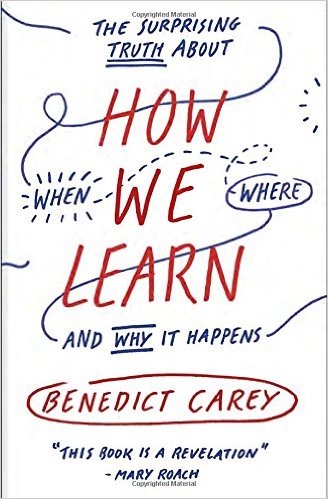
How We Learn: The Surprising Truth About When, Where, and Why It Happens by Benedict Carey

Monday, December 15th, 2014

Learn academic writing with AcademicHelp.net. See a lot of free writing guides and samples.

How We Learn

How We Learn: The Surprising Truth About When, Where, and Why It Happens by Benedict Carey summarizes research on this topic, much of which educators have yet to implement. Education’s leaders need to read this book and work to reform the system accordingly. Click the icon at the bottom of any page to get a copy for educators you know.

Benedict Carey

  • Benedict is an award-winning science reporter who has been at The New York Times since 2004. He is one of the newspaper’s most emailed reporters. He has a bachelor’s degree in math from the University of Colorado, and a master’s degree in journalism from Northwestern University. He has written about health and science for twenty-five years and lives in New York City.

Introduction

  • Benedict starts with his own story about how he got mostly A’s in school along with low SAT scores and couldn’t get in to any of his desired colleges. Along the way he discovered many of the techniques he covers in this book that allowed him to integrate the exotica of new subjects into daily life, in a way that makes them seep under his skin. He has mined the latest science to so how you can make learning part of living and less about isolated choice during his writing career.

1. The Biology of Memory

  • Benedict starts with a simplified explanation of how the brain is structured. Thanks to the study of brain injured patients, science has developed some understanding of how the brain stores and retrieves memories. At the bottom center of the brain is the hippocampus, which is vital for the formation of memories. One type of memory called episodic is used to remember events that take place over time like the first day of high school. The other type is semantic, which deals with facts rather than experiences. When we retrieve a memory of an event, we need to reconstruct it. As a result, the story is likely to change over time as one doesn’t put the story together the same way each time. The basic plot, however, should not change much if at all. In essence, using our memory changes our memory.
  • We have another kind of memory that remembers physical skills. This is called motor learning and is not dependent on the hippocampus. We also have conscious and subconscious systems and a lot goes on while we are at sleep. Thanks to surgery on patients with split brains, we know that the left side is the wordsmith while the right side is the visual expert. The left brain interprets what we experience and makes stories that we use to remember what happened. We have at least thousands of brain modules that perform skills like calculating changes in light, tone of voice, and changes in facial expression, and they all run at the same time.
Share this:
Share this page via Email Share this page via Stumble Upon Share this page via Digg this Share this page via Facebook Share this page via Twitter Share this page via Google Plus

Who’s Afraid of the Big Bad Dragon? Why China Has the Best (and Worst) Education System in the World by Young Zhao

Monday, December 1st, 2014

Who’s Afraid of the Big Bad Dragon? Why China Has the Best (and Worst) Education System in the World by Young Zhao offers and insider’s account of the Chinese school system, revealing the secrets that make it both the best and the worst. Yong was born in China and taught there. He has also maintained contact in order to tell us how China produces top scores on international tests but falls short when it comes to innovation and creativity. There are big lessons here for US policy makers. Click below to purchase this outstanding book that should be of interest to students, parents, and educators alike.

Yong Zhao

  • Yong holds the first presidential chair at the University of Oregon, where he serves as associate dean for global education, and professor in the Department of Educational Measurement, Policy, and Leadership. He has been featured in media ranging from The New York Times and USA Today to NPR and ABC. He is the author of more than 100 articles and 20 books. Check out his website and follow him on Twitter @YougZhaoUO.

Introduction – Fatal Attraction: America’s Suicidal Quest for Educational Excellence

  • The virus threatening America’s schools is the rising tide of authoritarianism. Most Americans have failed to recognize that government mandated tests are a Trojan horse containing the ghost of authoritarianism as they attempt to instill in all students the same knowledge and skills deemed valuable by the authority. All one need do is look to China to see the full range of tragic events that can happen under authoritarian rule. China indeed has produced superior test takers, but has failed to cultivate talents and creativity.
  • The damage being done takes instructional time away for testing, demoralizes teachers, and narrows educational experiences. Lost is a creative culture that celebrates diversity and respects individuality. School boards have surrendered to state and federal governments, and now in effect, only collect local taxes. Instead of learning from China’s miseries, we seen to be on the road to duplicate them. Do we want a system like China where only 10% of college graduates are deemed employable by multinational businesses because the students lack the qualities our new society needs?
Share this:
Share this page via Email Share this page via Stumble Upon Share this page via Digg this Share this page via Facebook Share this page via Twitter Share this page via Google Plus