Archive for the ‘Education Books’ Category

Aspiring Adults Adrift: Tentative Transitions of College Graduates by Richard Arum and Josipa Roksa

Monday, October 13th, 2014

Aspiring Adults Adrift: Tentative Transitions of College Graduates by Richard Arum and Josipa Roksa is a follow up to their landmark Academically Adrift that made the case for how many college students end up learning very little, end up unemployed or under employed, and living at home. Now they follow this same college cohort two years after graduation and see that many found a difficult transition to adulthood. Together these works should challenge students and colleges to rethink the aims, approaches, and achievements of higher education. Click here to read my summary of Academically Adrift.

Richard Arum and Josipa Roksa

  • Richard is a professor in the Department of Sociology with a joint appointment in the Steinhardt School of Education at New York University. He is a senior fellow at the Bill & Melinda Gates Foundation and the author of Judging School Discipline: The Crisis of Moral Authority in American Schools. Josipa Roksa is associate professor of sociology and education and associate director of the Center for Advanced Study of Teaching and Learning in Higher Education at the University of Virginia.

1. The Study

  • This book is based on research that tracks more than 1,600 students (emerging adults) through their senior year at twenty-five diverse four-year colleges and universities, and approximately 1,000 college graduates from this sample for two years following their graduation in 2009. They also did in-depth interviews with a subset of 80 graduates in 2011 in order to find how post-college outcomes were associated with collegiate experiences and academic performance. Like their previous study, they used the Collegiate Learning Assessment (CLA) to measure critical thinking, complex reasoning, and written communication around the time of their graduation.
Share this:
Share this page via Email Share this page via Stumble Upon Share this page via Digg this Share this page via Facebook Share this page via Twitter Share this page via Google Plus

New Math – New Technology = Failure by Elizabeth Green

Friday, September 5th, 2014

New Math – New Technology = Failure by Elizabeth Green (no relation) deals with the Common Core’s approach to teaching math and how few schools seem to have shown teachers how to teach it. This is from the July 27, 2014 edition of The New York Times Magazine. Read the entire article here.

Be sure to check out her new book Building a Better Teacher: How Teaching Works (And How to Teach It to Everyone). Also see Behind the Cover Story: Elizabeth Green on America’s Math Crisis. This is an interview by Rachel Nolan @rachelbnolan @nytmag.

Elizabeth Green

  • Elizabeth is co-founder, CEO, and editor-in-chief of Chalkbeat, a nonprofit news organization that covers educational change efforts across the country. She has written for The New York Times Magazine, The New York Sun, and U.S. News & World Report. She was an Abe Journalism Fellow studying education in Japan and a Spencer Fellow in education journalism at Columbia University. She serves on the board of the Education Writers Association. To consider asking her to speak click here. On Twitter she is @elizwgreen
Share this:
Share this page via Email Share this page via Stumble Upon Share this page via Digg this Share this page via Facebook Share this page via Twitter Share this page via Google Plus

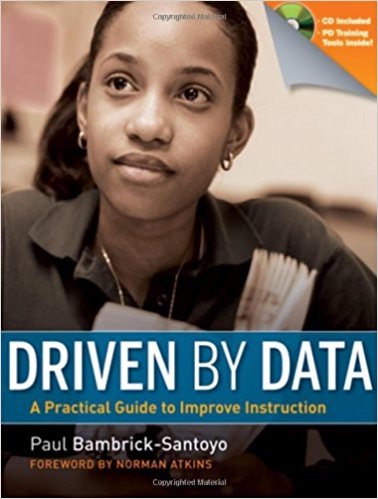
Driven by Data: A Practical Guide to Improve Instruction by Paul Bambrick-Santoyo

Thursday, August 21st, 2014
Data

Driven by Data: A Practical Guide to Improve Instruction by Paul Bambrick-Santoyo offers a step by step approach to preparing your students for high-stakes tests while students work to master standards. While you may be hoping for the current testing madness to end, Paul offers a practical way for your school to out perform other schools with similar demographics while the current tests are still with us. Part two includes specific workshop activities for data leaders.

Paul Bambrick-Santoyo

  • Paul is managing director of Uncommon Schools, leading six schools in the North Star Academy network that have achieved some of the highest results in the country. He has trained over 2,000 school leaders nationwide, and is the Data-Driven Instruction faculty member for New Leaders for New Schools, an urban school leadership training program.

Physicals or Autopsies?

  • Paul likens the analysis of end-of-year and high-stakes state testing to an autopsy where the purpose is to find out why the patient died. He prefers that educators spend their time looking at the results of interim tests and use them to inform instruction. This is similar to how a physician would use the results of a physical to determine treatment and recommend lifestyle changes. Paul also warns that data-driven instruction is not an elaborate stratagem for promoting “test prep.” While he sees many faults in the NCLB testing culture, he is happy to see educators focusing more on accountability for student achievement, and interim assessments hold them accountable throughout the year.

Excellent Interim Assessments

  • In order to be effective, interim assessments must be of high quality, which is seldom what you get when individual teachers slap something together at the end of a unit. The tests need to be in place prior to the start of the school year and be available to the teachers. Every teacher at the same grade level or subject should be using the same tests at the same time. This allows teachers to analyze the results together. Paul recommends assessments every six to eight weeks. Too seldom allows weaknesses to go unrecognized. Too often and teachers may not have time for satisfactory analysis. It is also important that teachers be involved in test creation or selection. Paul is ok with purchased tests as long a teachers get to see them. Some vendors don’t allow this in order to maintain test validity.
  • The tests are not seen as an end, but as a beginning. This is because they let the teachers know what needs to be taught and the desired level of rigor. When they are given, the results need to be available soon. (Doug: When I taught I always graded assessments the day they were given, and the students got the results as part of the next class. With some kinds of computerized testing, students can see their results immediately.)
Share this:
Share this page via Email Share this page via Stumble Upon Share this page via Digg this Share this page via Facebook Share this page via Twitter Share this page via Google Plus

Think Like a Freak by Levitt & Dubner

Monday, June 2nd, 2014

Think Like a Freak by Steven D Levitt & Stephen J. Dubner (©2014, Harpur Collins: New York, NY) offers to retrain your brain. This book follows Freakonomics and Super Reakonomics that were both best sellers. This claims to be the most revolutionary book yet. It features captivating stories and unconventional analysis that should help you think more productively, creatively, and rationally. Click at the bottom of any page to purchase this very cool book.

Levitt and Dubner

  • Steven D. Levitt is the William B. Ogden Distinguished Service Professor of Economics at the University of Chicago, where he directs the Becker Center on Chicago Price Theory. He is the 2003 John Bates Clark Medal winner, an award that recognizes the most outstanding economist in America under the age of 40. In 2006, he was named one of Time magazine’s 100 People Who Shape Our World. Levitt received his B.A. from Harvard University in 1989, his Ph.D. from M.I.T. in 1994, and has taught at the University of Chicago since 1997.
  • Stephen J. Dubner is an award-winning author, journalist, and TV and radio personality. His solo books include Turbulent Souls and The Boy With Two Belly Buttons. His journalism has been published in The New York Times, The New Yorker, and Time./li>
Share this:
Share this page via Email Share this page via Stumble Upon Share this page via Digg this Share this page via Facebook Share this page via Twitter Share this page via Google Plus

Class Rank Weighs Down True Learning by Thomas R. Guskey

Thursday, April 10th, 2014

Class Rank Weighs Down True Learning by Thomas R. Guskey – Phi Delta Kappan, March 2014, V95 N6, pp. 15-19. This is my summary of this fine article, which makes the point that teaching and grading schemes that work to select the most talented students often fail to benefit all students and to notice promising students. This may cause you to rethink what your high school is doing regarding this matter. Here is the link to the abstract. You will probably need a subscription if you want to view the full article, or you could hit your nearest college library.

Thomas R Guskey, PhD

  • Thomas is a professor of educational psychology at the University of Kentucky. He is a graduate of the University of Chicago, and began his career in education as a middle school teacher. He served as an administrator in Chicago Public Schools, and was the first Director of the Center for the Improvement of Teaching and Learning, a national educational research center. He is the author/editor of 18 books and over 200 articles published in prominent research journals as well as Educational Leadership, Phi Delta Kappan, and School Administrator. You can find him on Twitter @tguskey or email him at guskey@uky.edu
Share this:
Share this page via Email Share this page via Stumble Upon Share this page via Digg this Share this page via Facebook Share this page via Twitter Share this page via Google Plus