Archive for the ‘Education Books’ Category
Sunday, October 13th, 2013
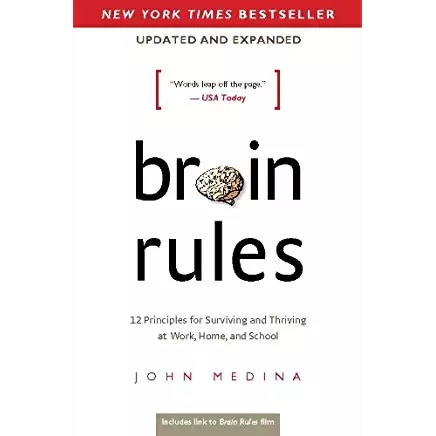
Brain Rules: 12 Principles for Surviving and Thriving at Work, Home, and School by John Medina tells how what we know about brain science can be used to positively influence our daily lives. This book is vital for educators, policy makers, and anyone who wants to get more out of their gray matter. Click at the bottom of any page to purchase this essential book.
Dr. John Medina
- John is a developmental molecular biologist focused on the genes involved in human brain development and the genetics of psychiatric disorders. Most of his life has been spent working in the biotechnology and pharmaceutical industries. He teaches at Seattle Pacific University where he is the director of the Brain Center for Applied Learning Research. He also teaches in the bioengineering department at the University of Washington. His other books include Brain Rules for Baby, The Genetic Inferno, as well as books on Alzheimer’s, depression, and AIDS.
The Brain is an Amazing Thing
- The human brain is easily the most sophisticated information-transfer system on Earth. As you read this, it sends jolts of electricity crackling through hundreds of miles of microscopic wires in less time than it takes to blink. Brain scientists have a lot to learn, but they rarely have conversations with educators and business people. This book is meant to fill this communications void. Each of the 12 rules here are supported by research that has been replicated, and John focuses on how what we know can be applied to our daily lives.
Posted in Book Summaries, Business Books, Education Books, Leadership Books | No Comments »
Monday, September 23rd, 2013
Why Students Don’t Like School? by Daniel T. Willingham (©2009, Jossey-Bass: SanFrancisco, CA) answers questions about how the mind works and what it means for the classroom. The focus here is how do students’ minds work, and how you can use this knowledge to be a better teacher. Click at the bottom of any page to pick up a copy of this vital book for your favorite teacher(s).
Daniel T. Willingham
- Daniel has a PhD in cognitive psychology from Harvard and is currently professor of psychology at the University of Virginia. He has done extensive research on the brain basis of learning and memory and now is concerned with the application of cognitive psychology to K-12 education. He writes for American Educator magazine. You can check his website DanielWillingham.Com.
.
Thinking Is Hard
- While the human brain is adept at seeing and guiding movement with little effort, thinking is slow, effortful, and uncertain. People do enjoy thinking as long as they can solve the problem at hand. There is not much pleasure in just being told the answer or working on problems that are too difficult. Thinking occurs when we combine information from our environment with information and/or procedures from long-term memory. This takes place in our short-term memory.
- The lesson here for teachers is that students need the proper background knowledge and procedures along with new information from the environment. They also need problems that offer moderate challenges. They need ways to organize the information at hand as short-term memory can only hold so much. Spend time developing the right questions based on the material at hand and look to keep it relevant. It is also self-defeating to give all students the same work as they don’t all have the same ability. If some students are behind others, giving them work that is beyond them is likely to make them fall further behind. Changing the topic will grab attention, and be sure to make notes in your lesson plans as to what works and what doesn’t.
Is Knowledge Under Rated?
- The main point here is that you are better able to engage in critical thinking if you have related knowledge in long-term memory that you can draw on. Many sources today are critical of schools for teaching too many facts and using tests that feature simple recall. It you try to get students to think critically and solve problems without giving them the necessary background knowledge, they are likely to be frustrated and have little success. You can also take in new information faster if you have related information in long-term memory. This will allow you to chunk new information into fewer pieces, which reduces the load on short-term memory. Studies show that reading skill is less important than background knowledge of a specific subject. Background knowledge also provides vocabulary, bridges gaps that authors leave, and helps you wade through concepts that might be ambiguous.
- When it comes to knowledge, the more you have, the more you gain. This explains why students from homes where they are exposed to a lot of language, books, museum trips and such do better in school. This is why poor children generally don’t do as well in school. The question for schools is which knowledge to instill? Daniel suggests newspapers, magazines, and books on serious topics written for the intelligent layman. He also suggests that schools focus on concepts that come up again and again. Knowledge pays off more when it is conceptual and when the facts are unrelated to each other. Drilling probably does more harm as it is likely to make students think that school is a place of boredom and drudgery.
Memory is the Residue of Thought
- Memory is still pretty mysterious. We know that thinking about something carefully should cause it to be stored in long-term memory. Whatever students think about is what they will remember. Attention is key. If you don’t pay attention to something, you can’t learn it. Things that create an emotional reaction will be better remembers, but emotion is not necessary for learning. Simple repetition is not enough either. A teacher’s goal, therefore, is to get students to think about meaning.
- Effective teachers are the ones that students like and who organize material in ways that make it interesting and easy to understand. Emotional bonds between students and teachers accounts for whether students learn. Turning a lesson plan into as story is one effective way to promote learning. Good stories feature causality, conflict, complications, and interesting characters. Teachers should also try to come up with the right questions to that the answers seem more interesting. For necessary rote memorization, Daniel does not discourage memory tricks and gives advice on which ones he prefers.
- Attention grabbers can be useful as long as the don’t continue to grab attention and become a distraction. Since you will usually have student attention at the beginning of a class, grabbers may be better used when student attention starts to fade. It can be interesting if students are exploring their own interests, but incorrect discoveries promote incorrect memories. Making things relevant can work, but making some topics seem relevant can seem phony. In any case, review each lesson plan in terms of what you want the students to think about.
Abstract Ideas are Hard
Our minds prefer concrete ideas over abstractions. The best way to understand an abstraction is to experience it in many different analogous versions. Examples help make abstractions appear more concrete. It is difficult to understand a new idea if it isn’t related to what you already know. Daniel discusses three types of knowledge starting with rote knowledge, which is composed of simple facts. Shallow knowledge implies there is some limited understanding. Finally, with deep knowledge we have the necessary pieces of knowledge richly interconnected. Problems and situations also have a surface structure and a deep structure. Deep structures are not obvious and many deep structures might apply to the same problem. Since surface structure can get in the way, it is sometimes best to disregard it. Comparing diverse examples is a good teaching strategy to promote deeper thinking. Teachers should let students know that the goal is deep thinking, and make sure that tests don’t emphasize too many factual questions. Shallow knowledge is better than no knowledge and is a natural step on the way to deeper knowledge.
Is Drilling Worth It?
- Thinking takes place when you combine information in new ways. This happens in short-term memory, which is limited in size. To make it more efficient you need to have more knowledge in long-term memory, and automate some key processes. You are an experienced reader so you have automated an important process. Memorizing simple math facts is another example.
- Research shows that practice that helps you automate a process is more effective if it is spread out over time. On the other hand, cramming for a test may help you pass the test, but you will forget the material faster than if you practiced over time. Also, if you practice something enough, you will effectively never forget it. For example, people who only take algebra forget most of it while people who take calculus remember most of their algebra. By spreading practice out, you need less of it, and teachers will have a better chance of making it seem less boring. Not everything can be practiced as there isn’t time. Teachers, therefore, must decide which material needs to be automated. These should be the building blocks of the discipline at hand.
Getting Students to Think
- As novices, students cannot think like experts. They lack the organized background knowledge and the practice that makes key processes automatic. While they won’t be able to create knew knowledge or interpretations of historic events, they can work to understand what experts have created. That doesn’t mean that teachers should never ask students to try to create something. It just means they probably won’t be very good at it. They can however, learn to understand how science and other fields work and progress. This also applies to the teaching profession. Beginning teachers may deal with the symptom when misbehavior occurs while expert teachers will deal with the root cause.
Teaching Different Types of Learners
- The guiding principle here is that children are more alike than different in terms of how they think and learn. Cognitive styles are not the same as cognitive abilities. Pages 150-151 offer 12 sets of opposing styles that can help with lesson planning. Unfortunately, scientists have yet to find specific styles in individuals that schools can use. This is due to the fact that the vast majority of schooling is concerned with what things mean, not what they look like or sound like.
- Teachers should differentiate instruction, but not based on any set of learning styles. They should treat students differently on the basis of their experience with each student and remain alert for what works. Here is where craft knowledge trumps science. Daniel also cautions against telling kids they have skills and smarts. Daniel Pink’s book on motivation supports this idea.
Helping Slow Learners
- We know that children differ in intelligence and that intelligence can be changed by hard work. It is vital that children believe this. Some kids think, however, that hard work makes them look dumb. They also seek to avoid failure rather than accept it and learn from it. One key factor is how children are praised. Praising them for being smart will discourage them from taking on challenging tasks for fear of failure. Failure means you are about to learn something. Also, don’t assume that slower students know how to study. Praising students for hard work has the opposite effect. This sends the message the intelligence is under their control. Create a classroom atmosphere in which failure is neither embarrassing nor wholly negative. Praising substandard work sends the message that you have lower expectations of a student. Praise what is good and say “let’s talk about how your could have done the other things better.”
How About My Mind
- Data suggests that most teachers improve during their first five years and then level off. In order to improve you need to increase your factual and procedural knowledge. Practice is difficult and feedback is essential. Students can give you feedback, but higher quality feedback is more likely to come from other experienced teachers. Working with another teacher can help, but it may not be possible to have another teacher in your room very often. Making videos of your lessons can help. You should first watch your videos yourself before you share them with another teacher who you trust. Here are two sites where you can watch other teachers’ videos. videoclassroom.org and learner.org. When you do watch videos with other teachers focus on concrete observations rather than subjective statements. In addition to videos, getting together with other teachers to discuss what seems to work and ask for suggestions can help. Daniel also suggests that you keep a diary of what worked and what didn’t and observe children in the age group you teach outside of the classroom whenever possible. It will help if you can observe children you don’t know you.
Conclusion
- In his final chapter, Daniel offers and excellent table that reviews his nine cognitive principles along with the required knowledge about students, and the most important classroom implications for each. It boils down to knowing how learning takes place, knowing the factors that facilitate learning, and perhaps most importantly, knowing your students. This is analogous to writers knowing their audience. The principles he selected from the entire body of cognitive science are the ones he sees as true all the time and based on a great deal of data. They are principals that can drive lesson planning, and principles that teachers can ill afford to ignore. They all certainly resonate with this educator who has been in the business since 1969. I hope you enjoy this book as much as I did.
Posted in Book Summaries, Education Books, Leadership Books | 1 Comment »
Monday, August 19th, 2013
Adapt: Why SUccess Always Starts with Failure by Tim Harford offers an inspiring and innovative alternative to traditional top-down decision making. Tim deftly weaves together psychology, evolutionary biology, anthropology, physics, and economics along with compelling stories of hard won lessons from the real world. He makes a passionate case for the importance of adaptive trial and error to deal with problems both global, personal, and everything in between. Click at the bottom of any page to purchase this breakthrough handbook for surviving and prospering in an ever-shifting world.
Posted in Book Summaries, Business Books, Education Books, Leadership Books | 1 Comment »
Saturday, June 29th, 2013
Thank You for Listening: Gain Influence & Improve Relationships, Better Listening in Eight Steps by Marc Wong (©2012) will help you learn how to put someone else’s speaking, thinking, and feeling needs ahead of your own. By so doing, you will build trust, earn respect, and gain influence. Marc’s eight steps are practical, and the book is an enjoyable read. Click the icon at the bottom of any page to purchase this fine book.
Tags: Listening, Marc Wong
Posted in Book Summaries, Business Books, Education Books, Leadership Books | No Comments »
Thursday, April 18th, 2013
Hacking Your Education: Ditch the Lectures, Save Tens of Thousands, and Learn More Than Your Peers Ever Will by Dale J. Stephens (©2013, A Perigee Book: New York, NY) is a handbook for people of any age who wants to take control of their own learning. Dale suggests actions you can take now and explores how school has failed almost everyone in some way. You will still need hard work and determination to thrive in the real world as this book offers an alternate approach to learning rather than an easy solution. Dale offers lots of valuable advice and many inspirational stories of success by unschoolers. Please click the icon at the bottom of any page to purchase this fine book.
Tags: Dale J. Stephens, Hacking Your Education
Posted in Book Summaries, Education Books, Leadership Books | No Comments »