Archive for the ‘Education Books’ Category

The Dragonfly Effect: Quick, Effective, and Powerful Ways to Use Social Media to Drive Social Change by Jennifer Aaker and Andy Smith

Saturday, December 29th, 2012

The Dragonfly Effect: Quick, Effective, and Powerful Ways to Use Social Media to Drive Social Change by Jennifer Aaker and Andy Smith with Carlye Adler, (©2010, Jossey-Bass: SanFrancisco, CA). will help you harness the power of social media to achieve a single, focused, concrete goal. The authors also hope you will be inspired to use social media for social good. Think of this as your playbook for moving your cause from awareness to action. To be successful, you must translate your passion into a powerful story that generates contagious energy. Jennifer and Andy draw on abundant psychological research to show you how to do this. They also provide many inspiring stories to make their points and inspire their audience. Click the icon at the bottom of any page to purchase this book.

Jennifer Aaker and Andy Smith

  • They are a married couple. Jennifer is a Professor of Marketing at Stanford University’s Graduate School of Business where she teaches a course on social media. Andy is a principal of Vonavona Ventures, where he advises on marketing, customer strategy, and operations. The book also contains a forward by Chip Heath, coauthor of Made to Stick, and Switch.
    .

The Dragonfly Model

  • The Dragonfly Effect, like the dragonfly, relies on four wings that achieve great results when they work together. It starts with focus. This is where you identify a concrete measurable goal. Next you grab attention by telling a personal story with unexpected, visceral, and visual aspects. Then you engage, which is where you empower your audience to care enough to want to do something. Finally, you enable and empower others to take action. To make action easier, you must prototype, deploy, and continuously tweak your approach towards making your audience team members.

Wing 1 – Focus – The HATCH Principals

  • There are five design principles associated with the focus wing. First is humanistic. You first need to understand who your audience is. Listen, observe, ask questions, and empathize. Second is to make your goal actionable by breaking long-term goals into a number of short-term goals that are small, actionable, and measurable. Third is to make a goal testable. You need to measure progress and success somehow. Fourth is clarity. Goals need to be highly specific. Failures often involve goals that are vague, conflicting, or too numerous. The final principle is happiness. Your goal must be personally meaningful. The prospect of happiness will serve to motivate.

Wing 2 – Grab Attention – How to Stick Out

  • Aaker and Smith suggest four design principles for grabbing attention. First is get personal. This can be a personal hook, using one’s name, or tagging someone’s picture. Second is to deliver the unexpected. The element of surprise can result in viral behavior, and you need to be original. Third is to visualize your message. Pictures trump words in terms of grabbing attention. You can juxtapose two images, combine images, or replace one with another. Finally you want to make a visceral connection. Do what you can to trigger the senses of sight, sound, hearing, or taste. Use music to tap emotions.
Share this:
Share this page via Email Share this page via Stumble Upon Share this page via Digg this Share this page via Facebook Share this page via Twitter Share this page via Google Plus

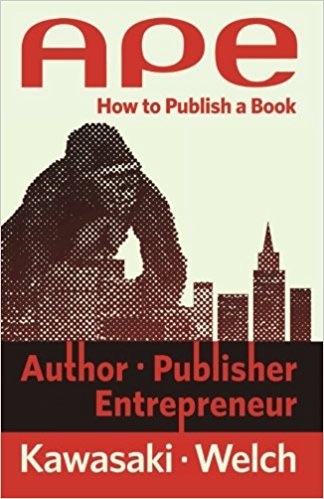
APE: How To Publish a Book by Guy Kawasaki & Shawn Welsh

Thursday, December 13th, 2012
APE

APE: How To Publish a Book by Guy Kawasaki and Shawn Welsh (©2012) As the digital world has created a revolutionary opportunity for writers to become their own publishers, a new self-publishing infrastructure has emerged. This book offers a guide to this new publishing universe with details and inspiration. After you read this you are unlikely to let anyone tell you that you shouldn’t, wouldn’t, or couldn’t write a book. The APE in the title stands for Author, Publisher, and Entrepreneur, and Guy and Shawn devote sections of this book to each part of the process. It makes for a great read and a better reference as you bring your book to life. Be sure to click the icon at the bottom of any page to support this stellar self-published effort.

Guy and Shawn

  • Guy Kawasaki is the author of eleven previous books, including What the Plus!, Enchantment, and The Art of the Start. He is also the cofounder of Alltop.Com and the former chief evangelist of Apple. Kawasaki has a BA from Stanford University, an MBA from UCLA, and an honorary doctorate from Babson College.
  • Shawn Welch is the author of From Idea to App, iOS 5 Core Frameworks, and iOS 6 for Developers. He is also the developer of several iOS apps. Previously he worked as a senior media editor for Pearson Education. He helped pioneer many of Pearson’s earliest efforts in iPad solutions. Welch has a BS from Kansas State University.

[Author Section] Why should anyone give a shiitake about your book?

  • This is the question Guy starts with to help you decide if you should write a book in the first place. Keep in mind that people by books to help themselves, not to further your career. Question two is, will your book enrich your readers with some combination of knowledge, understanding, entertainment, or laughter? If your answer is yes you should write a book. Other good reasons include the value of the intellectual challenge, furthering a cause you believe in, and the therapeutic value of the process. Bad reasons are thinking you are in popular demand and that you will make a lot of money. You just might. but the odds are against you.

Some Publishing History

  • While we don’t have to wait for scribes to hand copy books anymore, publishing a book in the traditional way still takes twelve to eighteen months. Authors and readers can’t wait this long anymore. Guy details the steps and the people involved in the traditional approach from agents to editors to copy editors to publicists. He warns about being rejected, and gives examples of many famous writers who had rejection experiences. He notes that traditional publishing is under siege by many forces, and may not be appropriate for writers like you. Self-publishing, on the other hand, is the best thing that has ever happened to writers.

The Self-Publishing Revolution

  • Traditional publishing grew up in a world with limits and logistics such as shelf space, access to printing presses, editing and production expertise, and shipping of physical books. The 1980’s brought us laser printers and software that allowed anyone to publish. This was followed by electronic delivery systems that eliminated the need to print physical books. As a result, publishing is more democratic. That doesn’t mean, however, that the quality is any better. Any intermediaries between the author and the reader must add value or face their demise.
  • Now authors can control content, design, and how long the marketing effort lasts. With print on demand services, books can stay in print for any length of time and revisions are easy to make. More, if not all, of the profit goes to the author. You can get global distribution, set your own price, cut quantity or license deals, and monitor sales as you wish.
Share this:
Share this page via Email Share this page via Stumble Upon Share this page via Digg this Share this page via Facebook Share this page via Twitter Share this page via Google Plus

Preventing Plagiarism: Tips and Techniques by Laura DeSena

Thursday, November 22nd, 2012

Preventing Plagiarism: Tips and Techniques by Laura Hennessey DeSena (©2007, National Counsel of Teachers of English: Urbana, Il) offers teachers (and even parents) ways to promote original thinking and head off plagiarism at its sources. Assignments that use free writing and original sources can build student confidence and critical thinking skills so they will be less likely to use online paper mills and cut and paste without attribution. Every college and secondary school teacher should have a copy, so click the icon at the bottom of any page to purchase. Even teachers of younger students can adapt the ideas presented here.

Share this:
Share this page via Email Share this page via Stumble Upon Share this page via Digg this Share this page via Facebook Share this page via Twitter Share this page via Google Plus

Do You Know Enough About Me to Teach Me? A Student’s Perspective by Stephen G. Peters

Friday, October 12th, 2012

Do You Know Enough About Me to Teach Me? A Student’s Perspective by Stephen G. Peters (©2006, The Peters Group Foundation: Orangeburg, SC.) provides insight from students he gathered during extensive interviews and uses this perspective to let teachers know what they may have missed in college. His goal is to help teachers learn how to care for all students by listening with all their hearts to the voices of students. Click the icon at the bottom of any page to purchase this fine book.

Stephen G. Peters

  • Stephen has been an educator for more than 25 years with experience as a teacher, assistant principal, principal, and director of secondary education. He is founder of The Gentleman’s Club, a program that seeks to change attitudes and behaviors of at-risk and borderline males and The Ladies Club that aims to empower girls to be their own best friends and inspire them to discover and be proud of who they are. He is also a partner at CasseNEX, a leader in online course design and delivery. For more on his work check his website.

It’s All About Relationships

  • Stephen believes that the solutions to many education problems reside within the hearts and minds of the students themselves and that we all lose when we silence or ignore their voices. It’s the special relationships between students, teachers, and administrators that are the keys that unlock the door to success and excellence in any school. Part 1 features interview transcripts from four selected students.

Keisha

  • Most students want to learn. We have a whole lot to deal with outside of school and we need respect, structure, and consistency. Her favorite teacher told the class on the first day that they all had A’s and that motivated her to work to keep it. It was her first A. As a 9th grader she finds that many teachers don’t seem to care. The best teachers treat you with respect and work hard to make lessons interesting.

Marvin

  • Marvin’s favorite teacher told him he was smarter than he thought he was and made learning relevant and meaningful. She was a master at forming positive relationships with her students and never wrote discipline referrals. The other key influence in Marvin’s life was his coach. The relationship was so strong that the coach felt like a family member and Marvin worked hard to meet the coaches expectations. He was impressed when one teacher showed up at one of his football games. That made him want to work to pass her course. He also appreciates teachers who stay late to help kids and go out of their way to do unexpected acts of kindness. He doesn’t like the administrators as he has the sense that they don’t like him.
Share this:
Share this page via Email Share this page via Stumble Upon Share this page via Digg this Share this page via Facebook Share this page via Twitter Share this page via Google Plus

The Reading Workout: A 30-Day Plan That Turns Teenagers into Readers by Chris Beatty

Monday, October 1st, 2012

The Reading Workout: A 30-Day Plan That Turns Teenagers into Readers by Chris Beatty offers straightforward advice that respects the intelligence of its readers and fosters a love of reading. It will take readers beyond the soulless world of standardized tests and provide them with a foundation for academic success. Each of the 30 daily chapters takes less than five minutes and can be used many ways, even by non teens. Be sure to click the icon at the bottom of each page to purchase copy(s) for your favorite teens and adult readers who want to love reading.

Share this:
Share this page via Email Share this page via Stumble Upon Share this page via Digg this Share this page via Facebook Share this page via Twitter Share this page via Google Plus