The Invisible Gorilla: And Other Ways Our Intuitions Deceive Us by Christopher Chabris and Daniel Simons, (©2010, CROWN: New York, NY.) is about six everyday illusions that profoundly influence our lives. They are the illusions of attention, memory, confidence, knowledge, cause, and potential. These are distorted beliefs we hold about our minds that are not just wrong, but wrong in dangerous ways. Once you know about these illusions, you will view the world differently and think about it more clearly. You will recognize when people are taking advantage of illusions in an attempt to obfuscate or persuade. Seeing through these veils will help connect you with reality. I will soon post a summary of Cathy Davidson’s Now You See It which draws heavily on this book.
Archive for the ‘Education Books’ Category
Invisible Gorilla Revised Summary
Thursday, November 3rd, 2011Brain-Powered Science Reform Your Science Program
Wednesday, October 19th, 2011Reform your science program one activity at a time with Dr. Thomas O’Brien’s three volume Brain-Powered Science: Teaching and Learning with Discrepant Events effort for grades 5-12. It is a cerebral treat for science teachers, science students, and science teacher educators alike. At the heart of each activity is a hands-on discrepant-event, which provides an unexpected outcome. This generates a need-to-know that motivates learners’ to think and often makes science fun and funny. The activities are safe, simple, inexpensive, enjoyable, effective, and relevant. Teachers who use these activities should also find that they serve to open their own doors to learning. In all cases there is a deep connection to recognized national science education standards. (Brain-Powered Science, (© 2010) More Brain-Powered Science, (© 2011), and Even More Brain-Powered Science, (© 2011) are published by the NSTA Press: Arlington, VA.)
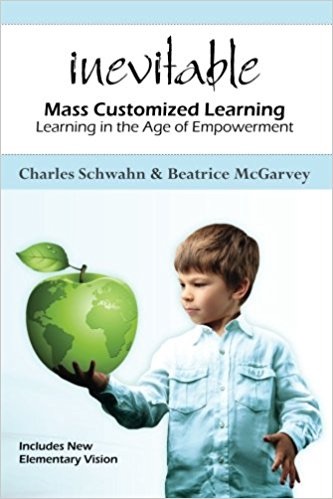
Inevitable: Mass Customized Learning in the Age of Empowerment
Thursday, September 22nd, 2011
Inevitable: Mass Customized Learning in the Age of Empowerment by Charles Schwahn & Beatrice McGarvey shares an exciting vision for education that uses today’s powerful mass customizing technology to meet the individual learning needs and interests of every learner every day. The goal is to do for learners what Apple does for music lovers, Amazon does for readers, and what Google does for seekers of information. Mass Customized Learning is necessary and doable.
Why This Book Is Necessary
- The world has left the Industrial Age of mass production and entered the Information Age of mass customization, except for education. We still presuppose that all students of the same age are ready to learn the same thing, the same way, in the same amount of time. This explains why people in general don’t think public schools are doing a good job. Technology has transformed nearly every sector of our lives and it should help enable changes toward customized learning. This is not only a book for teachers, but for everyone in the community especially students who will help show us how to do it. The models are available and there is no reason why it should cost more.
Facing Reality
- Schools are bureaucratic monopolies existing in a world of customization and service. What we teach now is not much different from a famous 1892 plan. The model was fine when dropouts could still get good jobs. It’s no longer ok to build in failure for some with a rigid time-driven system for learning. We know that not everyone learns at the same rate, but we plan as if they did. Not quite getting it is cumulative. Don’t ask if a child is ready for Kindergarten (or anything else), ask what is the child ready for.
- Policies and practices are chosen for administrative convenience and are inconsistent with basic learning research. We have expensive extra systems for those who need extra time while our fast runners are held back by the schedule and the curriculum. Averaging grades makes no sense. If someone can demonstrate learning they should move on. If they can’t, they’re just not finished yet. There also needs to be more relevance to the life students are living today and what they will face after school.
- Be sure to assess your agreement with these realities, which the authors admit may be overgeneralized, with the scale on page six. You should also take it again at the end to see if you have changed.
When You Come to a Fork in the Road, TAKE IT by Yogi Berra, with Dave Kaplan – Great for Educators & Parents
Friday, September 2nd, 2011
When You Come to a Fork in the Road, TAKE IT: Inspiration and Wisdom from One of Baseball’s Greatest Heroes by Yogi Berra, with Dave Kaplan (©2001, Hyperon: New York, NY) is funny, insightful, and inspirational all at once. I have always been a big fan of Yogi as he seems like such an unlikely hero. He doesn’t look like a star athlete and at first, his speech doesn’t sound like it contains a lot of wisdom. He was the son of poor immigrants and dropped out of school after the 8th grade. In spite of this be became an MVP and winner of a record ten world series. He was a successful manager and many of his quotations have become known throughout our culture. As this book shows, they are not just amusing. The quotes along with Yogi’s philosophy contain a lot of wisdom mixed in with the humor. Many apply very well to the field of education as I try to show here. There are a lot of pages, but they are short and good.
When You Come to a Fork in the Road, TAKE IT!
- Throughout life you come to serious forks in the road – decisions. No matter what decision you make, taking a job, getting married, buying a house, whatever it is, you shouldn’t look back. Trust your instincts. I’ve always done things that feel right. Learn from the choices you make and don’t second guess yourself.
- On big life decisions get all the advice you can. Talk it over with parents, a mentor, a teacher, or a coach. They’ve had more life experience. They have more miles on them and can help you get on the right path. A teacher once asked me, “Don’t you know anything?” I said I don’t even suspect anything.
Enjoy The Moment
- Nobody can help but be nervous in the World Series or at a job interview, or giving a presentation, or when you’re called on in class. You have to channel that nervousness. Enjoy the moment and make it a great experience. You need to learn to relax. You can’t be afraid of making a mistake. There’s always the next inning or the next day. Life goes on.
Nobody Did Nothin’ to Nobody
- There were many times I had to help my teammates so that bad things didn’t happen. When you’re part of a team you stand up for your teammates. Your loyalty is to them. You protect them through good and bad because they’d do the same for you.