Archive for the ‘Education Books’ Category
Saturday, October 31st, 2020
The Educator And The Oligarch: A Teacher Challenges The Gates Foundation by Anthony Cody shows how the Gates Foundations’ efforts to reform education have had a mostly negative impact. By spending a small fraction of the total education budget, people like Gates can buy politicians, muzzle the media, and control many special interest groups and non-profit organizations with grant money aimed at advancing their agenda. Please purchase this book and spread the word. (Note: Like every other book summarized here, this one was written prior to the COVID-19 pandemic.)
Preface and Introduction
- The thrust of this book is that something is seriously wrong with our system when one of the richest men in the world can spend a few billion dollars and seize the reins of education policy. By funding almost everyone who does advocacy, including teacher unions, Gates can call the tune. The tune is Common Core and associated tests that are designed to yield wide-spread failure. Like tobacco companies in the 1960s, their sponsored research tells them what they want to hear. This undermines the public’s democratic control of education and devalues the teaching profession. There is nothing generous in using the power of wealth this way.
- Unlike previous grant efforts by wealthy foundations, the Gates Foundation’s approach was different. Their starting point was “we know what is broken and we know how to fix it.” They invite proposals by directly contacting organizations. They then collaborate with the organizations to develop proposals that align with their agenda. With their vast wealth, an entire sector of organizations became dependent on their funds.
Part I: The Assault on Public Education by Bill Gates
1. Bill Gates’ Big Play: How Much Can Money Buy in Education?
- Gate’s vision starts will the total reliance on standardized tests that were already required by federal law (NCLB). These tests were flawed and NCLB was bound to fail so it was necessary to develop a new generation of tests based on new standards known as the Common Core. It also helped to get staff from the Gate’s Foundation transferred to the Federal Department of Education. Gates held that the field of education didn’t know much about teaching. He started by funding research that defined effectiveness as high test scores. This means that teachers get paid for these results. Next, he donated to advocacy groups to the extent that he became their largest donor. The final step was to donate to the media’s efforts to cover education.
2. Circular Reasoning at the Gates: Education Nation Off to a Confusing Start
- Here are excerpts from a Teacher Town Hall from 2011 on NBC moderated by Brian Williams. He tells the audience that they will be using facts provided by the Gates Foundation as they are the largest single funder of education in the world. (Doug: I think the US government is the largest single funder.) On this show, Melinda Gates claims that there are multiple measures that they are using along with test scores such as administrator and peer observations along with student questionnaires. But, the only models of these other measures that she wants to use are those that improve test scores. Here the author suggests that many of the strategies used to boost scores are harmful to our students.
3. Teachers Face Good Cops or Bad Cops in Push for Evaluations
- The bad cop is the New York Post, which published the names of teachers with the worst scores. The good cops are Bill Gates and Michelle Ree who said this is wrong and that multiple measures should be used in addition to tests. Their other measures, as we have seen, are correlated to test scores. These good cops also push value-added ratings (VAR), which research has shown to be highly unstable for individual teachers. Translation: VARs are garbage and should never be used as part of a teacher rating system. There is also the false assumption that there are a significant number of crummy teachers who need to be weeded out. (Doug: From what I’ve seen as an educator since 1969, crummy teachers weed themselves out as being a bad teacher really sucks.) As it stands, 50% of teachers leave the profession within five years and turnover rates in high-poverty schools are 20% each year.
4. Cui Bono? The Question Rarely Asked, Let Alone Investigated
- Cui bono means who benefits. Journalists should be asking this question, but they don’t seem to be doing so. They are, however, repeating false ideas that the reformers put forward such as our public schools are failing due to the ineffective teachers that need to be fired. They also tout the success of charter schools, which overall is not the case. The winners here are the testing companies, curriculum designers and publishers, consultants, technology and software companies, and various leadership organizations.
5. Bill Gates Discovers Money Cannot Buy Teachers
- The main idea here is that people, in general, can sense when they are being manipulated and coerced. When this happens they resent it and resist. Here we are talking specifically about teachers. They aren’t opposed to being evaluated based on student work such as portfolios, but they resist being evaluated by invalid standardized tests that are closely correlated with the socioeconomic background of their students. Teachers, therefore, are justified in being ungrateful for all the money Gates has poured into education to remake it in his own image.
6. Bill Gates Goes to College. Has He Learned From His k12 Project?
- Gates is also determined to change higher education with a focus on tests that measure specific skills that employers want. His focus is also on online courses, which have been shown to be less effective for all save the brightest. (Doug: We are seeing that now as well with remote learning) The approach sends the message that education is only for job preparation, which the author rejects. Blended learning, which offers a mix of online and in-person instruction appears to be effective, but 100% online doe not appear to be.
7. Is ASCD Embracing Market-Driven Education Reform?
- Organizations like ASCD are being directly paid to support the implementation of Common Core, which converts them into advocates for the controversial standards. Along with it comes “market-driven” systems, which feature a push for charter schools, private schools, and vouchers at the expense of public schools. In 2011, the Gates Foundation awarded ASCD a grant of $3 million to help implement the Common Core. If you just read ASCD’s journal you wouldn’t know that the Common Core is controversial.
8. Is Gate’s Money Going to Influence the National Board?
- While Gates claims that teachers participated in the creation of the Common Core Standards they were not involved. He also tries to convince us that since the schools can create the curriculum, teachers can still teach as they wish. He negates this when he says that he will know that his efforts have succeeded when the curriculum and the tests align with the standards. He pushes for control of schools by mayors as when just one person is in charge, change can be made more efficiently. It also means that he only has one person he needs to influence or buy off. Note that cities, where mayors are in charge, have fared worse. Other organizations know that if they want his money they have to sing this tune.
9. Gates and Duncan Seek to Use Trust in Teachers to Promote Common Core.
- If Gates and the Department of Education under Duncan (appointed by Obama) trusted teachers, they would not have had Common Core standards drafted by test makers instead of educators. They would not have created the pseudoscience of VAM to try to hunt down bad teachers. If leadership organizations were true leaders, they would not have allowed themselves to be co-opted and bought off. Gates seems to operate by bad analogies. One mentioned here is “standardization is important to allow for innovation… like the standardized outlets we have in our houses.” He sees innovation as the domain of the creators of mass-produced tools and the teachers as consumers. He accuses teachers of not knowing much about effective teaching, which is why he came up with the Common Core and its testing to define excellence.
Posted in Book Summaries, Business Books, Education Books, Leadership Books | No Comments »
Monday, September 21st, 2020
This is my most read book summary and I think it is timely for our current environment. Enjoy and be sure to get the book.
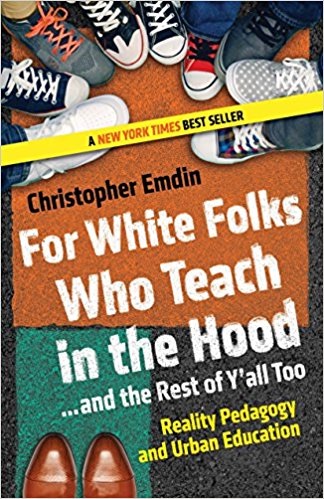
For White Folks Who Teach in the Hood…and the Rest of Y’all Too by Christopher Emdin explains how teachers from different cultures can connect and foster success when teaching black students in poor urban schools. While aimed at black cultures found in the inner city, the advice here applies to anyone teaching students from a cultural background that is not their own. In addition to the targeted audience, I strongly recommend this book to all teachers and their administrative leaders. Leaders of teacher preparation programs should also seriously consider this book.
Introduction
- Chris compares the urban poor black students to indigenous people like native Americans, who have suffered from the impact of colonization. He invented the term neoindigenous to describe his target population. The key idea in the book is how do we help white teachers better understand the culture of the black students they teach rather than spending their time trying to take their culture away from them. Strong discipline seems oppressive to many students and gives them the feeling that school is not for them. Harsh treatment is unlikely to produce academic success.
- The behavior students bring can make white teachers uncomfortable unless they are prepared for what they will face. They should become familiar with student culture including clothing, music, and speech. Viewing hip-hop as vulgar, for example, is a good way to make sure a teacher fails to connect. Students see a curriculum that is not connected to their culture and school rules that seek to erase that culture.
1. Camaraderie: Reality and the Neoindigenous
- Teachers in urban schools are usually from different neighborhoods and classes and don’t look much like their students. Unfortunately, they don’t see this as an impediment when it comes to engaging students. They can come in to save the students, which can make student experiences, emotions, and communities invisible. Teachers need to visit the community where students live and leaders need to facilitate visits. These students are often traumatized so it’s vital to get an idea of the nature of the traumas they face.
- Teachers can’t expect students to leave their experiences and emotions at the door. Even poverty comes with complexity. While you don’t have to use student vocabulary, it is important to know it. Teachers need to see students as individuals and meet them on their own cultural and emotional turf.
2. Courage: Teach Without Fear
- Watch out for code words like “these kids” and “those kids.” Black youth see white teachers as enforcing rules that are unrelated to teaching and learning. They often respond negatively to structures that teachers value at the expense of their academic success. Chris tells of his days as a student and rookie teacher when he was urged to take emotion from learning and teaching. This mantra served to mask fears.
- Too often white teachers become test-prep machines. Even teachers with good stories are apt not to tell them for fear of getting too personal. They also may avoid hands-on activities for fear of what students might do. Even Chris had an initial fear of students, which kept him from moving beyond fear and getting to know them.
Posted in Book Summaries, Education Books, Leadership Books | 2 Comments »
Monday, August 31st, 2020
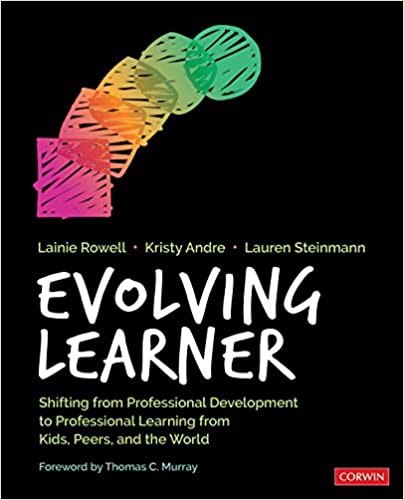
Evolving Learner: Shifting from Professional Development to Professional Learning From Kids, Peers, and the World (©2020) by Lainie Rowell, Kristy Andre, and Lauren Steinmann focuses on how teachers need to learn from their students, their peers, and the world at large. They also need to be allowed to have a voice and choice when it comes to their professional learning rather than be exposed to old school one-size-fits-all professional development.
Introduction
- The main idea is to move from traditional one-size-fits-all seat time professional development to innovative learner-driven personalized deliverables. An organization called Learning Forward developed Standards for Professional Learning and this book is a practitioner’s guide to mastering them. As you learn there are things that you have to unlearn, which is difficult. You also have to change your role from expert to learner and to not fear failure. Andragogy deals with the methods or techniques used to teach adults. 1. Adults should be involved in the planning and evaluation of their instruction. 2. Experience, which includes mistakes, provides the basis for learning activities. 3. Subjects should have immediate relevance and impact on their job or personal life. 4. Adult learning should be problem-centered rather than content-oriented.
- While there are many cycles of inquiry with similarities and differences, the authors decided to create their own. Their essential pieces are Focus, Learn, Refine, and Reflect. This cycle is revisited throughout the book. This book is about relationships for learning through a cycle of inquiry. Teachers who have experienced online and blended learning have higher aspirations for leveraging technology. With technology, it is much easier to differentiate learning. Social-emotional learning should also be integrated rather than separated from any learning.
1. Learning from Kids: Honor the Learner
- We need to shift from teacher-driven to learner-driven and by learner, we mean kids and adults. While students are engaged in the learning cycle of focus, learn, refine, and reflect based on content, teachers are engaged in this same cycle regarding their practice. Students should be seen as clientele. (Doug: I prefer customers.) Teachers need to respect each student’s ideas, experiences, and perspectives in order to serve them better. In other words, they need to constantly learn from the students.
Leveraging the Most Abundant Resource in Our Schools
- Students are the most underutilized resource in a classroom. They are critical to personalized learning for teachers. To learn from kids probably requires a change in mindset for most teachers. One survey of middle school students that asked “how do you feel in school each day” gave the top three responses as tired, bored, and stressed. The authors think that this may be because they don’t feel seen and heard. Making learning truly reciprocal may solve this problem. There an extended response here from Adora Svitak. She gave a TED Talk at the age of twelve on the topic of what adults can learn from kids that now has over five million views The response here was given when she was twenty.
What Are They Thinking? Making THinking Transparent to Tailor Instruction and Promote Teacher Inquiry
- Thanks to tech tools it’s possible for a teacher to ask a question and see everyone’s answer. This can greatly aid the ability to do formative assessments. Without such tools, you are likely to get the same kids answering all of the questions. When using these tools be sure to put lesson design first and not the tool. This approach will also give students more processing time as it lets the teacher assess prior knowledge.
- As students go through the grades they ask fewer questions. One way to fight this is to use the 5E’s approach. Here we start with Engaging students by asking an open-ended question. You can use a Word Cloud tool to create an illustration that students can use to Explore the topic further. The Explain part of the lesson can address unanswered questions. Further Elaboration comes next followed by Evaluation. Since learning is messy don’t be surprised if you move back and forth between these steps.
- Next the focus in on students formulating questions. First, the teacher comes up with a question focus contained in the curriculum. Students then independently produce questions without initial judgment of a question’s quality. They prioritize closed-ended and open-ended questions, plan the next steps, and reflect. Questions can even be used as part of assessments as creating questions is a higher-level thinking activity than answering them. The nature of the questions can help the teacher spot misunderstandings and provide opportunities to improve instruction. Peer instruction can also help as the teaching peer is dealing with something recently met. By circulating during this process teachers can learn new ways to explain concepts. You can even have students take tests in pairs after they take them as individuals and compare scores.
Ownership of Learning for All: Shifting From Students Who Consume Content to Learners Who Create Content
- Here we encounter the concepts of miinimally invasive education (MME) and self-organized learning environments (SOLEs). They are based on the work of Sugata Mitra who set up computer kiosks in poor neighborhoods starting in New Delhi, India. When he returned he was amazed at what the children had taught themselves with no help. Certainly these children owned their learning. We then hear about High Tech High, a charter school in San Diego, CA that accepts students via a lottery. They operate on the principles of equity, personalization, authentic work, and collaborative design. The only tech-based question they ask prospective teachers is “Are you willing to learn from your students?”
- One author tells a story of how she took over a kindergarten class and gave each student a computer tablet. She gave them four minutes to figure out the features of the drawing app and then teach them to the rest of the class. Then they had to show a number using manipulatives, take a picture of it, bring the picture into the drawing app, and annotate it. The vast majority had no trouble and those that did watched a peer and completed the task. Their teacher was amazed. This activity leveraged the learners in the room and produced artifacts that could be used to analyze the progress of each student. Students enjoyed the challenge, the chance to be creative, learning something new, and collaborating as they overcame their fear. Note that students here had voice and choice.
- Now we look at a number of specific learner-driven practices. Included are project-based learning, competency-based learning also known as mastery or performance-based learning, blended learning, and universal design for learning. There is an interview with Eric Marcos, a math teacher from Santa Monica, CA who’s website is MathTrain.Tv. He started making video tutorials for his students who soon wanted to make their own. In a way, they put him out of business. Among the many benefits are other family members learning math at home from student-generated tutorials.
- The rest of the chapter focuses on social-emotional learning (SEL) with short interviews of two teachers who use InspirED to help their students with this important learning. In the end, there are resources that help you internalize the key concepts as well as resources you can read, watch, listen to, and explore.
Posted in Book Summaries, Education Books, Leadership Books | No Comments »
Monday, July 27th, 2020
IEP & Section 504 Team Meetings…and the Law by Miriam Kurtzig Freedman joins her book on Grading, Reporting, Graduating… and the law as must-haves for your school’s special education library. Both are quick reads and provide educators and parents with all the need to know. Principals should put a few copies in the faculty room and parent support groups should have some for parents to borrow.
Introduction: You’re kidding! Another law book for educators and parents!
- The goal is to help educators and parents conduct meetings that are legal and efficient and build positive and trusting relationships as they get the job done. All of the relevant legislation is considered here in a way that anyone should be able to understand. This just deals with the law and Supreme Court decisions, not politics or pedagogy. It also does not weigh in on whether the law is good or bad. IEP’s are developed for students with disabilities so they can receive a free and appropriate public education (FAPE). Section 504 of the Rehabilitation Act of 1973 is an anti-discrimination law that requires schools to provide eligible students with disabilities the same opportunities as their average peers. Written 504 plans aren’t legally mandated, but they are considered a best practice.
What is the purpose of an IEP team meeting?
- The purpose is to develop a plan that provides a FAPE for the student as it offers the parents the opportunity to participate in a meaningful manner. They must be provided for students whose circumstances adversely impact their educational performance. It’s the school’s job to identify these students, although parents can bring it to the school’s attention. Appropriate here means that the plan is calculated to help the child make progress and receive educational benefits in light of their circumstances. It should strive to close the gap between their current performance and their potential. It need not close the gap between students and their age-level peers. IEPs are about learning, not passing.
- The plan should also be provided in the least restrictive environment (LRE), which usually means a regular classroom. The plan needs to include the child’s present levels of academic achievement and functional performance along with appropriate measurable goals that will demonstrate progress (evidence). Slow progress and repetition of goals from year to year are legal. That doesn’t mean that goals shouldn’t be ambitious. Some states define education to include emotional, social, behavioral, and physical needs.
What is the purpose of a 504 team meeting?
- These plans are designed to provide eligible students with disabilities the same opportunity to access, participate, and learn as their nondisabled peers. They often include accommodations, services, therapies, and even placements. They provide an equal opportunity while IEPs provide benefits.
Similarities between IEP and 504 meetings
- 1. They require that you provide what is needed, no more and no less. If the plan offers more it must be provided and may have unwanted side effects. 2. They are developed by teams, not individuals. Members need to discuss, reflect, and think, but voting should not occur. 3. If the team can’t reach consensus the school representative makes the call. 4. They aim to provide what the child needs, not what the parent wants even if they have a doctor’s prescription. 5. The plans belong to the child. If the parents dispute it they can seek due process. 6. The educators are the experts while the parent provides input about the child (WHO). Teachers know WHAT they teach and they know something about the child (WHO) as well. As long as schools have cogent explanations, courts generally defer to their judgment rather than the parents or third party experts that parents hire.
- 7. Team members need to know how to include the child appropriately. They should be aware if they are fundamentally altering any aspect of a program of study. Accommodations provide access without fundamentally altering the standards or expectations. Modifications provide access, but they also lower standards and expectations. For more on this see Grading, Reporting, Graduating…and the Law. You need not include standard classroom practices provided to all students, but it’s a good idea to include them. 8. Avoid providing more than the child needs such as overuse of 1:1 aides, inflated grades, or too many adaptations. They are often used to make parents happy. Schools are not required to hold meetings simply because parents want one. 9. Parent consent for IEP meetings must be voluntary, informed (plain language), written, and revocable. 504 plans do not need parental consent. 10. Educators need to avoid jargon and speak simply. There are samples here.
Differences between IEP and 504 meetings
- The law mandates who will attend IEP meetings, when the team needs to meet, and how it should proceed. For 504 meetings the district develops its own policies and practices.
IEP team meetings: Who, when, where, why, how
- Who: Parent(s), at least one regular education teacher, at least one special education teacher, the district’s representative, an individual who can interpret the instructional implications of evaluation results (Doug: It was the school psychologist for my meetings.), others with knowledge or special expertise, and whenever appropriate, the child. The district representative must be knowledgable about special education, general education, and the district’s available resources. The district must make a serious effort to get parents to the meeting. Just sending letters and leaving voice messages aren’t enough. Some members may be excused, but they must submit written input to parents. IEPs can be amended without meeting as long as the district and parent agree and it’s not the annual meeting.
- Goals on IEPs need to be specific, measurable, contain Action words, be realistic, and be time-specific. The first letters spell SMART. It is vital that good baseline information is available for the child at the start of the meeting. The team also needs evidence that the program they propose works. (evidence-based) Miriam suggests a pre-team huddle prior to starting the meeting with the parent to review available data. (Doug: I never did this as the meetings were already too long.) Team members need to have an open mind, but not an empty mind. Making decisions prior to a meeting has been found to be a denial of FAPE by the courts. If the school and parent disagree, the student “stays-put” in the last agreed-upon placement until the conflict is resolved.
Section 504 team meetings
- Written plans are not required, but you should have them. Standards should not be lowered so use accommodations, not modifications. 504 students have an impairment that substantially limits one or more major life activities and they need accommodations as a result. This meeting must determine if the child needs a 504 plan. Plans can be implemented without parent acceptance, which means there are no stay-put rights. The parents still have due process. Accommodations should be personalized not boilerplate. Don’t give more than the student needs, and don’t make it a consolation prize for students who don’t qualify for an IEP.
Good practices for both types of meetings
- Preparation prior to the meetings is key. Prepare an agenda, find a comfortable room that is large enough, and neatly decorated. Assign seats and make sure team members understand their roles. Miriam provides a list of “cringe words” that you should avoid. Make sure everyone understands the ground rules. Start on time. Don’t allow interruptions or side conversations. Turn phones off. Track issues agreed upon on a flipchart. Keep the meeting moving so it ends on time.
- The district representative should chair the meeting. This person needs to let other school employees know what is expected and how to behave. This person also needs to make sure that the parent’s rights are respected. At the end review what has been agreed on and make sure everyone understands the next steps. The focus should be on the future and what the student needs going forward. Smile and offer a friendly demeanor. Make sure school staff avoid negative body language. The goal here is to build TRUST with families. Members should actively listen and be succinct. Follow up with parents and reconvene if things don’t work out. Provide drinks and a snack. Miriam also gives two pages of advice for when things go wrong.
Miriam Kurtzig Freedman
- Miriam is an attorney and former teacher who works with people who want better schools. As an immigrant to America at elementary-school-age, she was empowered by public schools and works to help educators teach all children. She works for the Boston firm of Stoneman, Chandler, & Miller where she gives lively and practical presentations, training, and consultations. She co-founded Special Education Day, authored eight books, and has written for many national publications. If you are interested in her presentations visit schoollawpro.com and contact her at miriam@schoollawpro.com.
Posted in Book Summaries, Education Books, Leadership Books | No Comments »
Saturday, July 18th, 2020
Grading, Reporting, Graduating…and the Law by Miriam Kurtzig Freedman is a quick read that can help educators and parents learn about what the law requires so that parents can get their children what they deserve and so educators can obey the law and stay out of trouble as they provide their students with the services they are entitled to. Every school should have several copies.
Introduction: You’re kidding! Another law book for educators and parents! We’ve had enough!
- The goal here is to bridge the gap between the worlds of law and education and I feel that Miriam succeeds. The Every Student Succeeds Act (ESSA)requires that states develop a multiple-measure accountability system for all students. Schools need to communicate in plain language about how their children are doing. It needs to include WHAT the student studies and the level of difficulty. The law also prevents the school from reveling the students’ status. Each course has its own standards, while each child has their own needs. About 80% to 90% of students with disabilities have mild to moderate needs and can be taught in the regular classroom. That is the group that this book mostly deals with. The other 10% to 20% have profound needs, have alternate assessments, and alternate standards.
What are the legal requirements for grades and report cards, and setting policy for all students, general and special education?
- Although federal mandates have increased, education is a power that the constitution has left to local and state control. They must set clear standards, and if they do, the courts will back them up. This book contains many summaries of important court cases that help with understanding what schools must do and how to do it. Schools act as their state’s agents to provide public education and each student has the right to due process. Diplomas are property rights, but promotion and retention are not. Due process requires that high-stakes tests are also fair tests in that they measure what students had the opportunity to learn.
- States and local schools develop policies for these issues: class selection and eligibility, grades and report cards, promotion and retention, attendance requirements, gifted/talented programs, transcripts, honors, diplomas, graduation requirements, graduation ceremonies, waivers, and whatever else the school deems necessary. They proactively define course content, difficulty, performance standards, and how students are graded.
Getting more specific about grading policies and promotion/retenion
- Schools are in charge of determining grading Standards and policies. In order to earn regular grades, special education students need to meet the same standards even if their learning is adapted. Courts and hearing officers do not generally have the authority to change grades. Modified grades can be given if a student’s work is substantially different from general education standards even if they are in regular education classes. Such decisions are part of each student’s IEP. Weighted averages can be used if different courses in the same discipline have different degrees of difficulty. How difficult a course is for a particular student doesn’t matter. Schools must have clear course selection policies. Objective promotion and retention policies also need to be in place. Students should be retained for not doing the work, not because of a disability. Attendance policies apply equally to all students.
For students with disabilities: Section 504, ESSA, and the IDEA
- You can’t discriminate against any student simply because of their disability. Students are “otherwise qualified” if they can meet the essential requirements of a course or program. Fundamental alterations lower the standard or requirement. They don’t level the playing field, (accommodations) they change the game (modifications).
What are accommodations and modifications?
- You give students accommodations so they can meet regular course standards and requirements. You use modifications to lower the standards and requirements when necessary. These terms are often misused. Together they are things schools do for students with disabilities that they don’t do for general education students. Tests must accurately reflect what a student knows or is able to do in order to be valid. Accommodations provide access to students without lowering standards. They must not invalidate test scores. Schools may add accommodations to report cards, but not to transcripts. They should not result in adjusted grading and should not offer an unfair advantage.
- Modifications provide access also, but they do so by lowering standards and expectations. Modified curricula are not allowed. Rather, modifications are made on an individual basis as part of constructing IEPs. Both report cards and transcripts should record the use of modifications. Be careful about going overboard. This idea is to assist the children to learn, not to do the work for them.
Report cards, transcripts, honors, graduation, and diplomas: What’s okay?
- There are situations where schools do too much in the way of accommodations. An example would be giving a student a calculator rather than teaching him basic math computations. Accommodations and modifications should be designed to help the student reach his IEP goals, not pass a test or course. Students can be denied access to gifted programs as long as the criteria are objective. They cannot exclude students simply because they are classified or ELL. The same is true for school honors.
- A student’s special education status may be revealed on the report card as only parents see it. It can not be revealed on a transcript as it is seen by third parties. Focus on what the student studied and achieved, not WHO the student is. Any deviation from course standards must be spelled out in the IEP. Parents must be informed in Plain English. IEPs and 504 plans rise to the level of federal law and districts must implement them, so don’t promise what you can’t deliver.
Graduation requirements: Graduation, ceremony, diplomas
- Graduation requirements are set by the state and include courses, graduation tests, and attendance. Services end at graduation. All IEP goals need not be met for a school to graduate a student. Also, meeting all IEP goals does not guarantee a diploma. Parents must receive written notice prior to graduation. The contents of such notice are listed in this chapter. Transition planning must occur prior to graduation. Schools have the discretion to develop their own commencement ceremony criteria. They can also award a variety of diplomas to accommodate students who can’t earn a regular diploma.
Miriam Kurtzig Freedman
- Miriam is an attorney and former teacher who works with people who want better schools. As an immigrant to America at elementary-school-age, she was empowered by public schools and works to help educators teach all children. She works for the Boston firm of Stoneman, Chandler, & Miller where she gives lively and practical presentations, training, and consultations. She co-founded Special Education Day, authored eight books, and has written for many national publications. If you are interested in her presentations visit schoollawpro.com and contact her at miriam@schoollawpro.com.
Posted in Book Summaries, Education Books, Leadership Books | No Comments »