Archive for the ‘Leadership Books’ Category
Tuesday, March 16th, 2021
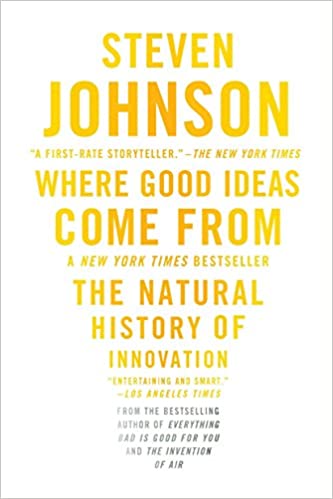
Where Good Ideas Come From: The Natural History of Innovation by Steven Johnson tracks the innovation process through history and shows what ingredients promote a creative climate. From Darwin to the World-Wide-Web we see how individuals, networks, markets, and open-source projects have forged our modern world. Anyone interested in history and/or science should add this to their bookshelf. Every school and professional development library should too.
Introduction: Reef, City, Web
- We start with Darwin discovering that coral reefs can harbor uncountable numbers of species compared to the fewer life forms found in surrounding waters. Then we visit Kleiber’s law which states that the number of heartbeats per lifetime tends to be stable from species to species. Bigger animals just take longer to use up their quota and therefore live longer. When Geoffrey West investigated whether Kleiber’s law and applied it to cities he found that as cities get bigger, creativity per capita increases. Using data like R&D budgets and patents he found that a city ten times larger than its neighbor was seventeen times more innovative and a city fifty times bigger was 130 times more innovative. This is also true for the biological diversity of coral reefs.
- Here we meet the 10/10 rule which states that it takes about ten years for a new innovation to be developed and ten more years for it to be widely accepted. Innovations like color TV, HDTV, AM radio, Video Tape players, CD and DVD players, and GPS navigation all followed that rough time lime. The same was true for the graphical user interface on computers and most software like word processors and spreadsheets. Running counter to the 10/10 rule was Youtube. It went from idea to mass market in two years creating the 1/1 rule. Like YouTube, good ideas want to connect, combine, and cross conceptual borders. They want to complete each other as much as they want to compete.
1. The Adjacent Possible
- The idea for the original baby incubator happened when someone saw how baby chicks were kept warm at a zoo. When modern incubators costing $40,000 were sent to developing counties, however, they soon broke and no one knew how to fix them. An MIT professor named Timothy Prestero got the idea of building incubators using local technology and parts. Since locals in most developing countries could repair cars, he used spare auto parts and his invention was a great success. In many ways, our good ideas are constrained by the parts and skills that surround them.
- The concept of the adjacent possible states that in a given environment there are only so many new things that can be created. In Earth’s early atmosphere, for example, the simple molecules could only create so many more complex molecules, but as they did so further expansion became possible. This fairly describes how evolution works. It also explains why big cities and reefs are more innovative as there are more adjacent possibles. Throughout history, major inventions have happened in multiple places. This is because they couldn’t happen until the parts were available. The trick to having good ideas is to get more parts on the table.
2. Liquid Networks
- A good idea is a network of novel nerve connections and they wouldn’t happen if the nerve connections in our brain weren’t plastic and capable to changing. The new idea also has to be part of the adjacent possible. Since all you have to generate ideas are your genes and your environment, this explains why some environments generate more good ideas than others.
- After explaining why life is based on the connections of the carbon atom and the necessity of water, Steven extends the ideas of why cities produce innovations. A graphic shows the key innovations that occurred prior to the rise of cities and after and there is no contest even though cities haven’t been around that long compared to humans. The Italian Renaissance is an example of how cities and trade promote innovation. The excess wealth they created also promoted the arts.
- The studies of Kevin Dunbar in the early 1990s showed that ideas are more likely to emerge during meetings than in isolation. The results of one person’s reasoning out loud can become the inputs for another person’s reasoning. When people realized this they started designing buildings that would promote more interaction between people. Total open environments don’t seem to work as people don’t like them. The current idea is to have flexible environments where people can get together (conference rooms) and where people run into each other (water coolers). It’s also good to have multiple disciplines in the same building as innovations often happen at disciplinary boundaries.
Posted in Book Summaries, Business Books, Education Books, Leadership Books | No Comments »
Monday, February 8th, 2021
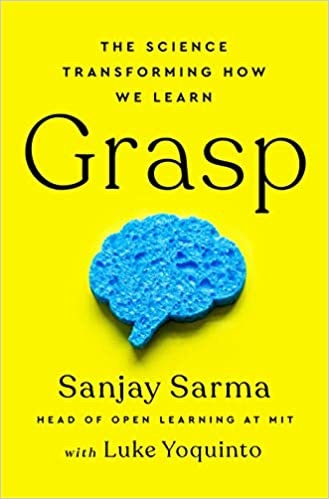
Grasp: The Science of Transforming How We Learn by Sanjay Sarma with Luke Yoquinto tells the story of teaching and learning during the last hundred plus years. They explain what works and what doesn’t. They make it clear that learning should be spaced rather than crammed at the last minute, that different concepts should be interleaved, and that the effort one uses to retrieve memories helps reinforce them. While we need to teach hard facts, we also need to let students use their hands to wield them. This book is a must-read for teachers and learners alike and would make a great textbook for any introduction to education course.
Introduction: The Adventure Begins
- The big metaphor used here is the educational winnower. From the beginning, education is designed to sort students into gifted programs and elite schools. We think we are testing aptitude when we are mainly testing a student’s environment and experiences. At the end of the trail is the opportunity to innovate, which mostly ends up in the hands of males from wealthy homes (patent-holding inventors). In addition to gender, the great winnowers include poverty, expectations, and environments that lack access to language and feature lots of stress. In our efforts to standardize education we have made it too damn hard. We need to shed the myth that serious learning must be difficult and use what we know about the brain to make it more user friendly so we can save more students from the winnowing process.
Part One: Learning Is Science and Science Is Learning
1. The Learning Divide
- Through the lens of a robotics course at MIT we learn that any education scheme worth its salt must not only deliver knowledge but do so in a way that is highly engaging. It must activate that knowledge so its owner can do real work in the world. Next Sanjoy plots the path that education took from the beginning of the twentieth century away from the holistic approach of John Dewey towards the reductionist path of Edward Thorndike. This lead to standardized education where repetition ruled based to an extent on behaviorism. IQ tests were used to sort students into tracks and if you weren’t sorted into the college track, you weren’t going to be prepared for college. Not only is this approach racist and classist, but it also conflicts with how people really learn.
2. Layer One: Slug Cells and School Bells
- It is well established that spacing out your study rather than cramming all a once leads to more retention. This is even true for invertebrates without brains. Here we encounter Eric Kandel’s work with the large neurons in sea slugs. This lead to a Nobel prize for describing the connection between memory and the action of individual neurons. Repetition creates more connections known as synaptic strength. The concept of interleaving suggests that while you are putting space between learning efforts on the same content, you should work on learning another subject. It seems that universities feature a few high-stakes tests each semester with no return to the content in subsequent semesters in many disciplines. This goes against what we know about the spacing effect. Corporations, however, seem to know better as they teach and test frequently. This is due to the fact that their employees must understand the key concepts.. It’s clear that frequent low-stakes quizzes that continually call back earlier material promote efficient learning.
Posted in Book Summaries, Education Books, Leadership Books | No Comments »
Tuesday, January 12th, 2021
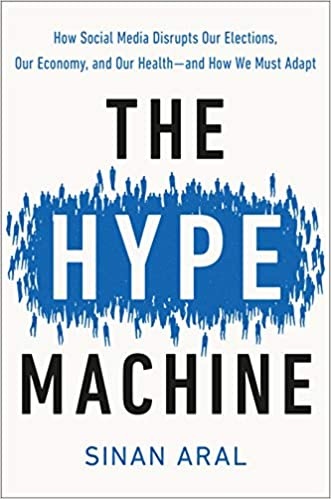
The Hype Machine: How Social Media Disrupts Our Elections, Our Economy, and Our Health and How We Must Adapt by Sinan Aral takes an in-depth look at the impact that social media has had on our society. He covers the positive and negative aspects and offers advice for how scientists, industrial leaders, and policymakers can collaborate to clean up issues associated with things like fake news, election tampering, and free speech. This is a book that every consumer of modern media needs to read so click here to get your copy now.
Preface: Pandemics, Promise, and Peril
- Sinan’s Hype Machine is the real-time communications ecosystem created by social media. We start by seeing how COIVD pushed billions of more people to laptops and smartphones as many digital Luddites were forced on to various online platforms. Even routine users found themselves using it more and young people who were given limited screen time by parents prior to COVID started spending the entire school day online. People responded by organizing Zoom meetings to brainstorm problems old and new. As automated “bot” software along with cyborg and troll networks spread misinformation about things like COVID and elections, others got to work to fight these new digital enemies. As we have seen there is potential for great promise and peril. This book takes a look at both and offers suggestions for how we can make the most of the Hype Machine.
1. The New Social Age
- Humans have always been social animals. The Hype Machine has simply poured gas on our campfires. It is designed to inform, persuade, entertain, and manipulate us. It learns from our choices and location to improve its persuasive leverage. The motivation of course is money. It can rightly be considered the social media industrial complex
- We start with the story of how Russia used social media as a key part of their armed takeover of Crimea in 2014. Every time a pro-Ukrainian message was posted it was swarmed by messages from Russian bots and subsequently taken down. Most people were left with the idea that the people of Crimea wanted to be part of Russia.
- During his PhD work, Sinan realized that statistics required observations to be independent while modern networking made everything interdependent. His epiphany at the time was that digital social networking was going to turbocharge how information, behavior, economic opportunity, and political ideology flowed between people. His thesis was on how information flows through digital social networks and as he now evaluates hundreds of companies each year, he gets to see what is coming. He knows that we don’t know enough and advocating for more research is a theme of this book.
2. The End of Reality
- Fake news isn’t new, but the speed at which it can spread can cause real consequences. Rumors of gas shortages and a shooting at the White house caused long gas lines and a brief stock market crash. Some put out positive fake news about stocks they own and sell when the price goes up (pump and dump). We know that Russia made an effort to impact the 2016 election using the Hype Machine, but we don’t know the impact that effort had. Using social media in an effort to impact elections is a global problem.
- Another area where fake news distributed by social media has had an impact is the world of vaccines. Anti-vaxers have used it and caused some communities to decrease vaccination percents below the point where they offer heard immunity. This has caused an increase in cases of measles, a disease that the US declared conquered in 2000. Another problem is that several studies show that false news spreads faster than real news. Political false news travels faster than any other category.
- Social bots are software controlled social media profiles. They pounce on fake news and retweet it broadly. Real people then pick it up and do most of the spreading. They often mention influential humans who can give them a greater reach. Novelty attracts attention (the novelty hypotheses) and as a result, false news is more novel. Big repetition causes belief. (Doug: This is something that Hitler took advantage of.) People also believe what they already think (confirmation bias) so when you try to convince them that what they believe is false they tend to dig in even harder. Since fake news attracts more readers it makes more money by posting Google ads. This makes it a big business. Generative adversarial networks (GANs) pit two neural networks against each other. One learns from the other’s decisions and optimizes its efforts to fool the other. They can also be used for good. Deepfaked audio can allow one person to sound like another, which has been used to defraud companies.
3. The Hype Machine
- The Hype Machine is an information processor regulating and directing the flow of information in society. It is comprised of the network itself, the interaction between people and machine intelligence, and the input/output device, which is most commonly the smartphone. In addition to these three components, there are the four levers of Money, Code, Norms, and Law. Networks learn about us by looking at who we are connected to, what we read, and what we buy. People tend to cluster and similar people connect. This causes echo chambers that spread fake news. If one person has strong connections to two others, the others are likely to have at least a weak connection. The small-world phenomenon also shows up in social media as the average distance between any two people is about 4.7 degrees, not six.
- Sinan describes what he calls the Hype Loop. It starts with machine algorithms sensing who we are by what we say, what we consume, and what we do. It then offers suggestions for things like who to friend and what to buy. We then consume content based on the suggestions and finally, we take action such as making a purchase, sharing content with others, or voting.
- Connections via social media platforms are much more likely to happen via suggestions offered by algorithms than by people searching. This may also contribute to political polarization as similar people get connected faster. Algorithms also recommend the content we consume. Facebook is now the largest news outlet. Its goal is to attract more likes and more viewership. Some things are best done by the machine. Spam filters and newsfeed ranking are examples. More reflective people tend to want their news recommended for them. Since our smartphones are always with us the Hype Machine is constantly learning about us. Apps constantly share data with five to ten other apps. The next big thing is likely to be the brain-computer interface so we can control things with our thoughts. Think of using your “brain mouse” to click on something you see in an augmented reality space.
Posted in Book Summaries, Business Books, Education Books, Leadership Books | No Comments »
Monday, December 7th, 2020
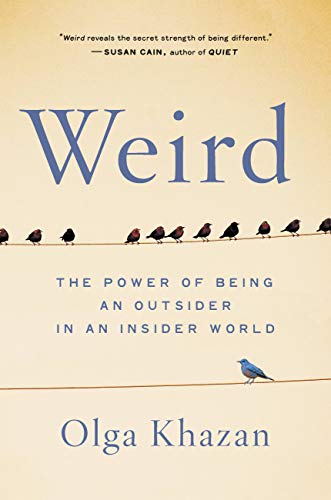
Weird: The Power of Being an Outsider in an Insider World by Olga Khazan is for anyone who has felt like they were different from typical people in their culture. Since we are all unique, we probably all feel different or weird from time to time. There are a number of research-based coping methods here that just about anyone can use. While this book is aimed at the general public, it is especially good for anyone doing counseling.
Part One: Being Weird
1. Weird
- Olga was a Russian Jewish immigrant who grew up in West Texas. The rest of the people in her town were either white evangelical Christians or immigrants from Mexico. Since Russian Jews were forced to be atheists, they don’t even fit in with American jews. Her feeling of weirdness was also fostered by the fact that her parents moved a lot and always to different school districts. At home, her parents watched only Russian television and ate only Russian food. She attended American University in Washington, D.C., which didn’t help her feel any less weird. After interviews with over three dozen successful “weird” people, she concluded that it can be good to be weird as it confers a hidden advantage. It also behooves you to live and work among weirdos. Groups are smarter and more powerful when their members hold a diversity of views and backgrounds.
2. The Realization
- Cultural norms are unwritten rules that make us think that “right” is what everyone else is doing. There is even a gene that predisposes people to be rule followers. People like it when others follow norms as they don’t like being surprised. Norms are inherently conservative and can get in the way of innovation and creativity. They also may not make sense, think neckties. Olga presents a review of how swimwear reveals the randomness of social norms.
- Next, we have short stories of two “weirdos.” The first is a gay male kindergarten/preschool supervisor. Only 2% of kindergarten teachers are men and a female NASCAR driver who represents a microscopic fraction of the total. Their problems aren’t the same, but they both have many more challenges to face than their peers.
- Friends are for comfort, taking it easy, relaxing, and not being challenged. By hanging out with people who are just like you, you can be out of touch with the big, beautiful, diverse world. Unfortunately, it’s difficult to find acceptance and friendship in an environment where you are the different one.
- Cultures can be tight or loose. In tight cultures, norms are strict and formal, and the punishments for breaking them can be severe. Loose cultures permit a wider range of behaviors. Weird people have an easier time in loose cultures. Tight countries like Russia are autocratic and have less free media. As you go from tight to loose cultures you go from orderliness to creativity. Rural cultures tend to be tight while urban cultures tend to be loose. The LGBTQ folks definitely need to find a loose culture to live in. People who travel between tight and loose cultures in either direction tend to be disoriented and feel weird. The stories of three more weirdos conclude this chapter.
3. The Exclusion
- Once humans formed groups intergroup conflict was sure to start. Rather than being inborn, prejudice is a reflection of the dynamics between groups. In our hunter-gather days, social relationships were the only wealth a person had. That predisposed them to take care of other group members. Successful groups look out for each other. Rulers, money, and organized religion created subgroups and pitted them against each other. Groups are based on their differences even when they are laughably minor (think protestants and Catholics in Northern Ireland). The idea that diversity can be a source of strength and advantage is a relatively recent concept.
- When it comes to differences, gender is a big one. Historically, women have had to put their own interests after their mate’s. They needed to take their cues from their husband’s mood in order to prosper. We can thank our brains for our ability to recognize differences as it seems to be automatic. The brain also stores stereotypes. Our instincts set us up to avoid or alienate people who don’t look like us. One outsider is a deviant. As the number grows they become a threat and cause a fear of losing status. Americans are more accepting of immigrants who speak English, while the Swiss are more accepting of people who get to work on time.
- People who have a problem with someone from a different group tend to generalize the issue to the entire group. Peripheral group members tend to marginalize someone else as pushing someone weirder to the side can make you feel normal. People who are more offended by norm violators are not likely to think outside of the box and be more creative. As a result, looser cultures are more creative. They are also sick less. Tight nations have fewer natural resources, worse air and water, more deaths from communicable diseases, and more natural disasters. Such collective threats foster tightness. Stories here include an Amish girl and an African Muslim immigrant girl.
Posted in Book Summaries, Business Books, Leadership Books | No Comments »
Saturday, October 31st, 2020
The Educator And The Oligarch: A Teacher Challenges The Gates Foundation by Anthony Cody shows how the Gates Foundations’ efforts to reform education have had a mostly negative impact. By spending a small fraction of the total education budget, people like Gates can buy politicians, muzzle the media, and control many special interest groups and non-profit organizations with grant money aimed at advancing their agenda. Please purchase this book and spread the word. (Note: Like every other book summarized here, this one was written prior to the COVID-19 pandemic.)
Preface and Introduction
- The thrust of this book is that something is seriously wrong with our system when one of the richest men in the world can spend a few billion dollars and seize the reins of education policy. By funding almost everyone who does advocacy, including teacher unions, Gates can call the tune. The tune is Common Core and associated tests that are designed to yield wide-spread failure. Like tobacco companies in the 1960s, their sponsored research tells them what they want to hear. This undermines the public’s democratic control of education and devalues the teaching profession. There is nothing generous in using the power of wealth this way.
- Unlike previous grant efforts by wealthy foundations, the Gates Foundation’s approach was different. Their starting point was “we know what is broken and we know how to fix it.” They invite proposals by directly contacting organizations. They then collaborate with the organizations to develop proposals that align with their agenda. With their vast wealth, an entire sector of organizations became dependent on their funds.
Part I: The Assault on Public Education by Bill Gates
1. Bill Gates’ Big Play: How Much Can Money Buy in Education?
- Gate’s vision starts will the total reliance on standardized tests that were already required by federal law (NCLB). These tests were flawed and NCLB was bound to fail so it was necessary to develop a new generation of tests based on new standards known as the Common Core. It also helped to get staff from the Gate’s Foundation transferred to the Federal Department of Education. Gates held that the field of education didn’t know much about teaching. He started by funding research that defined effectiveness as high test scores. This means that teachers get paid for these results. Next, he donated to advocacy groups to the extent that he became their largest donor. The final step was to donate to the media’s efforts to cover education.
2. Circular Reasoning at the Gates: Education Nation Off to a Confusing Start
- Here are excerpts from a Teacher Town Hall from 2011 on NBC moderated by Brian Williams. He tells the audience that they will be using facts provided by the Gates Foundation as they are the largest single funder of education in the world. (Doug: I think the US government is the largest single funder.) On this show, Melinda Gates claims that there are multiple measures that they are using along with test scores such as administrator and peer observations along with student questionnaires. But, the only models of these other measures that she wants to use are those that improve test scores. Here the author suggests that many of the strategies used to boost scores are harmful to our students.
3. Teachers Face Good Cops or Bad Cops in Push for Evaluations
- The bad cop is the New York Post, which published the names of teachers with the worst scores. The good cops are Bill Gates and Michelle Ree who said this is wrong and that multiple measures should be used in addition to tests. Their other measures, as we have seen, are correlated to test scores. These good cops also push value-added ratings (VAR), which research has shown to be highly unstable for individual teachers. Translation: VARs are garbage and should never be used as part of a teacher rating system. There is also the false assumption that there are a significant number of crummy teachers who need to be weeded out. (Doug: From what I’ve seen as an educator since 1969, crummy teachers weed themselves out as being a bad teacher really sucks.) As it stands, 50% of teachers leave the profession within five years and turnover rates in high-poverty schools are 20% each year.
4. Cui Bono? The Question Rarely Asked, Let Alone Investigated
- Cui bono means who benefits. Journalists should be asking this question, but they don’t seem to be doing so. They are, however, repeating false ideas that the reformers put forward such as our public schools are failing due to the ineffective teachers that need to be fired. They also tout the success of charter schools, which overall is not the case. The winners here are the testing companies, curriculum designers and publishers, consultants, technology and software companies, and various leadership organizations.
5. Bill Gates Discovers Money Cannot Buy Teachers
- The main idea here is that people, in general, can sense when they are being manipulated and coerced. When this happens they resent it and resist. Here we are talking specifically about teachers. They aren’t opposed to being evaluated based on student work such as portfolios, but they resist being evaluated by invalid standardized tests that are closely correlated with the socioeconomic background of their students. Teachers, therefore, are justified in being ungrateful for all the money Gates has poured into education to remake it in his own image.
6. Bill Gates Goes to College. Has He Learned From His k12 Project?
- Gates is also determined to change higher education with a focus on tests that measure specific skills that employers want. His focus is also on online courses, which have been shown to be less effective for all save the brightest. (Doug: We are seeing that now as well with remote learning) The approach sends the message that education is only for job preparation, which the author rejects. Blended learning, which offers a mix of online and in-person instruction appears to be effective, but 100% online doe not appear to be.
7. Is ASCD Embracing Market-Driven Education Reform?
- Organizations like ASCD are being directly paid to support the implementation of Common Core, which converts them into advocates for the controversial standards. Along with it comes “market-driven” systems, which feature a push for charter schools, private schools, and vouchers at the expense of public schools. In 2011, the Gates Foundation awarded ASCD a grant of $3 million to help implement the Common Core. If you just read ASCD’s journal you wouldn’t know that the Common Core is controversial.
8. Is Gate’s Money Going to Influence the National Board?
- While Gates claims that teachers participated in the creation of the Common Core Standards they were not involved. He also tries to convince us that since the schools can create the curriculum, teachers can still teach as they wish. He negates this when he says that he will know that his efforts have succeeded when the curriculum and the tests align with the standards. He pushes for control of schools by mayors as when just one person is in charge, change can be made more efficiently. It also means that he only has one person he needs to influence or buy off. Note that cities, where mayors are in charge, have fared worse. Other organizations know that if they want his money they have to sing this tune.
9. Gates and Duncan Seek to Use Trust in Teachers to Promote Common Core.
- If Gates and the Department of Education under Duncan (appointed by Obama) trusted teachers, they would not have had Common Core standards drafted by test makers instead of educators. They would not have created the pseudoscience of VAM to try to hunt down bad teachers. If leadership organizations were true leaders, they would not have allowed themselves to be co-opted and bought off. Gates seems to operate by bad analogies. One mentioned here is “standardization is important to allow for innovation… like the standardized outlets we have in our houses.” He sees innovation as the domain of the creators of mass-produced tools and the teachers as consumers. He accuses teachers of not knowing much about effective teaching, which is why he came up with the Common Core and its testing to define excellence.
Posted in Book Summaries, Business Books, Education Books, Leadership Books | No Comments »