Archive for the ‘Leadership Books’ Category
Monday, April 13th, 2020
The Knowledge GAP: The Hidden Cause of America’s Broken Education System and How to Fix It by Natalie Wexler confronts the difference between content-rich and skills-based ELA curricula and makes a strong case for the former. She argues that students need a strong knowledge base in their long-term memories in order to comprehend complex text and to think critically. They also need systematic phonics instruction to learn how to decode words as they gain knowledge beyond their personal sphere. She sees a shift away from a focus on skills and leveled readers slowly taking place.
Part One – The Way We Teach Now: All You Need Is Skills – 1. The Water They’ve Been Swimming In
- The main point here is that all over the country, the focus in elementary schools is on teaching reading skills using texts that shun any meaningful history or science content. Math is also given a lot of attention as it is the other subject that shows up on federally mandated tests and test prep takes up a significant amount of time in most schools. Meanwhile, the achievement gap, which is really a test-gap, has not budged in twenty-five years. History and science are shunned in the early grades as they are widely considered to be not developmentally appropriate.
2. A Problem Hiding in Plain Sight
- An experiment from 1987 demonstrates the importance of prior knowledge when it comes to comprehension. It involved presenting students with texts that involved the play by play of a baseball game. It showed that bad readers who knew a lot about baseball outperformed good readers who didn’t. The idea is that real knowledge from social studies and science should be embedded in all reading lessons. This implies that the gaps we see on tests are more likely to be knowledge gaps than skills gaps.
- History is a series of stories and kids love stories. The same is true for science topics. It’s ironic that abstract concepts like captions and symbols are considered appropriate for six-year-olds while information from history, science, and the arts are not. Teaching disconnected comprehension skills boosts neither comprehension nor reading scores. They are analogous to empty calories.
Next Natalie explains why poor kids don’t generally do as well in school. At home, they are exposed to less conversation and less complex vocabulary. They also engage in less turn-taking conversation and debate with parents. Parents read more to them and introduce them to more knowledge about the real world. This knowledge gap only widens over time as students who start out with more learn more. By using texts light in knowledge to teach skills, schools are the problem handing in plain sight. You can’t think critically if you don’t have a knowledge base to think with. Students also need to write about what they are learning.
3. Everything Was Surprising and Novel
- The focus here is on the work of Daniel Willingham. The two basic components of reading are decoding and comprehension. They are treated as one subject, but factors leading to success in each are fundamentally different. Instruction in phonics can teach decoding. As for comprehension, it depends on how much vocabulary and background knowledge the student has. It can be achieved naturally if you have enough information. Relying on teaching strategies to teach comprehension can explain the disastrous results we have seen. Teaching content is teaching reading. Reading tests are really knowledge tests in disguise as they draw on it to assess comprehension.
- Much of the problem can be laid at the feet of the schools of education. They spend little or no time on practicalities like classroom management. They seem to think that the more removed they are from ordinary concerns the more prestige they will garner. They aren’t big on exposing students to the findings of science. Most are also responsible for teaching that you should use strategies and skills for teaching comprehension and not using them much to teach decoding.
- Another reason some avoid testing content is that anything can be easily looked up on the Internet. What they miss is if you have to spend an inordinate amount of time looking things up, you will interrupt the flow of understanding that comprehension depends on. Retrieving information from long-term memory serves to reinforce it. You also might look up the wrong meaning of a word with multiple definitions.
4. The Reading Wars
- Here we get some history regarding Rudolph Flesch’s 1950’s studies and his conclusion that the systematic teaching of phonics was necessary to help students learn how to decode text. His book Why Johnny Can’t Read was a big sensation. This was the beginning of the Reading Wars. On the other side was the “whole language” movement. This turned somewhat political as teaching whole words was considered progressive and was largely adopted by the left who didn’t trust academics has they had never taught in an elementary classroom. Unfortunately, the Reading Wars aren’t over, they have only gone underground.
- What Flesch and his opponents missed was that unless you build knowledge and vocabulary, the ability to decode or recognize whole words wouldn’t count for much. Large adoptions of whole language programs largely failed. A phonics-based program called Reading First showed promise, but congress defunded it in 2008. It also treated reading as a self-contained subject, which leads to a decrease in subjects that could build knowledge and vocabulary. It’s also hard to change the beliefs of teachers when you don’t explain the underlying ideas.
Posted in Book Summaries, Education Books, Leadership Books | 1 Comment »
Monday, April 6th, 2020
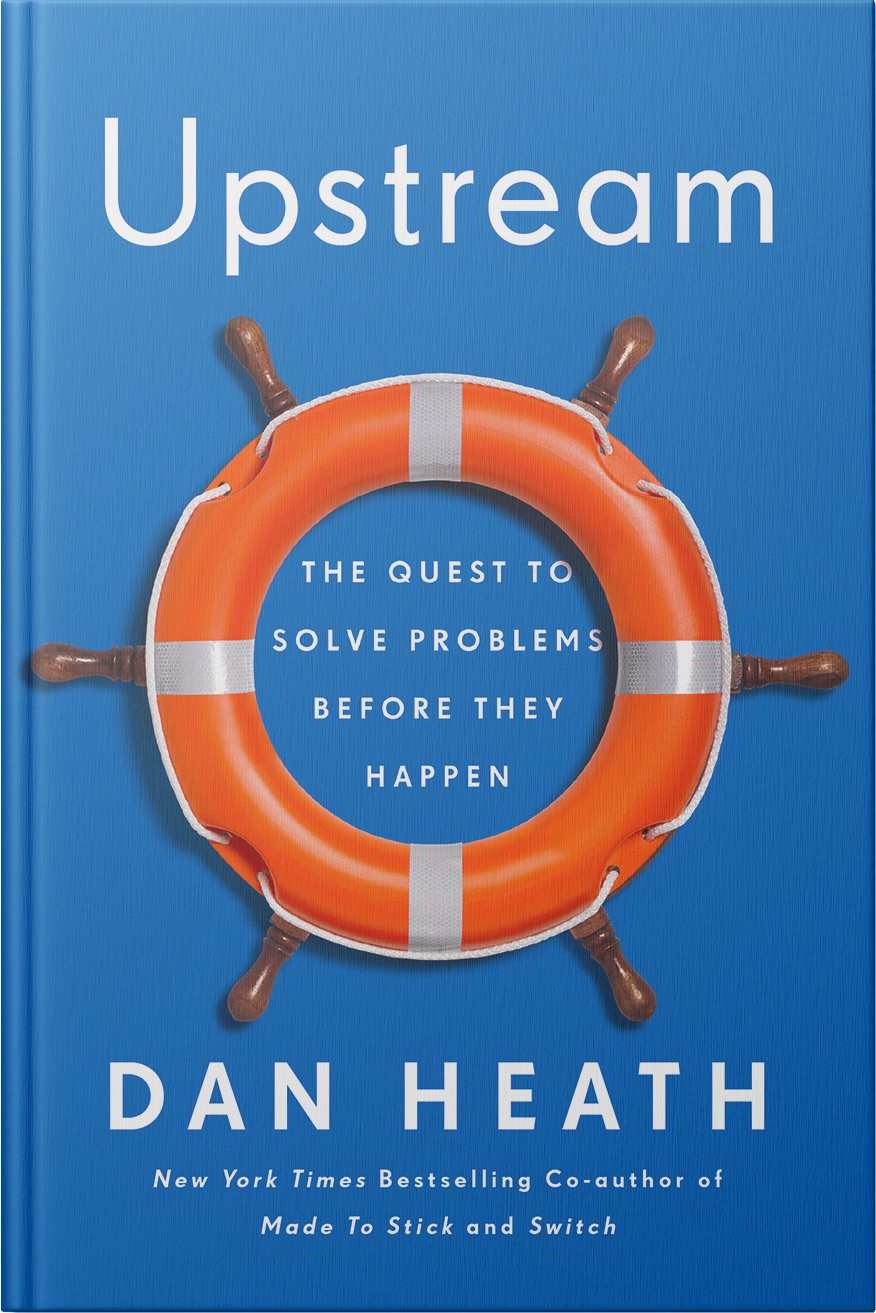
Upstream: How to Solve Problems Before They Happen by Dan Heath deals with the notion of preventing problems before they happen rather than being stuck with constantly fixing things after they break. He discusses barriers to Upstream thinking and offers questions Upstream leaders need to address. Whether you are a leader in your organization or just an ordinary individual trying to reduce stress and live a happier life, this book is a must.
1. Moving Upstream
- The book starts with a parable about two men rescuing drowning children who one after another come past them in a river. When one man stops the effort to head Upstream his friend asks what he is doing. The man says that he is going Upstream to tackle the man who is throwing the kids into the river. The key point is that Upstream efforts are aimed at preventing problems while Downstream efforts react to problems once they’ve occurred.
- An example is Expedia’s 58% call support rate. When they looked at the problem they found that none of their teams were judged on this number. Once they looked at the reasons for the calls it was easy to lower the rate to 15%. Another example compares one police officer who stands on the corner causing people to slow down and preventing accidents to another who hides and gives out tickets. Dan sees health care as one area where the US needs to shift to more Upstream efforts as other developed countries have done. The general goal in this book, therefore, is that we should all shift more of our energies Upstream.
Section 1 – The Three Barriers to Upstream Thinking
2. Problem Blindness
- Problem blindness happens when we believe that negative outcomes are natural and unavoidable. A successful example of fighting this problem happened in the Chicago Public Schools where the graduation rate in 1998 was 53%. They found that the key to graduation was a successful freshman year and a program to attack this problem was put in place. It involved teachers getting to know individual students better, giving more support, and collaborating with each other to help students in need. By 2018 the graduation rate had risen to 78%.
- Sometimes we miss problems because we focus on one thing and miss a problem in our peripheral vision. In the 1960s and 1970s, sexual harassment had been normalized in the workplace to the extent that women were encouraged to embrace it. In 1975 a journalist coined the term sexual harassment. Now that the problem had a name demanding a solution was an implied obligation.
- Another example relates to the extensive use of C-sections for child delivery in Brazil. They increased as they were convenient since they could be scheduled and they resulted in more money for the doctors. They also resulted in more babies ending up in intensive care as they were born sooner than necessary. Thanks to one woman and one doctor who saw the problem and took action, the C-section percentage is now coming way down.
3. A Lack of Ownership
- An example of this issue goes back to the Chicago Public Schools with its dismal graduation rate. It got that way because the adults saw it as the kids’ problem. It was greatly improved when the adults decided to make it their problem. There is a story here about a man who owned a carpet business. When he read about our environmental problems he decided to see what he could do. He motivated everyone in the company to look for ways to do things like recycling old carpets. When a doctor in Tennessee found out that more kids died inside cars than outside cars he went to work in 1976 on legislation requiring car seats for kids. By 1985 all 50 states had car seat laws. In short, upstream work is generally chosen rather than demanded. If you find yourself saying “it’s not my problem,” you are likely living downstream.
4. Tunneling
- When you are reacting to problems it can be like you are in a tunnel just digging forward. You don’t have time to step back and take a system-wide look at why the problem exists. Such time would be slack time and it is smart to build slack time for system thinking into your schedule. Poverty tends to cause more tunneling as it reduces bandwidth and causes stress. People who aren’t poor can solve some of their problems with money, which leaves more resources for the problems that money can’t solve. Dan gives examples of situations where tunneling gets in the way of upstream problem-solving.
Posted in Book Summaries, Business Books, Education Books, Leadership Books | No Comments »
Monday, March 16th, 2020
Slaying Goliath: The Passionate Resistance to Privatization and the Fight to Save America’s Public Schools by Diane Ravitch tells the story of how wealthy people like Bill Gates and the Koch brothers aided by politicians and the media have disrupted public schools in an effort to privatize K-12 education. She does an excellent job of showing how their efforts have been seriously misguided and how they have damaged public schools, teachers, and students. She also shows how the underfunded opposition has had a number of victories in their efforts to fight back. If you want ammunition for the fight against charter schools, vouchers, and standardized tests, look no further.
1. Disruption Is Not Reform!
- In this book Diane documents the failures of what she calls “Corporate Disruption.” This refers to the reforms backed by conservative and liberal wealthy people and adopted by conservative and liberal politicians. At the heart of the programs are high-stakes standardized tests that have been used to evaluate schools and teachers. They have served to demoralize students and teachers, and have resulted in teacher shortages as many teachers leave and fewer desire to enter the profession.
- Ravitch and many others are convinced that the real problems are poverty and racial segregation rather than failing schools and teachers. Teacher autonomy and creativity have been reduced as they spend abundant time engaging in test preparation. Since the tests only deal with ELA and math, other subjects including recess have been reduced in many schools.
2. The Odious Status Quo
- It seems that a lot of wealthy people want to reinvent education in spite of their lack of expertise. As such they use their philanthropy to control others under the guise of helping. That’s how we get things like kids too young to read in front of computer screens. Meanwhile, things like the cultivation of character are often ignored. When one looks at the data one can see that the crisis in education was a manufactured one. Here Diane summarizes the history of the reform movement. This includes NCLB with it’s patently absurd goal of having all students be proficient.
- The NCLB reform brought the fear of punishment, failure, and losing one’s job into our nation’s classrooms. The so-called remedies had no prior evidence of success. The law was insanely punitive and without a global president. Schools cut back on civics, science, the arts, PE, and recess. Obama’s Race to the Top basically bribed states to adopt the untested Common Core, add more charter schools, and use test scores to evaluate teachers. This was essentially an unconstitutional take over by the federal government. Unfortunately, this mess was also bipartisan.
3. What Do the Disrupters Want?
- They like mayoral control of schools as there is only one person to manipulate. They don’t like teachers’ pensions, which encourage longevity. They like to demonize public schools as failing. They admire disruptive innovations because that is what happens in business. Why would you want to disrupt the lives of our children? They like machine teaching, which they call blended or personalized learning. What they don’t want is any disruption of their private clubs or the exclusive schools that their kids attend.
- Who are they? They are governmental officials like the Secretary of Education regardless of the party. Governors are also included. They are philanthropists with their foundations like Bill Gates, the Walton family, Michael Bloomberg, and the Koch brothers among others. They are hedge fund managers who believe in competition and the free market. They like start-ups (i.e. charter schools) and they don’t like government regulations. There are organizations that sound like they should pro-student, but are largely funded by rich folks. Journalists are also part of the problem as they often carry water for this crowd. (e.g. editorial writers for The New York Times and The Washington Post.)
4. Meet the Resistance
- Resisters have some genuine connection to education such as teachers, administrators, students, and their families. They believe that public schools are a foundation stone or a democratic society. They oppose the privatization of public schools and the misuse of standardized tests. They respect teachers and want public schools to have the resources they need. They want to cultivate a joy of learning. They understand that students’ lives are heavily impacted by conditions they face outside of school. The few foundations that support the resistance are lead by the Schott Foundation for Public Education.
- They are winning because everything the Disruptors have imposed has failed. They are highly motivated and not powered by money. They understand that competition produces few winners and many losers. They are supported by a number of prominent scholars who are listed along with their works. Many resisters like myself have blogs that constantly fight back.
Posted in Book Summaries, Education Books, Leadership Books | No Comments »
Monday, January 6th, 2020
Teach Like Finland: 33 Simple Strategies for Joyful Classrooms by Timothy D. Walker tells the story of an American teacher who moved to Finland with his Finnish wife and got a job teaching in a Finnish school. Although he realizes that there are many constraints that prevent American schools from being like Finnish schools, he does think that we can borrow a great deal from the way Finnish teachers operate. All school leaders should get a copy and consider making copies available to their teaching staff.
Forward by Pasi Sahlberg
- You can read my summary of Pasi’s Finnish Lessons here.
- When the first PISA scores were released in 2001, to everyone’s surprise, Finland came in first. There was also less variation between schools and less influence from family backgrounds. Spending was modest. Students start at age seven, schools address all subjects evenly, there are no private schools, students aren’t segregated by their ability, and they believe anyone can learn most of the expected things with sufficient support. Teachers must have a research-based masters and a full-year internship, and about half of all students get some special education support as soon as they need it.
- Principals are certified teachers and do some teaching. After school, there are many associations and clubs that allow almost all students to engage in sports, arts, and/or cultural activities. While it is impossible to transfer education systems from one place to the other, Tim shows how you can use principles found in Finnish schools to improve the quality of education in your school.
Introduction
- As a first-year teacher in Massachusettes, Tim was so burned out that he took a month-long leave in February. After three years of teaching, he moved to Helsinki with his Finnish wife and landed a job teaching in an English speaking fifth grade. In addition to teaching there for two years, he also visited other schools and interviewed many other teachers. He believes that American teachers can and should put Joy first in their classrooms. To organize this book he starts with Raj Raghunathan’s four ingredients of happiness, which are belonging, autonomy, mastery, and mindset. To these, he adds well-being.
1. Well-Being
- Schedule Brain Breaks: When Tim started teaching in Finland he shunned the 15-minute breaks every forty fine minutes employed by other teachers. He soon noticed that his students became zombie-like after a while. When he did start with breaks he noticed that students were much more focused. Refreshing one’s brain leads to greater productivity and creativity. Students should have a choice of what to do during breaks. Look for enjoyment, novelty, and independence. Classrooms also should have “calm spots.”
- Learn On the Move: Until recently, Finland, like the US, got a D for physical activity levels. This prompted the introduction of a program called “Finland on the Move.” They realized that students weren’t getting enough exercise so they added more movement during breaks and during class time. Older students act as exercise facilitators for younger students. Playground gear is checked out to each student. Calisthenics breaks happen during class. Standing desks and exercise balls as seats are being added to classrooms. Students post work in class or hallways and then walk around leaving questions and praise on other students’ work with sticky notes.
- Recharge After School: Finish teachers know the importance of recharging after work. They engage in activities that are not related to their school work. It helps that their teaching load of about 18 hours a week is much less than the 26.8 US schools average. Unlike many US teachers, they don’t equate success with how many hours they work. Rather than encourage teachers to stay late like some US schools, principals will say things like “shouldn’t you be home by now.” This greatly lessens stress and anxiety. Finnish teachers do give homework, but it consists of simple tasks which can be completed over several days without parental help.
- Simplify the Space: Unlike many US classrooms that feature walls cluttered with teacher displays and student work, classrooms in Finland are relatively simple. Studies show that cluttered walls distract student attention and interfere with learning. By putting only a few things on the walls they will get more attention. Posting quality student work is fine, but it need not stay up too long. Not having to constantly decorate also gives teachers more time for other uses.
- Breathe Fresh Air: Classrooms full of students can also have increased levels of carbon dioxide, which can negatively impact learning. For this reason, opening windows from time to time is part of the Finnish philosophy. They also get students outdoors even when it’s raining and at temperatures as low as 5 degrees F (-15 C). Classroom temperatures should be between 68 and 74 F and they should feature as much natural lighting as possible.
- Get Into the Wild: Howard Gardner the creator of multiple intelligence theory has added an eighth intelligence he calls naturalist intelligence. Finnish teachers get their students into nature as much as possible be it on the school grounds or via a field trip. On the school grounds, you can observe and record nature. You can also grow things and add bird feeders. Be sure to bring nature into your classroom where you can also grow plants and some small animals like frogs.
- Keep the Peace: Peaceful classrooms make for better learning. At times the room will be quiet as students work independently. At other times students will collaborate. Sometimes both may be happening with the collaborators off in a corner. Students work to make class rules with a focus on respect and three rules is a good number. Then they make anchor sheets, which show the kind of behaviors that promote the rules. Students take charge of a “noise detector” so they feel responsible for keeping the peace. Meditative-like mindfulness activities help settle students down after periods of physical activity.
Posted in Book Summaries, Education Books, Leadership Books | No Comments »
Monday, November 11th, 2019
Innovate Inside the Box: Empowering Learners Through UDL and the Innovator’s Mindset by George Couros with Katie Novak builds on his previous book The Innovator’s Midset. The goal of this book is to help teachers grow so they are more likely to make a difference in their students’ lives. Constraints like red tape, limitations, and lack of funds comprise “The Box” in the title. Innovating in spite of those constraints involves finding another way around problems that limit the impact teachers have on their students.
Introduction: Because a Teacher
- Most of us can remember one or more teachers who made a significant positive difference in our lives. Perhaps other adults have done the same. A goal of this book is to help teachers grow so they are more likely to be that kind of difference-maker. Constraints like red tape, limitations, and lack of funds comprise “The Box” in the title. Innovating in spite of those constraints involves finding another way around problems that limit the impact teachers have on their students.
Part One – The Core of Innovative Teaching and Learning
- 1. Relationships: Research shows that students perform better when teachers prioritize relationship building. Increased social capital leads to higher test scores. Since collaboration builds social capital it also raises scores. This means that relationships between adults are important too. It seems we learn more from someone with whom we have a positive connection.
- Tips for relationship building include: Greeting kids at the door, playing music as they enter, making first interactions positive, calling parents early, flexible planning, allowing students to design the classroom, tapping into to each student’s passion, encouraging students to ask questions to keep them curious, and loving them. Studies with dropouts show that they usually weren’t connected with anyone at school. If a student arrives late just say “I’m glad you are here.”
- 2. Learner-Driven, Evidence-Informed: Learner-driven means that students have a voice in setting learning goals. Evidence-informed means that teachers go beyond grades when they give students feedback. You should be driven by students, not data. Students get lost in the process when teachers are driven by test scores. Beyond grades, evidence can include portfolios, self-assessments, performances, and anything that highlights learning and growth.
- Most of what employers look for cannot be graded. That includes creativity, initiative, critical thinking, and complex problem-solving. Grades can even deter learning. George suggests that you give students feedback without grades. When students are invested in their own goals, they will go beyond the goals the teacher sets for them. Focus on students’ strengths first. If they see weakness as they use their strengths they will be more motivated to work on it.
- 3. Creating Empowered Learning Experiences: Empowerment is about helping students figure out what they can do for themselves. Rather than listening, reading, observing, and consuming they should spend more time speaking, writing, interacting, and creating. Student choice is big here. If students have a voice in what they learn and how they demonstrate that they have learned they will be more motivated. They should be doing writing blogs, video scripts, and podcasts.
- The next big idea is to have students generate questions rather than just give the right answers. The best questions might be those that the teacher can’t answer. We also note that curiosity improves intelligence as it drives the acquisition of knowledge. In essence, our goal is to create self-directed learners. George tells of how he created a student IT department at his school and how another teacher had students be responsible for all aspects of running the school store. In essence, students are the most underused resource in our schools.
- 4. Master Learner, Master Educator: In addition to continuously learning, teachers need to make sure that students know they are learning. For example, if you want students to curate digital portfolios, you should first make one yourself and let them see it. This is learning for your students. Learning about your students should, however, be your first priority. Start with the student who gives you the most trouble and spend time every day in personal conversation. That should improve that student’s behavior, which can improve the entire class.
- Rather than planning every step of the way be ready to adapt. Be sure to tell students to “figure it out” rather than telling them the answers. Students should be finding resources on their own and experiencing the power of teaching the teacher. The teacher and the class are smarter than the teacher alone.
Posted in Book Summaries, Education Books, Leadership Books | No Comments »