Archive for the ‘Book Summaries’ Category
Monday, November 11th, 2019
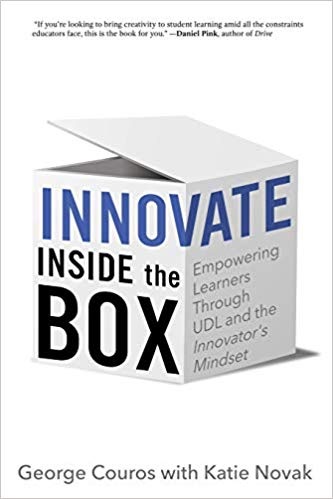
Innovate Inside the Box: Empowering Learners Through UDL and the Innovator’s Mindset by George Couros with Katie Novak builds on his previous book The Innovator’s Midset. The goal of this book is to help teachers grow so they are more likely to make a difference in their students’ lives. Constraints like red tape, limitations, and lack of funds comprise “The Box” in the title. Innovating in spite of those constraints involves finding another way around problems that limit the impact teachers have on their students.
Introduction: Because a Teacher
- Most of us can remember one or more teachers who made a significant positive difference in our lives. Perhaps other adults have done the same. A goal of this book is to help teachers grow so they are more likely to be that kind of difference-maker. Constraints like red tape, limitations, and lack of funds comprise “The Box” in the title. Innovating in spite of those constraints involves finding another way around problems that limit the impact teachers have on their students.
Part One – The Core of Innovative Teaching and Learning
- 1. Relationships: Research shows that students perform better when teachers prioritize relationship building. Increased social capital leads to higher test scores. Since collaboration builds social capital it also raises scores. This means that relationships between adults are important too. It seems we learn more from someone with whom we have a positive connection.
- Tips for relationship building include: Greeting kids at the door, playing music as they enter, making first interactions positive, calling parents early, flexible planning, allowing students to design the classroom, tapping into to each student’s passion, encouraging students to ask questions to keep them curious, and loving them. Studies with dropouts show that they usually weren’t connected with anyone at school. If a student arrives late just say “I’m glad you are here.”
- 2. Learner-Driven, Evidence-Informed: Learner-driven means that students have a voice in setting learning goals. Evidence-informed means that teachers go beyond grades when they give students feedback. You should be driven by students, not data. Students get lost in the process when teachers are driven by test scores. Beyond grades, evidence can include portfolios, self-assessments, performances, and anything that highlights learning and growth.
- Most of what employers look for cannot be graded. That includes creativity, initiative, critical thinking, and complex problem-solving. Grades can even deter learning. George suggests that you give students feedback without grades. When students are invested in their own goals, they will go beyond the goals the teacher sets for them. Focus on students’ strengths first. If they see weakness as they use their strengths they will be more motivated to work on it.
- 3. Creating Empowered Learning Experiences: Empowerment is about helping students figure out what they can do for themselves. Rather than listening, reading, observing, and consuming they should spend more time speaking, writing, interacting, and creating. Student choice is big here. If students have a voice in what they learn and how they demonstrate that they have learned they will be more motivated. They should be doing writing blogs, video scripts, and podcasts.
- The next big idea is to have students generate questions rather than just give the right answers. The best questions might be those that the teacher can’t answer. We also note that curiosity improves intelligence as it drives the acquisition of knowledge. In essence, our goal is to create self-directed learners. George tells of how he created a student IT department at his school and how another teacher had students be responsible for all aspects of running the school store. In essence, students are the most underused resource in our schools.
- 4. Master Learner, Master Educator: In addition to continuously learning, teachers need to make sure that students know they are learning. For example, if you want students to curate digital portfolios, you should first make one yourself and let them see it. This is learning for your students. Learning about your students should, however, be your first priority. Start with the student who gives you the most trouble and spend time every day in personal conversation. That should improve that student’s behavior, which can improve the entire class.
- Rather than planning every step of the way be ready to adapt. Be sure to tell students to “figure it out” rather than telling them the answers. Students should be finding resources on their own and experiencing the power of teaching the teacher. The teacher and the class are smarter than the teacher alone.
Posted in Book Summaries, Education Books, Leadership Books | No Comments »
Friday, October 18th, 2019
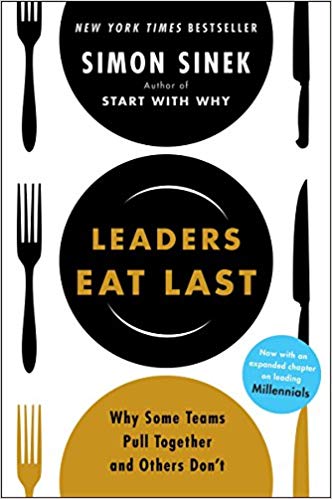
Leaders Eat Last: Why Some Teams Pull Together and Others Don’t by Simon Sinek tells stories about leaders who found success mainly by putting people first. Seeking short term gains and seeking to serve one’s own selfish interests is short-sighted and sure to fail over time. This book will help leaders in all fields be the type of leader they wish they had. This would be a great textbook for any leadership course. Be sure to get a copy for leaders you know.
Forward by George J. Flynn Lieutenant General, U.S. Marine Corps (Ret.)
- An organization’s success or failure is based on leadership excellence and not managerial acumen. These organizations have strong cultures and shared values and understand the importance of teamwork and trust. They understanding the importance of people and relationships. The true price of leadership is the willingness to place the needs of others above your own. You must know your people and realize that they are much more than an expendable resource. Good leaders truly care. Leaders who take care of their people can never fail.
Part 1 – Our Need to Feel Safe
- 1. Protection from Above: We start with a story about a pilot risking his life to save 22 men in Afghanistan. He said he was just doing his job and that empathy for others is the single greatest asset he had to do his job. “They would have done it for me.” Empathy helps you share your glory and help those with whom you work to succeed. This strong foundation leads to success that no amount of money, fame, or awards can buy. Exceptional organizations have cultures in which leaders provide cover from above and the people on the ground look out for each other thanks to empathy.
- 2.Employees Are People Too: By getting rid of time clocks, bells that signaled breaks and lunch, locks on boxes of spare parts, and replacing free anytime phones with asking for permission payphones one leader used trust to turn his company around. People offered to donate vacation days to an employee with family problems. The workers also took better care of the machines. This happens when leaders listen and avoid coercion. They treat workers like family and realize that everyone is someone’s son or daughter.
- 3. Belonging: The authors use the metaphor of The Circle of Safety. It’s like four oxen standing so that no matter which direction the lion comes from it will always be met be horns. After thirteen weeks of boot camp, Marines know that they can trust every other Marine to protect them. It’s important that everyone in an organization feel that way about every other member so that everyone feels as safe as possible. This will result in better collaboration and problem-solving.
- 4. Yeah, but…: Stress can have negative effects on one’s health so it’s important to avoid it as much as possible. The more control a person has the less likely they are to be stressed. Top leaders, therefore, do what they can to give workers control and to acknowledge their efforts. We also know that coming home angry from a job you hate will have a negative impact on your children. You may be better off with no job rather than one you hate.
Part 2 – Powerful forces
- 5. When Enough Was Enough: In order to survive, humans have had to rely on cooperation and mutual aid rather than competition. If we don’t look out for our group, our group won’t look out for us. Conversely, if we don’t take care of ourselves first, we won’t be of much use to others.
- 6. E.D.S.O: Four brain chemicals help us survive. Endorphins are the brain’s pain relievers. They give us a remarkable capacity for physical endurance. Dopamine causes a feeling of satisfaction when we accomplish something. It makes us a goal-oriented species. Together these two chemicals help us get things done. Serotonin gives us the feeling of pride we get when we perceive that others like or respect us. As social animals we need approval. This causes us to give of our selves. Oxytocin is the feeling of friendship, love, or deep trust. Without it, there would be no empathy. You get it when to do something nice for someone. Such behaviors make us happy and help us live longer.
- 7. The Big C: When something goes wrong or you don’t feel safe your body releases cortisol. It’s the chemical that causes feelings of anxiety, discomfort, or stress. It’s like an early warning system. If you work with a group where members don’t care much about one another’s fate cortisol starts to seep through your veins. It inhibits the release of oxytocin, the empathy chemical. One can adapt to regular doses of cortisol, but it isn’t good for one’s health. Here is a story of a company that adopted a no-fire policy. As a result, people communicated more openly and pointed out problems more quickly. Turnover shrank and people felt safe.
Part 3 – Reality
- 9. The Courage to Do the Right Thing: Here we have a story of an aircraft controller who broke the rules and saved many lives. The point is that you have to know when to break rules and that you need rules to keep things running well. Also, relationships aren’t really based on rules.
- 10. Snowmobile in the Desert: Snowmobiles don’t run so well in the desert. Sometimes amazing humans are like snowmobiles in the desert. Sometimes the harder we try to do things right the worse we feel. We need to get the environment right at work and at home and learn how to work together as nothing great was ever accomplished by a single person.
Posted in Book Summaries, Business Books, Leadership Books | No Comments »
Friday, September 27th, 2019
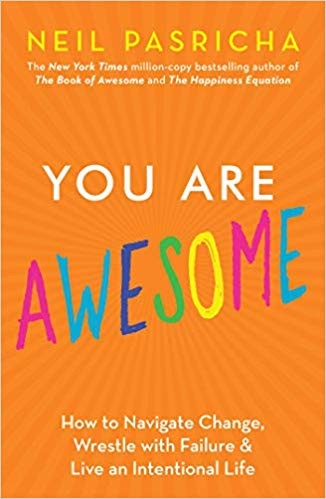
You Are Awesome: 9 Secrets to Getting Stronger and Living an Intentional Life by Neil Pasricha offers excellent advice that we can all use to have a more fulfilled and productive life. The advice here is appropriate for people in business, educators, and students alike. In short, everyone. Be sure to get some copies for your professional development library and get one for yourself.
Introduction: You Need to be More Resilient
- It starts with a very cool fable that demonstrates the notion of resilience. The key is to not let defeats define who you are. Every end is a beginning. Resilience seems to be in short supply, which is why Neil wrote this book. He offers nine research-backed secrets, shared through personal stories on how we can move from shattering to strengthening. If you find yourself off course, this book is for you.
Secret #1 – Add a Dot Dot Dot
- The dot dot dot here is known as an ellipsis which marks incomplete utterances in plays. Compare this to a period known as a full stop, which marks a finished sentence. Neil uses the ellipsis as a metaphor for life were everything is unfinished until you die. He uses the inspirational story of his mother, born the fifth girl in Kenya to a family who wanted a fourth boy. She was self-taught and got the highest score in the nation’s standardized test, which earned her a full scholarship to a white prep school. She just kept going like an ellipsis and looked past the periods.
- The other key lesson here is that like Neil’s mom, the one word you should use over and over at the end of your sentence is yet. As is “I don’t have any better options…yet.”
Secret #2 – Shift the Spotlight
- It’s egotistical to think that “it’s all about you.” It’s foolish to think that people are constantly looking and you and judging you. It’s folly to think the spotlight is on you because it isn’t. Stop caring with other people who are self-absorbed think of you. There is so much beyond your control that you need to simply learn from your failures and move on. Share your failures with others as it will help you seem more human. You will seem more normal, real, and relatable, which will help improve your relationships. If you make self-harming statements you are likely to believe them. Also, avoid exaggerating the size of your problems.
Secret #3 – See It as a Step
- If you think of life as a long stairway you need to realize that you can see the steps taken but the upcoming steps are invisible. Also, realize that we are all really bad a predicting the future. People think that they have changed a lot in the past, but won’t change much in the future. This is probably wrong. When people are down, they often think they will probably stay there. This is the wrong way to think. See failure as a step towards a future that you will be happy with. Neil also recommends that you avoid the endless reports of bad news that our modern media doles out. It’s largely a machine-gun barrage of superficial negativity. He also found that writing a blog was cathartic as it helped him swap dark thoughts for lighter ones. For him, it was the dot dot dot, a shift of the spotlight, and the next step. When you fail, just prepare for this next step, which might be positive.
Secret #4 – Tell Yourself a Different Story
- Shame is an intensely painful feeling or experience that we are flawed and unworthy of love or belonging. It plays a role in how we think of ourselves. Your problem is the story you are telling yourself and you can choose another story like you can choose your attitude. Three questions can help. 1. Will this matter on my death bed? 2. Can I do something about this? 3. Is this a story I am telling myself?
Secret #5 – Lose More to Win More
- Some good things just take time. They take lots of failure, lots of loss, and lots of experience. Wanting to get better is a real gift. It means you keep trying, failing, and learning. If your number of failures exceed those of most people you should be proud of that. Cy Young had the most wins and the most losses. Nolan Ryan had the most strikeouts and the most walks. The more times you step to the mound the more chances you have to win. Go to parties where you don’t know people. Have a failure budget. Can you afford to lose hundreds on something that fails? How about thousands or more? More losses give you more chances to win. If you want good pictures, take more pictures.
Secret #6 – Reveal to Heal
- Physical releases are easier than mental releases. Take time to let go of something and take time to feel grateful and write down at least five gratitudes a week.
Secret #7 – Find Small Ponds
- Would you rather be a big fish in a small pond or a small fish in a big pond? If you choose the former your self-esteem will go up and stay up. Neil got this advice from a dean so instead of applying to a top company he looked for ones that were broken in some way. He got a job where he was a big deal and could make a difference. This concept applies to life. Rather than chase the hot person on the beach, look for the nerd in the library. Just don’t be arrogant or act boastfully while you are in the small pond.
Secret #8 – Go Untouchable
- It seems that every day there are more distractions in our lives. Cellphones are a big culprit while things like meetings at work and a barrage of emails also contribute. When Neil quit Walmart to become a full-time writer he found that he didn’t have the amount of time he anticipated to do creative work. His solution was to create weekly UNTOUCHABLE days where he unplugged and just focused on creative activity. He found his productivity skyrocketed so he now schedules two such days a week sixteen weeks into the future. If he has to shift one of these days he keeps it in the same week.
Secret #9 – Never, Never Stop
- This chapter could have been called “what I learned from my dad.” He emigrated from India to Canada, worked hard, and never gave up. He kept things simple and when he made a decision he didn’t waste time rethinking it. The big idea is that you can only go forward so start going that way and never stop. Thanks, Neil.
Neil Pasricha
- Neil is a New York Times bestselling author of six books including The Book of Awesome and The Happiness Equation. His podcast 3 Books is his quest to uncover the most formative books in the world. He gives 50+ speeches a year including TED Talks and SXSW. He has degrees from Queen’s University and Harvard Business School and lives in Toronto. Reach him on Twitter as @nielpasricha, visit his blog at Neil.Blog, and drop him a line at neil@globalhappiness.org.
Posted in Book Summaries, Business Books, Leadership Books | No Comments »
Thursday, September 5th, 2019
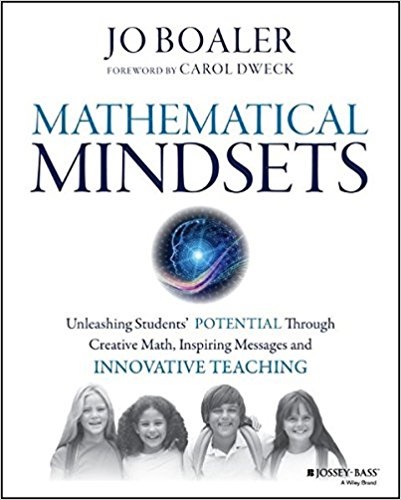
Mathematical Mindsets: Unleashing Students’ Potential Through Creative Math, Inspiring Messages and Innovative Teaching by Jo Boaler with Forward by Carol Dweck starts with the premise that math is the subject most in need of a makeover. Jo draws on modern brain research to show how changes in teaching and parenting can change students’ mathematical pathways. Click at the bottom on any page to get this book for parents and people in your school in charge of math instruction.
Jo Boaler
- Jo is a British education author and is Professor of Mathematics Education at the Stanford Graduate School of Education. She is involved in promoting math education reform and equitable mathematics classrooms. She is the CEO and co-founder of Youcubed, a non-profit organization that provides mathematics education resources to parents and educators of K–12 students. She is the author of seven books including, What’s Math Got To Do With It? and The Elephant in the Classroom. Her book, Experiencing School Mathematics won the Outstanding Book of the Year award for education in Britain. Currently, she is the Research Commentary Editor for the Journal for Research in Mathematics Education.
1. The Brain and Mathematics Learning
- Jo starts with explaining the power of having a growth mindset as opposed to a fixed mindset. This is centered on the work of Carol Dweck. Be sure to read my summary of Carol Dweck’s book Mindset: The New Psychology of Success – How We Can Learn to Fulfill Our Potential. It will help you to decide if you wish to purchase it and to review the key concepts after you read it. Teachers and parents are key here in that they are responsible for telling students that intelligence is not something fixed at birth. They should also avoid sending the message that only some kids are good at math. Jo believes that there is no reason that about 95% of all students can take calculus in high school. She also points out that there should be no preordained pace for learning math.
Posted in Book Summaries, Education Books | No Comments »
Tuesday, August 13th, 2019
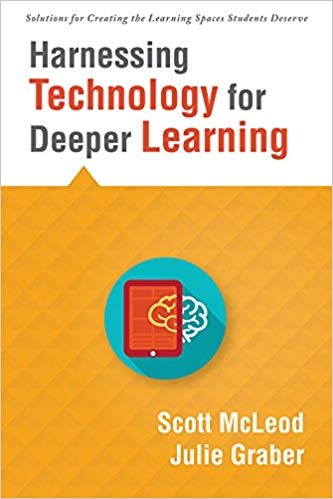
Harnessing Technology for Deeper Learning by Scott McLeod and Julie Graber starts with the fact that schools purchase a lot of technology and then hope for magic to happen. Since magic doesn’t in most schools they invented a practical protocol that teachers can use to help students engage in deeper thinking, do authentic real-world work, have more control and ownership of their learning, and be more involved in communication and collaboration. In addition to the protocol, they give concrete examples of how it can work with real lesson plans. Every school should have copies of this book.
Forward by William M. Ferriter
- Over 70% of students who don’t graduate from high school report having lost interest by ninth grade. The majority say that motivation is all that prevented them from earning a diploma. These numbers indicate a systemic failure and an immediate need to transform education. We need schools to be different and to move away from routine cognitive work. If students extracurricular learning is richer and deeper than what they experience in school it’s time for us to catch up. Learning is more important than schooling and it’s time to rethink everything.
Introduction
- Most schools struggle with their technology integration efforts and digital technologies are not really transforming the learning experience. Educators continue to do the same things that they have always done and available technologies tend to function as add-ons. Many in the press see the impact of technology as negative. New digital tools bring us great power. If they didn’t, they wouldn’t have pervaded our homes and offices so quickly.
- We now have the ability to communicate with people all over the world. We can learn anytime, anywhere from anyone, about anything we want. We can create content, reach others, and collaborate in new and unimaginable ways. We can quickly access almost all human knowledge. There is no better way to cement schools’ irrelevance that to ignore the digital transformations that are reshaping the rest of society.
1. Seeking a New Approach
- We start by looking at several frameworks commonly used as part of professional development efforts. What they have in common is that they start by using technology to replicate what is already being done and move towards transformations where students do things that they couldn’t have done before. In practice, however, these frameworks are difficult to implement in practice. They simply don’t help teachers know what to do different. Teachers are often frustrated and defeated as they struggle to fins meaning, make sense of the frameworks, and improve their practice.
2. Introducing the Four Shifts Protocol
- Since the existing frameworks were too vague and general, Scott and Julie came up with what to look for and called their work the Four Shifts Protocol. These are specific, concrete look-fors and think-abouts that can help teachers contemplate instructional changes they might make.
- A. Deeper Thinking and Learning: Look for student work focused around big important themes, messy problem solving, students designing and making things, students reflecting on their work, and critical thinking.
- B. Authentic Work: Look for interdisciplinary work, use of the tools that people in the discipline use, use of authentic research, student-created real-world products or performances for an authentic audience, contributions beyond the classroom walls, and student agency when it comes to selecting what and how they learn along with how they will demonstrate the learning.
- C. Student Agency and Personalization: Look for student ownership and control of the process, which leads to greater personalization, individualization, and differentiation. Is the work reflective of student interests or passions? Can students go beyond the given parameters?
- D. Technology Infusion: Look for how the students communicate and who they communicate with. Are students working along or collaborating with others. Does technology facilitate collaboration? Does technology make learning possible? Do the tools overshadow the learning? Are digital tools used in a responsible manner?
3. Redesigning Elementary School Lessons and Units
- Here we see how three somewhat innovative lessons can be taken to the next level using the protocol shits from chapter two as guidance.
- Social Studies: We start with a mystery Skype activity where two classrooms from different schools connect and take turns asking questions to see if they can find out where the other school is located. While this is a fun activity the learning isn’t very deep. A redesign would expect students to delve into things like local geography, politics, language, vegetation, religion, and other differences of the other school’s environment.
- English Language Arts: The original lesson has students select a book to read dealing with pumpkins. They then decorate a pumpkin to resemble their favorite character. Students also make short videos of children talking about their character while holding their pumpkin. The redesign would expect students to infer their character’s main traits and to supply supporting text. They would determine the theme of the story and create images that depict major events in the story. They then make a multimedia video using their images. The videos of all students are then made available on the Internet.
- Math: The base lesson tells students to design a treehouse using 1400 square feet of boards and to make sure the volume is at least 250 cubic feet. They must include 2D sketches and explain why their dimensions are reasonable. The redesign requires a 3D prototype and a 3D printed scale model. Students then need to put together a persuasive presentation to essentially sell their product. This gives it an interdisciplinary aspect. Beyond the base lesson, a local builder could be asked to judge the work and have the winning design built. Student work would also be displayed on the Internet.
4. Redesigning Secondary Lessons and Units
- High School Life Science: Student’s are to make a poster that about harmful water-borne bacteria and the best posters will be hung in the hallway. The refined lesson tells them that they are to inform the local citizens about harmful water-borne bacteria in their local river including its effects, prevention, and treatment. This requires them to select a presentation tool and medium and it will require the use of ELA skills. They also have an authentic purpose and audience.
- Middle School Health: In the original lesson students pick a food and make five postcards that food would send as it travels through the digestive system. The revised lesson allows the students to choose how they will illustrate the trip through the digestive system. All they need do is explain what the structures look like and how they work. Their work will then be presented on the class’s website. They make videos or animations and again will need to employ and improve their ELA skills.
- High School Physical Science: The original assignment asks students to fill in the blanks on a Google Doc as they listen to a teacher lecture about sedimentary rocks. The redesign asks students how the structures and processes of the Earth change the Earth and its surface? They can also explain why processes such as plate tectonics and national disasters change the Earth and its surface. In addition, they need to deal with the implications for cities, seaports, and countries when these changes occur. They should include examples and what we should start or stop doing and why. They are expected to aim their work at a specific audience and choose the tech tools they will use for their presentation that will go live when it’s finished.
5. Designing From Standards
- Elementary Example: The standard asks students to understand that individuals and groups within a society may promote change or the status quo. The unit overview starts with whole group instruction that discusses an activist that stood for change. Other activists are explored during small group work with the teacher facilitating one group at a time. Students identify main ideas and supporting details as they work and present them using a graphic organizer. They brainstorm a list and select an individual or group to research. They choose presentation technology to share their findings as individuals or groups. They will interview people outside of school and decide how they would convince an audience that change is needed regarding their subject or that nothing needs to be done.
- Secondary Example: The standard asks students to write informative and explanatory texts to examine and convey complex ideas, concepts, and information clearly and accurately through the effective selection, organization, and analysis of content. The lesson starts with students identifying an issue or topic that they are interested in with the end goal of writing to inform an authentic audience. Students will use a variety of technology tools to help organize their facts, details, and examples. They will write and share an initial draft and look for feedback from other students and adults. They will edit their work and decide which technology to use to present it to their audience. Finally, they will reflect on what went well and what they would do differently next time.
6. Implementing the Protocol—Techniques, Strategies, and Suggestions
- The authors give some concrete suggestions here as they have found very few on other publications. This is complex work, but you don’t want to just insert technology into your classrooms and hope that magic will happen. Since the Four Shifts Protocol can be overwhelming, try selecting only a few sections to address at any given time. Ideally, you would hit every aspect multiple times during the school year and try to hit more than one at a time. As you do students will engage in deeper thinking, do authentic real-world work, have more control and ownership of their learning, and be more involved in communication and collaboration. This chapter also contains some tips for professional development and a call for suggestions for improvement.
Epilogue: Staying in Touch
- Scott and Julie look forward to hearing from you. You can reach Scott at dr.scott.mcleod@gmail.com, follow him on Twitter @mcleod, and check out his blog at dangerouslyirrelevant.org. You can reach Julie at jckgraber@gmail.com and follow her on Twitter @jgraber.
Scott Mcleod and Julie Graber
- Scott is an associate professor of educational leadership at the University of Colorado, Denver and a leading expert in PreK-12 school technology leadership. He is the founding director of the University Council for Educational Administration’s Center for the Advanced Study of Technology Leadership in Education (CASTLE). He has received numerous awards and has written over 170 articles and other publications.
- Julie is an instructional technology consultant on a technology innovation team for Prairie Lakes Area Education Agency in Iowa. Her areas of expertise include deeper thinking with technology, authentic learning, curriculum design, and performance tasks and assessments. She is a regular speaker at local, state, and national conferences focusing on authentic work and student-centered, personalized, and project-based learning.
Posted in Book Summaries, Education Books, Leadership Books | No Comments »