Archive for the ‘Book Summaries’ Category
Monday, February 11th, 2019
From Teacher to Leader: Finding Your Way as a First-Time Leader—Without Losing Your Mind by Starr Sackstein recounts her first year as an administrator. This story of a remarkably gifted teacher’s journey into administration after her first year is a great read. Starr’s reflections, research efforts, and writing skills have resulted in a valuable resource for teachers considering a jump to administration and experienced administrators alike. She lives up to her desire of becoming the kind of leader she would want to have. As an educator since 1969 and an administrator for 30 years, I find her advice to be spot on. Make sure that you and your professional development library has a copy.
Forward
- The forward by Dan Rehman, Superintendent West Hempstead Union Free School District tells the story of how Starr was hired as the district’s director of Humanities. While she clearly had the necessary qualities, she lacked the necessary certification, which Starr and the district were finally able to work around. Dan paints her as enthusiastic, goal focused, persistent, self-aware, creative, innovative, willing to take risks, and reflective. What else could you ask for in a leader?
- While she loved her nine years teaching journalism in New York City, (16 years total) she struggled with boredom and dissatisfaction with administrative decisions, and began experimenting with grading less and helping students began a flurry of reflection and problem-solving. She questioned what learning should look like. She became an administrator to become a mentor for new teachers. This book tells the story of her first year, mistakes and all.
- Each chapter also ends with some valuable Daily Reflections for Change that you can do.
1. To Leave or Not to Leave
- As a teacher, there is no single right way to know when to leave. Possible reasons are boredom or complacency with your work, urge to share your expertise with others, or someone suggesting that you make the move. (Doug: They also make more money.) Once you start to think about it the more you need to look for administrative programs. Ideally, you find one where you can take a few courses as a non-matriculated student to get your feet wet. Interview working administrators to get a better idea of what the job entails. Read some of the books Starr suggests and look for Twitter chats on leadership.
- Thirteen years into teaching Starr was able to take on a “hybrid” role as part teacher and part teacher coach. She felt that still doing some teaching gave her more credibility with the people she coached as she was still doing the things that she was trying to get them to do. Teachers could visit her classroom and she could still continue to try new things.
- Before you start looking for jobs create a description for your ideal job. Starr provides one here based on her desires and skills. Once you have your goals spelled out you can better articulate them in interviews. While no two people take the same path to administration, Starr’s path covers the basics that all teachers need to consider. She suggests that you are not there to fix teachers but to help them further develop the skills they already possess. Stay humble, be present, listen, collaborate, and be patient.
2. Teacher Leadership as a Precursor to School Leadership
- Consider the job description and ask a lot of questions about the school culture and needs to make sure the job is a good fit. Before transitioning grow your content or pedagogical expertise and serve on committees. Apply to present at local, regional, or national conferences on topics important to you. Adult learners are different from students. How so? Nothing is worse than discounting ideas elicited from others. It’s a surefire way to make your team resent you.
3. The Ache of the Shift
- Starr became very aware of the void that had been created inside by not being in the classroom. She worked to rebrand her decision as an extension of her teaching career and not as a replacement for it. She spends time in classrooms. Plans with teachers and offers to co-teach when it is appropriate. As a new team leader, you will definitely experience isolation. For the most part, it will continue because you are no longer part of us. Now you are one of them. Leadership doesn’t have to be the dark side. It can be light, optimistic, and supportive, but it definitely takes time to get your team to believe you are one of them. To get feedback Starr uses anonymous Google forms. Be ready with “Plan B” in the event your day changes unexpectedly. Starr also offers advice on attire here. Learning—in the classroom and in life—happens moments forced her to figure things out. You are going to have to do a lot of learning so it helps if you enjoy learning. Exhibit the behaviors you’d like to see.
Posted in Book Summaries, Education Books, Leadership Books | No Comments »
Sunday, January 27th, 2019
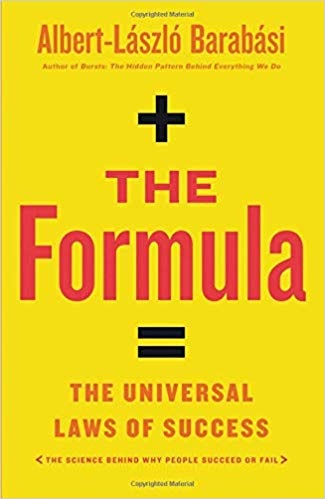
The Formula: The Universal Laws of Success by Albert-László Barabási explains how his team discovered these laws and how they can apply to your life and the lives of those you touch. While successful people throughout the ages had no idea of why they succeeded, you don’t have to. This is certainly one of the most important books I have summarized to date. Be sure to get a copy for your school.
Introduction
- Albert and his team gathered data on people who achieved success in as many fields as possible. The assumption is that success leaves a trail of data points behind it such as publications, museum exhibits, sales, and even sports statistics. The idea was to find a series of recurring patterns that drive success in most areas of human performance. This is not about success as judged by the individual as that leaves no trail. As a result of this effort, we have the universal laws of success..
1. The Red Baron and the Forgotten Ace
- This starts with the story of Manfred von Richthofen, Germany’s ‘Red Barron’ who shot down eighty allied planes during World War I. His success was magnified by the German government and he did what he could to blow his own horn. His fame lives on thanks to Charles Schultz and Snoopy. Contrast him to René Fonck, a French pilot who may have shot down as many as 127 German planes. Fonck is an example of outstanding performance without success. He is like the opposite of Kim Kardashian. This reminds us that success and fame are very different. Albert tells stories of other people who did something first only to see a latecomer get the credit. Success, therefore, is about how you and your performance is perceived by others.
2. Grand Slams and College Diplomas
- The First Law: Performance drives success, but when performance can’t be measured, networks drive success. It’s time to see the largely invisible networks that shape our success.
- First we see that some areas like academic performance with metrics like SAT scores and GPAs and tennis with its precise ranking system are much different from most fields where accurate performance metrics don’t exist. The interesting finding here is that ambition along with performance seems to be important. Students who are rejected by top colleges like Harvard do just as well as students who go there due to their ambition. This suggests that the schools don’t really matter. It’s the student who matters.
3. The $2 Million Urinal
- Now we look at a field where there is no easy metric to judge performance, the field of fine art. Here what matters most is your network. This network is composed of curators, art historians, gallery owners, dealers, agents, auction houses, and collectors. At the center of the story is a toilet simply signed by Marcel Duchamp that sold for $2 Million dollars. Albert also points out that the Mona Lisa didn’t become the world’s most famous painting until it was stolen and wasn’t found for two years. This shows the importance of context. There is a trove of data here that contains information about where artists have shown their works. Again we see that the ambition to have your works shown in top galleries along with persistence and expanding your network are key attributes. Like students ambitious enough to apply to Ivy League schools, artists ambitious enough to promote their works to top galleries are the ones more likely to succeed.
Posted in Book Summaries, Business Books, Education Books, Leadership Books | No Comments »
Monday, December 24th, 2018
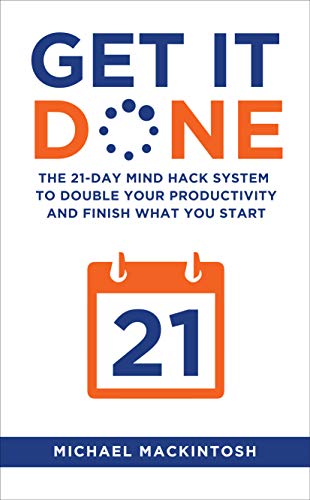
Get It Done: The 21-day Mind Hack System to Double Your Productivity and Finish What You Start by Michael Mackintosh offers sound advice for people prone to procrastination and who suffer from the endless disruptions that exist in our hi-tech world. If this sounds like you be sure to get a copy along with one for your school’s professional development library.
Introduction
- This book is aimed at creative entrepreneurs but I believe that educational leaders can learn from it as well. It makes very big promises, but depending on where you are it should help you focus on what’s important, increase your productivity, and finish your most important projects. It also reminds us all to build in time for rest, relaxation, and celebrating our accomplishments.
Part I – 11 Essential Mind Hacks to Make Things Happen
- 1. The Prolonged Pain or the Short-Lived Pain: If you continue doing things that are inefficient and less effective you are inviting long-term pain. Change in the near term can be painful too, but if it leads to success you won’t have to deal with it in the long-term.
- 2. The Defining Choice: Acting differently and thinking differently is a choice. Keep in mind it is the only way you are likely to get different results.
- 3. The 80/20 Rule: This rule states that 80% of your input or effort leads to 20% of your outputs or results. Therefore, the opposite has to be true that 20% of your effort leads to 80% of your results. The trick is to identify the activities that produce 20% of your output and either do them less or do them when you are not so sharp.
- 4. Good is Good Enough: The old saying “the perfect is the enemy of the good” applies here. It is important sometimes to stop when you have reached the good enough point in a job unless it’s a job that has to be perfect like a computer program.
- 5. The Delusion of Time Management: The idea here is that you only have NOW in terms of doing something. Even if you are thinking about the future you are doing it NOW. Trying to micromanage your schedule is not likely to lead to great productivity. Rather than thinking about managing time, think about managing your thoughts, words, actions, energy, and focus. As you move through the day ask if what you are doing is moving directly toward your goals. Make your most important work a priority. Organize your day to make the most of your energy. If you are a morning person like me, save the most important work for the morning. (Doug: Yes, I’m writing this in the morning.) Recognize when you are a tired, hungry, or distracted and do what it takes to recharge. It’s not how much time you put into something, it’s how much high-quality energy you invest.
- 6. The Resistance: You can’t do something new, significant, and meaningful without resistance so get ready for it. Some can come from your lower self that is comfortable with the status quo. Be alert and look for it within and without so you can take it on.
- 7. Fears and Hallucinations: Fears can be real or irrational. They can be healthy and necessary for success. They can also arise when it’s not required. Unconscious fears include the unknown, failure, and not being good enough. Once you identify them you can accept that they only exist in your mind. This should help prevent the destructive worry that come with them.
- 8. Focus: You don’t want to try to make all of your dreams come true at the same time. The idea here is to bring one idea to completion before you begin another one. Fear could be part of the problem for people who try to do too many things at once.
- 9. How to Overcome Self-Doubt: This can sabotage you before you begin. Michael suggests that you focus on the people who will be helped if you complete what you are doing and realize that self-doubt, like most fears, is also irrational.
- 10. Do It Now: Everything happens in the now, and now won’t last forever. This should help you get going and avoid procrastination.
- 11. Do Less Work to Get More Done: You don’t do your best work when you work too hard. You are more likely to make mistakes and quality is likely to go downhill. Be sure to build rest and recharge into your game plan. Sleeping on a problem or just taking a walk can help you solve it. You are also more likely to screw up your family life and other important relationships. You still have to work hard, but working too hard can even make your sick.
Posted in Book Summaries, Business Books, Leadership Books | No Comments »
Sunday, December 16th, 2018
Just in time for Christmas. Here is an executive summary of my recent book. Based on the feedback I received so far, it would make an excellent present for any educators and parents with kids in school. Also, consider getting a copy for any policymakers you know.I hope you like it.
Click here to buy at Amazon
1. Introduction
- Teaching is tricky business. If it were as easy as rocket science, which we seem to have figured out, all students would be learning as fast as their individual brains would allow. This implies that they would learn at their own individual pace, which would cause the gaps between the faster learners and the slower learners to gradually increase.
- Unfortunately, our current set of reforms driven by the corporate/ political complex gives the same tests to students each year based on their born on date, regardless of their ability. It also expects teachers to close the gaps between slow and fast learners. One way to do this is to slow down the fast learners. In this book, Dr. Green explains why the current reforms and out-dated teaching methods need to go and just where we might head.
2. Teaching Isn’t Rocket Science; It’s Way More Complex
- It’s clear that we understand how rockets work as we have sent them all around the solar system and beyond. The human brain, however, which is the learning playground for students and teachers is much more complex and less understood. Promising ideas in education spread slowly, if at all, because of a resistance to change and federally imposed standardized testing. Thanks to the media, however, the public doesn’t realize this and they think that teachers are generally doing a bad job. They also think that all students should be able to achieve at high levels, which is nonsense. We all know that some students are more capable at cognitive tasks than others.
3. The Pressure On Teachers To Get Good Test Scores Makes It Inevitable They Will Cheat
- When the government encouraged by business leaders imposes high-states tests on schools, three things can happen. First, some will cheat and many have. Second, most will try to game the system with endless test prep that brings with it a lot of bad teaching practice. Finally, some will just fail. Schools will be closed and careers will be negatively impacted or ended altogether. This chapter documents some of the cheating and explains the different ways that teachers can cheat. It also suggests that teachers work to create engaging lessons and let the tests take care of themselves. If they do, test scores are unlikely to go down and just might go up.
4. Are You Smarter Than Bill Gates?
- Bill isn’t the only member of the corporate class pushing for test-based accountability, he is just the most famous and has the most wealth to push his ideas. Dr. Green suspects that when Bill wants to cure some disease, he reaches out to experts in the field. When it comes to education, it seems that he thinks he already knows the answers. Meanwhile, it’s hard to find any real expert in the field who thinks the current reforms are a good idea.
5. Failing at the Business of Schools
- Unlike businesses, schools cannot control their raw materials. They just take the students that their parents drop off. Most are also run from the top by a school board composed of elected volunteers who for the most part lack any serious educational expertise. For these reasons, trying to hold schools to business standards makes no sense. It also makes no sense to hold all schools to the same standard as their raw materials vary.
6. Achievement Gaps and Ethnic Groups
- When advocates for blacks, Hispanics, and poor kids see that that whites and Asians perform better on standardized tests, they expect schools to work on closing the gaps. Ironically, if schools did a perfect job of letting every student learn as fast as possible, the gaps would increase. Doug maintains that the best way to close the gaps is to slow down the fast learners, which some schools do well. He also points out that the subgroups themselves are arbitrary and don’t make much sense. For example, why are Spanish speakers the only group based on the language they speak when more people speak English and Chinese? People from China and India are very different in appearance and culture, yet they are in the same group.
Posted in Book Summaries, Education Books, Leadership Books | 2 Comments »
Monday, December 3rd, 2018
Your Starter Guide to Maker Spaces by Nicholas Provenzano tell the story of how he started and built a successful maker space at his school. His guidelines explain what one is, who can help you build one, where it should go, and what to put in it. He explains how it can promote project-based learning and turn failure into a positive thing. Every school should have a copy.
Introduction
- Since making doesn’t have a set curriculum, it should be no surprise that this book is written by an English teacher. The goal is to have students use different tools to demonstrate understanding. You don’t have to be an expert to turn your students lose and it’s ok to fail. This book features Nick’s experiences rather than a pile of research. He claims to be a tinkerer rather than an expert and hopes that you can draw on his work to help jump-start your own and the work of your students.
1. So, What is Making?
- Nick’s definition of making is that it is the creation of something new that was not there before. By being broad and vague it is not constrained. This definition also makes it more inclusive so the everyone can make with anything you can find along with computer code. It is also vital that you ditch the idea that making is for STEM classes. You need to add the arts (STEAM) as the arts bring everything together. You want students to be creators, not just consumers.
- Since some students don’t have a supportive making environment at home, schools need to provide one. They all need to experience problem-based lessons to prepare for life after school. Another key is that teachers have to see themselves as makers. At the least, they make lesson plans. They also make other things and need to be role models when it comes to making. There is also an element of storytelling as just about anything you make has a story associated with it.
2. I Know What Making Is, but Why Should I Care?
- In many schools students don’t have much choice about what they do or study. A maker space gives them choice and freedom if they are making what they want. Creativity and innovation are also often eliminated from the curriculum. Not so in a maker space. You should also design your maker space to support collaboration. Businesses want all of these things and many schools don’t try to build them into students’ lives. Finally, a maker space should be a fun place for students to be. There is no reason why school can’t be more fun than it already is and maker spaces can help.
Posted in Book Summaries, Education Books, Leadership Books | No Comments »