Archive for the ‘Book Summaries’ Category
Wednesday, August 1st, 2018
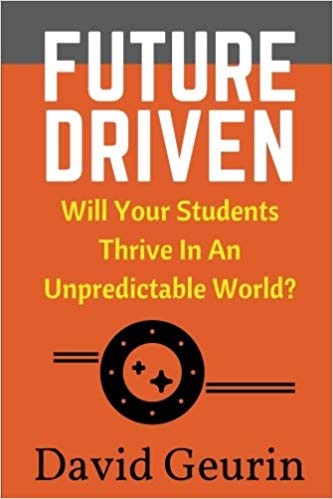
Future Driven: Will Your Students Thrive In An Unpredictable World? by David Geurin encourages teachers to look to the future as they design lessons to excite their students. To make students future ready you need lessons connected with reality, projects, collaboration, and tolerance for risk. Although we can’t predict the future, we need to adopt a futurist vision and be adaptable and mentor adaptable learners. After you read this fine book be sure to get a copy into the hands of any educational leaders you know.
1. Shaping the Future
- Too many classrooms don’t look or function much differently than they did decades ago. Nonetheless, educators need to look forward as they prepare their students for an uncertain future. For most of us, there were parts of our education that were timeless. There were also probably too many that were needlessly passive. The idea that we should help students find and explore their passions is relatively new.
- One thing that is apparent is that we need to create adaptable learners as adaptable learners will own the future. The key is to develop skills that are transferable to unknown situations rather than reducing a student’s achievement to a few numbers. The need to adapt is not new. People with adaptive ability have been more successful in the past and this skill is more important as change accelerates.
2. The Unexpected
- Everyone encounters the unexpected in life. Rising to unexpected challenges is essential to success. Students should know this. We can expect, however, millions of jobs to be replaced by automation. We can also expect new jobs related to technology. Knowing this should help educators be more forward-thinking and future driven. It’s also a safe bet that hard work will still have great value in the future as it has in the past.
- To think like a futurist teachers should 1) Be willing to challenge how they are doing things now 2) Read the news with an eye to the future 3) Reflect on ways to help students be adaptable 4) Share ideas with students and colleagues about what the future may demand 5) Embrace the future even when it’s difficult.
3. What If Schools Were More Like Google or Starbucks?
- Here David provides the names of successful companies who are very innovative along with companies that have failed for failing to innovate. Unfortunately, many schools are happy with traditional teaching methods where there is a lack of student input and collaboration and a focus on test prep. Such schools will not thrive in the future. Some schools are looking to innovative companies that turn employees loose to innovate and tailor products and services to individual needs.
- Schools need to personalize instruction, which is easier to do if every student has a laptop. Student voices need to be heard and students need to have some choice in regard to what they study. The students should function like a think tank, which will promoter ownership. Classrooms should be flexible (including standing desks) so that furniture can be rearranged to allow for various sized student collaboration groups. Students should also have a say in classroom decoration and design. Innovative companies want employees with the ability to learn and who know when to lead and stand back. School libraries should feel like Starbucks.
4. Connect, Grow, Serve
- Like many other authors in the modern education field, David feels that student relationships are the most important thing that educators should work on. He tells how what he has done as a principal to get to better know more of his students. Strong relationships are the foundation of one’s ability to lead and influence. For this reason, schools must teach and model interpersonal skills. Teachers need to be aware that many of their students will suffer physical and emotional problems outside of school and be prepared to offer empathy.
- The next big idea is to make sure that you take care of your own physical and emotional needs so you will be fit enough to help others. Ideas for connecting include attending student extracurricular activities and sending positive handwritten notes to students and parents. David even devotes part of a faculty meeting for note writing.
- David thinks that schools put too much emphasis on student weakness and remediation and not enough focussing on student strengths. The chapter ends with ten things you should say more often like I believe in you, I’m here to help, and I’m listening.
Posted in Education Books, Leadership Books | No Comments »
Tuesday, June 5th, 2018
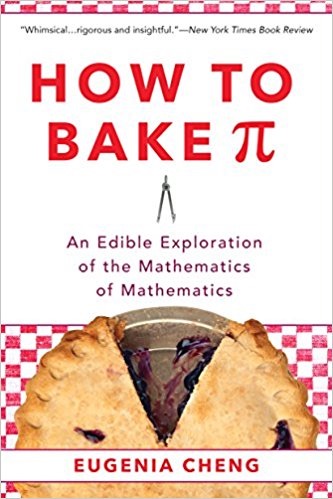
How To Bake ∏: An Edible Exploration of the Mathematics of Mathematics by Eugenia Cheng uses classic baking recipes to illuminate many math concepts. It helps take math into the real world as it helps to make some math seem easier to its readers. At the very least, it should find its way into the hands of every math teacher and serious math students.
Part I: Math – 1. What Is Math?
- Like all chapters this one starts with a recipe since like recipes math has both ingredients and methods. In math, however, the method being used is probably more important than the ingredients. Once you find a technique in math you can always find more things to study with it. The two key concepts here are abstraction and generalization. Math is abstract in that it studies ideas of things, rather than real things. The invention of numbers to represent things was perhaps the first-ever process of abstraction.
2. Abstraction
- To do math you have to step away from reality. This is where math finds its strength. The idea that two things cost twice as much as one thing applies to all things, for example. Here we have a process that generalizes. Maps are abstractions of reality. The key for map makers is to find the most appropriate level of abstraction for the given moment. There are a number of math problems here that show how procedures work regardless of the specific numbers involved.
3. Principals
- When making any recipe, it helps to understand the principals of the ingredients and finished products you are working on. Understanding the principles allows you to take shortcuts and substitute ingredients without ruining everything. Recipe books, however, rarely explain such principles. Understanding is power in cooking and in math. At the heart of math is the desire to understand things rather than just knowing them. The chapter goes on to spell out the principals for the natural numbers we use for counting.
4. Process
- Flour, butter, water, and salt can make a delicious puff pastry, but only if you follow a specific method. Math requires the proper method also and further requires that almost nothing is basic or given. The rules of logic must be followed. Eugenia shows how you can make two mistakes in math and still get the correct answer. At the heart of math is the need to understand things rather than just knowing them. In other words, the means justifies the end.
Posted in Book Summaries, Education Books, Leadership Books | No Comments »
Monday, May 21st, 2018
You, Your Child, and School: Navigate Your Way to the Best Education by Sir Ken Robinson and Lou Aronica will help parents get the education their children need to live productive, fulfilled lives. If you or anyone you know has children in or approaching school, this is a must-read. Be sure to get a copy and perhaps some gift copies for parents you know. This is a sequel to Creative Schools. See my summary here.
1. Get Your Bearings
- As a parent your worry list includes too much testing, a narrow curriculum, individual attention, learning problems, medication, possible bullying, college costs, and finding a good job. Schools also might not value a child’s strength as they magnify their weaknesses, and make grades so important that students lose a sense of self. Children love to learn and are natural learners. For most of human history, children educated themselves as they learned from others. With today’s focus on test scores, children are more likely to dislike learning as they become less healthy and more sedentary.
- A focus on things like STEM is often done to the detriment of other subjects that are none the less important to our economy and society. Ken argues for ditching the acronyms. Current reforms have not budged achievement levels as they cause enormous stress and loss of enjoyment. Businesses want employees who are adaptable creative team players as the support reforms that suppress these very attributes. Vocational courses are also squeezed out as too many college graduates can’t find appropriate work.
2. Know Your Role
- Regardless of your family structure, the adults in a child’s life are responsible for meeting a variety of needs. Here Ken uses Maslow’s hierarchy, which includes physiological, safety, love and belonging, esteem, and self-actualization. The final need means becoming meaningfully fulfilled as a person. As for esteem, children need praise, but it shouldn’t be endless and it should be tempered with constructive criticism. Children know when they have worked hard. Parents should set boundaries and provide moral education. Help them learn how to make decisions and to find a sense of direction and purpose. This shows why one-size-fits-all education is wrong.
- Ken defines five parenting styles. It seems that the authoritative style is usually the best as it involves setting rules that can be justified to the child and the willingness to alter the rules it conditions permit. Students should be allowed to struggle at times so as to work to solve their own problems. Such rules are more like guidelines that are a work in progress, and they tend to produce the happiest children.
3. Know Your Child
- Research indicates the one’s genes and one’s environment have about the same impact on what one becomes. This means that parents have about half of the responsibility. The culture surrounding a child has a huge impact. Usually, money has a big role as poverty brings with it a great deal of stress for many reasons. Poor kids are six times more likely to be neglected or abused, live in neighborhoods that are less safe, have lower birth weight, learning disabilities, and emotional and behavioral problems. There is no single definition of intelligence and each child’s potential needs to be unlocked if they are to be successful.
Posted in Book Summaries, Education Books, Leadership Books | No Comments »
Monday, April 30th, 2018
Reach for Greatness: Personalizable Education for All Children by Yong Zhao argues for a transformation of our schools from a focus on deficits and remediation to a focus on strengths and making every student great in their own way. It makes a short and compelling case for giving students more control and more responsibility for their learning and their futures. Please grab a copy and send one to any policymaker you know.
Introduction
- Yong uses his own story about how he wasn’t good at farming chores and that his father had the good sense to send him to school. At the time he was also able to avoid subjects he wasn’t good at or not interested in. This allowed him to leave China for the US and to become a college teacher. He compares this to our system that rather than focusing on student strengths focuses on their deficiencies. The system assumes that every student should learn the same knowledge and skills (standards) and that they should all demonstrate the same level of proficiency.
- While federal mandates have changed a bit, there is still an unreasonable focus on closing achievement gaps. He maintains that achievement gap mania has changed America for the worse. Changes in society continue to redefine the knowledge and skills that will be useful as some skills become obsolete. Humans are differently talented so we need to stop preparing students to become a homogeneous group of average individuals who are mediocre at everything but great at nothing. We need to begin helping everyone become great.
1. The Ambitious Pursuit of Mediocrity: How Education Curtails Children’s Potential for Greatness
- Our education system is a meritocracy that rewards students who do the best on the tests they take in a limited number of subjects. If you can jump through the required hoops on schedule, you will do fine. If your interests and talents don’t fit the curriculum, it will damage your confidence and self-esteem, and your talents are likely to be wasted. Ironically, meritocracy leads to mediocrity.
- The tests are norm-referenced so if one student goes up another goes down. (Doug: This is known as a zero-sum game. If you see percentiles, that is what is happening.) The tests only assess the ability to take the tests. As a result, Einstein and your top physics student both get the same grades. (Doug: There is no way to spot outliers.) Merit is defined a one’s ability and interest in performing well on tests in a few subjects. Thankfully, a growing number of schools have begun to implement programs such as genius hours and maker spaces, but they are still limited in scale and reach.
2. All Children Are Above the Average: The Potential for Greatness
- While all children cannot be above average on any single scale, there are so many ways to be above average on something that Yong believes that all children can be above average at one or more things. It is up to the adults in their lives to help children find out just what their individual strengths and weaknesses are. Since everyone is unique, there really isn’t any such thing as an average person.
- Yong mentions a number of ways to judge ability. There is Howard Gardner’s multiple intelligence theory, Dan Pink’s left and right brain directed thinking, Goldberg’s personality traits, and Reiss’ passion and intrinsic drives desires. Talent, personality, and passion are foundational sources of strengths and weaknesses and they are enhanced or suppressed by experiences. As you look for potential for greatness, avoid applying a predetermined set of criteria to all students. This includes curriculum standards as a student’s strength may lie outside their narrow definition.
- All human beings possess creativity. This is the ability to come up with new ideas, methods, theories, concepts, and products. Every student has a combination of innate qualities and environmental experiences that helps turn her or him into a unique individual. When you look hard without preconceived views, you will find them in all children.
Posted in Book Summaries, Education Books, Leadership Books | 2 Comments »
Wednesday, April 18th, 2018
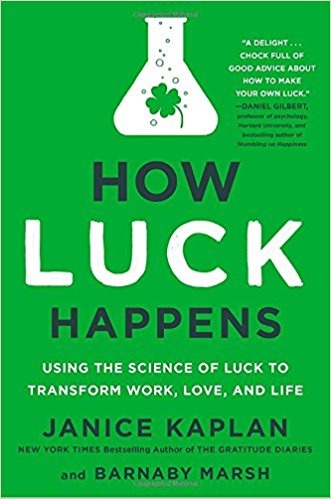
How luck Happens: Using the Science of Luck to Transform Work, Love, and Life by Janice Kaplan and Barnaby Marsh lays the groundwork for the new field of luck studies. This is a fine piece of qualitative research that can help you and your kids understand how to lead a luckier and happier life. Parents and leaders alike should read this groundbreaking book to help themselves and everyone they touch.
Preface
- We start with the legend of Harrison Ford who was working as a carpenter at the home of the young director George Lucas who was working on his first film American Graffiti. George got to know him a bit and gave him a small part. The rest is history. Certainly, Mr. Ford got lucky so the big question is how do we make our own luck? The idea is to put enough of the right pieces in place so you can take some of the onus off of random chance. Time to join the thrilling journey of discovery that Janice and Barnaby took during the last year that they claim will help you learn the approaches they uncovered that are almost guaranteed to bring more luck your way.
Part One – Understanding Luck – 1. Prepare to Be Lucky
- Shortly after their research began, Janice realized that real luck happens at the intersection of chance, talent, and hard work. Chance is never enough. You also need a bias towards action. You have to be willing to try as you focus on the things that you can control. Since this field is brand new, Janice and Barnaby couldn’t comb through existing research. They had to do their own.
2. Some People Have All the Luck—And You Can Be One of Them
- Most people (67%) think that working hard contributes to lucky outcomes. They (67%) also think that you can get lucky by being curious. Here we have a story about a girl who found a four-leaf clover, a one in 10,000 chance. Her friends told her how lucky she was, but she made her own luck by being persistent and knowing that there would be a lot of failure along the way. Getting the right information is also necessary, which might mean just asking one more question. The most important ability may be to pay attention and notice opportunities. Good attention is also flexible, which allows us to switch between narrow and open focus.
3. Pick the Statistic You Want to Be
- While about one-third of Americans are obese, this doesn’t mean that your odds of being obese are one out of three. This is a clear example of where you can make your own luck depending on the diet and exercise program you choose. It’s important to take risks, but not all risks are worth taking so you must size up the risks prior to forging ahead. Improbable things are likely to happen and they are not likely to happen to people who don’t spend some time outside of their comfort zone.
Posted in Book Summaries, Education Books, Leadership Books | No Comments »