Archive for the ‘Book Summaries’ Category

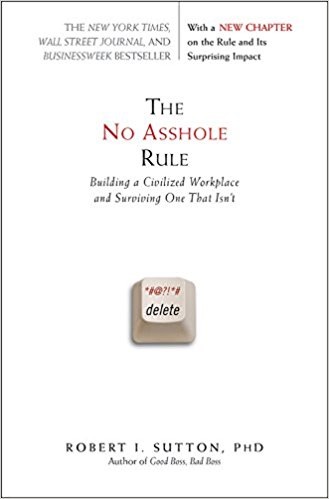
The No Asshole Rule: Building a Civilized Workplace and Surviving One That Isn’t by Robert I. Sutton

Monday, September 21st, 2015
Asshole

The No Asshole Rule: Building a Civilized Workplace and Surviving One That Isn’t by Robert I. Sutton ©2007 & 2010 should help organizations of all kinds make their cultures less toxic and more productive. Click at the bottom of any page to get a copy so you can get started dealing with jerky behavior where you live and work.

Robert I. Sutton

  • Robert is Professor of Management Science at the Stanford Engineering School and researcher in the field of evidence-based management. He is a popular speaker and the author of two other best sellers Good Boss, Bad Boss: How to Be The Best…And Learn From The Worst and Scaling Up Excellence: Getting to More without Settling for Less with Huggy Rao.

1. Asshole Defined

  • With a title like this, it is essential to define what one means by the term asshole. Robert offers two tests we can use to spot this type of person. Test one: After talking to the person, do you feel oppressed, humiliated, de-energized, or belittled? Test two: Does this person aim venom at people who are less powerful rather than at people who are more powerful? He also gives us a list of actions that assholes use. They include personal insults, uninvited contact, threats and intimidation, sarcasm, two-faced attacks, dirty looks, and ignoring people. We are cautioned that there is a difference between a temporary asshole and a certified asshole, as nearly all of us act like one at times.
  • Just because you want to avoid hiring assholes, neither do you want to hire spineless wimps. What is needed is for teams to engage in conflict over ideas in an atmosphere of mutual respect. Robert even suggests taking classes in constructive confrontation. When he studied this topic, Robert found that just about everyone he talked to volunteered stories about abuse in their work environment. While every work environment has a significant problem with this, some are worse. It seems that nurses may lead the league when it comes to taking abuse from doctors, along with patients, their families, fellow nurses, and supervisors. Men and women are victimized at about the same rate and the lion’s share of abuse is within gender. What you want are people who are consistently warm toward people who are unknown or of lower status.
Share this:
Share this page via Email Share this page via Stumble Upon Share this page via Digg this Share this page via Facebook Share this page via Twitter Share this page via Google Plus

Wired to Care: how companies prosper when they create widespread empathy by Dev Patniak with Peter Mortensen

Monday, August 17th, 2015

Wired to Care: how companies prosper when they create widespread empathy by Dev Patniak with Peter Mortensen ©2009 explains the importance of empathy and how to spread it around. While written for businesses, this is a book that all school leaders should read and act on. Click at the bottom of any page to by copies for leaders you know.

Dev Patniak and Pete Mortensen

  • DEV is the CEO of Jump Associates, a strategy and innovation firm. Jump helps companies create new businesses and reinvent existing ones. Jump works with some of the world’s most admired companies, including GE, Nike, Target, and Virgin. Jump has become particularly well-known for its pioneering culture. Dev is a frequent speaker at business forums and his articles have appeared in numerous publications, including BusinessWeek, Forbes, and Fast Company. He is an adjunct professor at Stanford University, where he teaches a course called Needfinding. Contact Dev at dpatnaik@jumpassociates.com and follow him on Twitter at @devpatnaik.
  • Pete is the communications lead for Jump Associates. A journalist by training, he has written for and edited numerous monthly, weekly and daily publications, including Spin Magazine, nyou, the Holland Sentinel, the Windsor Times, and Wired News.

Part I: The Case for Empathy Introduction

  • As the title says, we are wired to care. Unfortunately, that instinct seems to get short-circuited when we get together in large groups. Real empathy can ensure more ethical behavior in a way that no policies and procedures ever could. The trick is to encourage everyone to walk in other people’s shoes. This book is packed with great stories that demonstrate how some companies strive to really understand their customers and meet their needs. If you want people to be interested in you and what you do, you should be genuinely interested in the people you are dealing with.

2. The Map Is Not the Territory

  • Reports are abstractions and often lose touch with reality. A plan is only a map that doesn’t know the territory. In organizations, decision makers often find themselves working with simplified data that lacks context. This makes it easy to digest but can’t tell the whole story. There is a great story here about how Lou Gerstner turned IBM around by sending his people out to meet with customers and develop more empathy. As a result, support and service became a major growth area for the company. His mantra was “what are you hearing from our customers?” Empathy helps people see the world as it really is, not how it looks on a map. (Doug: I have long thought that it is important to view parents and students as customers, listen to them, and try to meet their needs. As a principal, I also viewed teachers and other staff members as my customers.)

3. The Way Things Used to Be

  • The longer a team knows each other, the better they tend to do. This is something Dev discovered while teaching at Stanford. For thousands of years people made things for people they knew. Thanks to industrialization, a rift grew between producers and consumers. Is something lost when snowshoes are made by people who have never seen snow? Dev believes that it is much harder to succeed when you create things for people you don’t know. I love the story of the Zildjian Cymbal Company used to reinforce this concept. Their secret was keeping close relationships with drummers. Unfortunately, most companies don’t work this way and lose the ability to meet face to face with ordinary people. Such face to face meetings forms empathic connections.
Share this:
Share this page via Email Share this page via Stumble Upon Share this page via Digg this Share this page via Facebook Share this page via Twitter Share this page via Google Plus

Why Don’t Students Like School by Daniel T. Willingham

Tuesday, July 7th, 2015

Why Don’t Students Like School (© 2009) by Daniel T. Willingham answers questions about how the mind works and what it means for the classroom. Daniel’s nine principles are still fresh and can guide teachers to become more effective. The chart in the last chapter summarizes the principles and belongs on every teacher’s wall. Click at the bottom of any page to get copies for any teachers you know.

Daniel T. Willingham

  • Daniel has a B.A. in psychology from Duke and a Ph.D. in cognitive psychology from Harvard. He is currently professor of psychology at the University of Virginia, where he has taught since 1992. His research concerns the application of cognitive psychology to K-12 education. He writes the Ask the Cognitive Scientist column for American Educator magazine. Check out his website and follow him on Twitter at @DTWillingham.

1. Why Don’t Students Like School

  • The big question is: Why is it difficult to make school enjoyable for students? The kind of thinking that is required to solve problems is difficult. To understand why, Daniel explains how thinking happens in a part of our brain called working memory. Working memory draws on two resources to solve problems. The first is information from the environment such as sensory information or facts presented by another person or some kind of media. The second is information and procedures stored in long-term memory. In order to solve a problem, it has to be not too difficult. It also helps keep things interesting if the problem is not trivial. If problems are in this Goldilocks Zone, student curiosity will thrive. It helps if the content in question is interesting to the students, but that is not enough as Daniel demonstrates by telling of a middle school teacher who made the subject of sex boring.
  • With this in mind, it’s easy to see why the teacher’s job is daunting. Problems just right for some will be too easy for some and to hard for others. This implies that it is self-defeating to give all students the same work. It is also necessary to make sure that students have the necessary background knowledge in long-term memory. You also need to avoid overloading working memory with multistep instructions, lists of unconnected facts, long chains of logic, or the application of a just-learned concept. Ideally the problems can be made more interesting by being relevant to the students’ life outside of school.
Share this:
Share this page via Email Share this page via Stumble Upon Share this page via Digg this Share this page via Facebook Share this page via Twitter Share this page via Google Plus

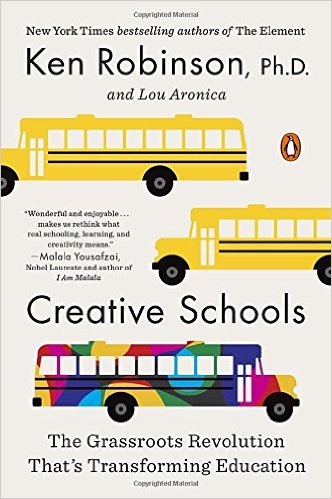
Creative Schools: The Grassroots Revolution That’s Transforming Education by Sir Ken Robinson and Lou Aronica

Wednesday, June 3rd, 2015
Creative

Creative Schools: The Grassroots Revolution That’s Transforming Education by Sir Ken Robinson and Lou Aronica ©2015 offers advice for educators and policy makers that can bring rigorous, personalized, and engaged education to everyone. As a leading voice in education, it’s vital that anyone interested hear what Sir Ken has to say. If you haven’t seen his number one TED Talk check that out too. Click at the bottom on any page to purchase this necessary book.

Sir Ken Robinson, PhD and Lou Aronica

  • Sir Ken is an English author, speaker, and international advisor on education in the arts to governments, non-profits, education, and arts bodies. He was Director of The Arts in Schools Project (1985–89), Professor of Arts Education at the University of Warwick (1989–2001), and was knighted in 2003 for services to education. He is the author of The Element, Finding Your Element, and Out of Ours Minds. His 2006 TED Talk How Schools Kill Creativity is the most watched in history with over 33 million views. Originally from a working-class Liverpool family, Robinson now lives in Los Angeles with his wife Marie-Therese and children James and Kate.
  • Lou Aronica is the author of three novels and the coauthor of several works of nonfiction, including the national best sellers The Culture Code, The Element, and Finding Your Element.

Introduction: One Minute to Midnight

  • The current reforms are being driven by political and commercial interests that misunderstand how real people learn, and how great schools work. As a result they are damaging the prospects of countless young people. The standards culture is harming students. In response, Sir Ken continues to push for a more balanced, individualized, and creative approach to education. Instead, schools take children with voracious appetites for learning and see to it that their appetites are dulled as they go through school. Current efforts focused on raising standards through competition and accountability do not work, and compound the problems they claim to solve. If you design a system based on standardization and conformity, you suppress individuality, imagination, and creativity. Schools that were designed to produce factory workers resemble factories with their assembly line approach. Current reforms stick with this approach only to be less in tune with the circumstances of the 21st century. Sir Ken thinks that schools need to be transformed not reformed, and that we know how to do it even though we aren’t.
Share this:
Share this page via Email Share this page via Stumble Upon Share this page via Digg this Share this page via Facebook Share this page via Twitter Share this page via Google Plus

Ball or Bands: Football vs Music as an Educational and Community Investment by John Gerdy

Monday, May 18th, 2015
Ball

Ball or Bands: Football vs Music as an Educational and Community Investment by John Gerdy (©2014) uses research to support the notion that due to costs, injuries, its focus on elite male athletes, and a negative impact on school cultures, support for high school football can no longer be defended. He also makes a case for why music and the arts in general need more support. He comes at this topic as a musician and an athlete with a brief career in the NBA. Click at the bottom of any page to get copies for your board of education members, and be strong if you take on king football.

John R. Gerdy

  • John is founder and executive director of Music for Everyone. A former all-American and professional basketball player, he served at the NCAA and as associate commissioner of the Southeastern Conference. He is author of Sports: The All-American Addiction and Air Ball: American Education’s Failed Experiment with Elite Athletics.

John’s Journey Through Sports and Music

  • The first two chapters outline John’s background experiences in athletics and music. While his father was a physics teacher, he was also the head football coach. Much to his father’s disappointment, John chose basketball and went on to become the leading career scorer at Davidson College followed by a brief professional career. He then went on to get a PhD and work several jobs as a sports administrator. His music life started in eight grade where he quit the school chorus because the director wouldn’t do any Beatles songs (1971). In high school he picked up the guitar, and over time gradually learned percussion and saxophone. As he moved around, he looked for opportunities to play in pick up bands and perform in clubs.
  • When his kids started school he volunteered to perform and teach, and even went so far as to develop a seven-week blues curriculum, which culminates in an assembly where children sing and play percussion to a blues song that they have written. John sees little difference between open mic and pick up basketball or other team sports. Each group is striving toward a common goal, which is to figure out where everyone’s talents can contribute.
Share this:
Share this page via Email Share this page via Stumble Upon Share this page via Digg this Share this page via Facebook Share this page via Twitter Share this page via Google Plus