Archive for the ‘Book Summaries’ Category
Thursday, May 7th, 2015
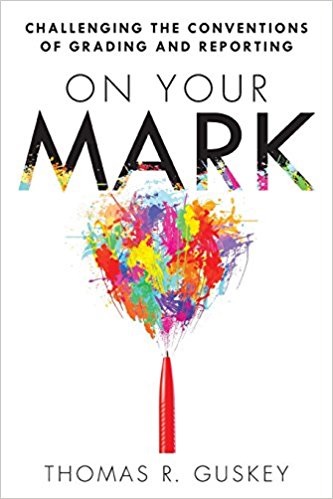
On Your Mark: Challenging the Conventions of Grading and Reporting ©2015 by Thomas R. Guskey explains to all teachers why their grading practices are probably wrong for many reasons. If you teach or know teachers you need to share this book. Click the icon at the bottom of any page to get this essential book.
Thomas R. Guskey
- Thomas is Professor of Educational Psychology in the College of Education at the University of Kentucky. A graduate of the University of Chicago, he began his career in education as a middle school teacher, served as an administrator in Chicago Public Schools, and was the first Director of the Center for the Improvement of Teaching and Learning. He is the author/editor of 18 books and over 200 articles. Dr. Guskey served on the Policy Research Team of the National Commission on Teaching & America’s Future, on the Task Force to develop the National Standards for Staff Development, and recently was named a Fellow in the American Educational Research Association. His books include Developing Standards-Based Report Cards (2010), Practical Solutions for Serious Problems in Standards-Based Grading (Ed.) (2009), The Principal as Assessment Leader (Ed.) (2009), The Teacher as Assessment Leader (Ed.) (2009), and Benjamin S. Bloom: Portraits of an Educator (Ed.) (2006).
1. Define the Purpose of Grades
- Guskey finds that there is little in the way of formal teacher preparation that deals with this subject. Teachers, therefore, tend to grade the way they were graded. As for report cards, they are usually cobbled together by a committee that takes what they like from other schools’ work. The process features enough compromise that everyone ends up with report cards that everyone can stand, but that no one really likes.
- If you want to reform your reporting process the first thing you should do is step back and ask what is your purpose. There might be many and it is likely that no single reporting instrument will serve all your purposes well. While schools and policy makers aim for success by all, if that really happened there would be no variation in grades. This doesn’t happen and teachers and test makers set out to sort students and they tend to be very successful. Bottom line is that your reporting process should be aimed at facilitating student learning. Guskey recommends that whatever your purpose is, it should be printed on your report.
Posted in Book Summaries, Education Books, Leadership Books | No Comments »
Wednesday, April 29th, 2015
Intelligence and How to Get It: Why Schools and Cultures Count ©2009 by Richard Nisbett shows how intelligence is mostly determined by one’s environment and provides concrete things that parents and teachers can do to make kids smarter. He is convinced that intelligence has nothing to do with race and lots to do with hard work. This is a must read for educators and parents alike.
Richard Nisbett
- Richard is a distinguished professor at the University of Michigan. He has written numerous books on intelligence and cultural psychology, and is a member the National Academy of Sciences. If you like this book you might also like The Geography of Thought: How Asians and Westerners Think Differently and Why and Culture of Honor: The Psychology of Violence in the South with Dov Cohen.
10. Raising Your Child’s Intelligence…and Your Own
- Here are Rickard’s tips from the final chapter that you should share with all parents you know. The previous chapters delve into each of these tips and backs them up with research. 1) Talk to your child using high-level vocabulary, and include children in adult conversations. 2) Read to your child and ask questions to look for understanding. 3) Minimize reprimands and maximize comments that will encourage your child to explore the environment. 4) Teach how to categorize objects and events and how to make comparisons among them. 5) Encourage your child to analyze and evaluate interesting aspects of the world. 6) Give your child intellectually stimulating after-school and summertime activities. 7) Steer your child toward peers who will promote intellectual interests. 8) Exercise while you are pregnant and continue exercising into old age. Make sure your children do the same. 9) Brest feed if you can for nine months. More doesn’t seem to help. 10) Model delaying gratification. 11) Teach children that their intelligence is under their control. 12) Praise children for hard work not for being intelligent. 13) Avoid giving rewards for activities that are intrinsically rewarding. Save rewards for things they might not otherwise try. Avoid praise that could make the child feel like they are being evaluated. 14) Do what you can to get the best teachers for your child and avoid rookies. Look for schools that promote cooperative learning.
Posted in Book Summaries, Education Books, Leadership Books | No Comments »
Monday, April 13th, 2015
the smartest kids in the world: and how they got that way ©2013 by Amanda Ripley tells the stories of three American exchange students’ experiences in Finland, South Korea, and Poland. These countries were selected due to their high performance in the international PISA exams. While very different in many ways, all three countries feature highly prepared teachers, cultures where students are expected to develop higher-order thinking skills, and a high-stakes test for students at the end of high school. There are lessons here for the US. Be sure to pick up a copy for yourself and any policy makers you know.
Amanda Ripley
- Amanda is a literary journalist whose stories on human behavior and public policy have appeared in Time, The Atlantic, and Slate and helped Time win two National Magazine Awards. She has appeared on ABC, NBC, CNN, FOX News, and NPR. Her first book, Unthinkable: Who Survives When Disaster Strikes and Why, was published in fifteen countries and turned into a PBS documentary. Join her on Twitter at @amandaripley and follow her blog at AmandaRipley.Com.
The Mystery
- When Amanda looked at the results of the international test scores she noticed that many countries out performed the US. In an attempt to find out why she recruited three exchange students who spent the 2010-11 school year in Finland, South Korea, and Poland. These so-called field agents introduced her to other students, parents, and teachers who helped in her quest. Video interviews with her subject sources are available at AmandaRipley.Com.
Tags: Amanda Ripley, the smartest kids in the world
Posted in Book Summaries, Education Books, Leadership Books | No Comments »
Monday, March 23rd, 2015
Reign of Error: The Hoax of the Privatization Movement and the Danger to America’s Public Schools (©2014) by Diane Ravitch takes on the private-sector school leaders and the political officials behind our current reform movement. Diane exposes the many myths that have driven reform, and supplies solutions that we should seriously consider. If you want to know what’s wrong with education reform this book is a must. Be sure to click at the bottom of any page to get copies for concerned educators and parents you know.
Diane Ravitch
- Diane is a research professor at New York University. She served as Assistant Secretary of Education for Research for George H. W. Bush, and was appointed to the National Assessment Governing Board by Bill Clinton. She is the author of ten previous books. In 2011, she received the Daniel Patrick Moynihan Prize from the American Academy of Political and Social Science. She has an excellent blog at DianeRavitch.Net and is active on Twitter @DianeRavitch.
Our School Are at Risk
- Politicians on both sides along with our media seem to agree that public education is broken. This has feed the ideas that we need to close schools and fire a large number of teachers and administrators. It wasn’t until Diane saw the corrosive effects of No Child Left Behind (NCLB) legislation that she recanted her support for high-stakes testing, test-based accountability, competition, and school choice via charter schools and vouchers. NCLB’s unrealistic goals have turned reform into a privatization movement, which was probably the intent of many of the bill’s supporters.
- Diane claims that what works is what well off parents do and expect schools to do. This includes rich programs in the arts, physical education, libraries, well maintained schools, small classes, and after school programs where students can explore their interests. There should be a joyful pursuit of play, time to sing and dance, and draw. Diagnostics should focus on what students know, and what they need to learn next. These same parents supply learning opportunities before and after their kids start school unlike poor parents who generally have less education themselves.
The Context for Corporate Reform
- Diane points out that much of the rational for NCLB was based on a Texas Miracle that never existed. The law’s impossible goals guaranteed failing schools that could be closed so the students could be shifted to charter or private schools, and first among the failing schools were those that served poor and minority children. Charters were supposed to innovate and share success with public schools. Due to the competitive nature of the reform movement, however, sharing between schools doesn’t happen much. It wasn’t long after NCLB passed that teaching to the test, narrowing the curriculum, and outright cheating became common proactices.
- Rather than fix NCLB when it was up for reauthorization in 2007, Congress did nothing, which left an opening for the Obama administration to introduce Race to the Top (RTTT) in a unilateral manner. The only real difference between the two was that RTTT introduced the use of test scores to evaluate teachers. It also put more emphasis on competition as a means of allocating federal funding.
Posted in Book Summaries, Education Books, Leadership Books | No Comments »
Thursday, March 12th, 2015
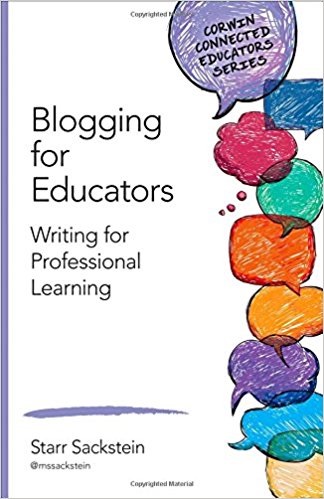
Blogging for Educators: Writing for Professional Learning by Starr Sackstein provides a strong rational for why educators should blog along with advice on how to get started. She is one of the best education bloggers I have found to date, and I explore the educational blogosphere every day. Be sure to click the icon at the bottom of any page to get copies for teachers you know.
Starr Sackstein
- Starr is a high school English and Journalism teacher at World Journalism Preparatory School in Flushing, NY. She is also the author of Teaching Mythology Exposed: Helping Teachers Create Visionary Classroom Perspective. She does a blog for Education Week called Work in Progress in addition to her personal blog at StarrSackstein.Com where she discusses all aspects of being a teacher. She moderates #jerdchat and #sunchat and contributes to #NYedChat. If you are looking for an energetic, high quality speaker on the subjects of blogging, journalism education, and bring your own device (BYOD), contact her at twitter (@mssackstein) or FaceBook.
Introduction
- Starr sees blogging as an important tool for educations leaders and students. Blogging adds virtual connections to writing, which is a vital part of communication. Sharing reflections and ideas with an audience can certainly richen one’s educational experience. Few educators, however, have been formally prepared with the necessary skills for teacher blogging, which is the main purpose of this book. This book should make it easier for you to help students reflect, develop metacognitive skills, foster an authentic voice, and develop a deeper understanding of their strengths and challenges.
1. Why Blog
- Starr starts by pointing out that blogs are the natural evolution of diaries and journals. Anyone in the habit of daily entries is certainly a natural for blogging. The difference of course is that blogs by their nature are public. They generally also allow for comments, so they can be much more collaborative than their predecessors. To buy Starr’s argument you need to share her vision that regular blogging will enhance your writing and thinking ability as you gain stamina and an outlet for your creativity. It will also make you more accountable to your audience and allow opportunities for greater reflection.
- Like myself, Starr had help from someone who knew more about the technicalities of setting up a blog, so don’t feel bad if you do too. Most districts should have tech support to help you get thinks going. Perhaps an easier place to start is with a Twitter account. With a 140 character limit, Twitter is considered a microblog. Once you start you can follow your favorite news outlets, which can save you time. Also try to find educators with common interests to connect with. (Each day I post the Twitter names of top bloggers.) Look for opportunities to engage in Twitter chats. My favorite is #edchat. In addition to tweeting out your thoughts and opinions, you can seek help for others. The purpose for blogging in a teaching context is to expand your personal learning community (PLN).
- Make sure your tweets and posts avoid going off on a tirade, and back up your opinions. While it is easy to tweet every day, extended blog posts might be something you post less often. Keep in mind that once you start, students and parents will naturally find and follow you, so you might as well use your blog to connect them to what happens in your classroom and school. At the end of this chapter there are links and advice from other teachers who blog. Like all chapters, it also ends with reflection questions that you can consider yourself and discuss with others.
Tags: Blogging for Educators, Starr Sackstein
Posted in Education Books | No Comments »