Archive for the ‘Book Summaries’ Category

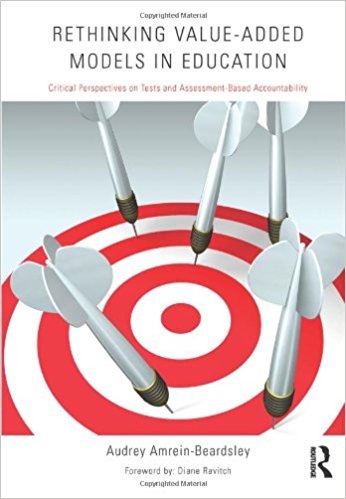
Rethinking Value-Added Models in Education: Critical Perspective on Tests and Assessment-Based Accountability by Audrey Amrein-Beardsley

Wednesday, February 11th, 2015
VAM

Rethinking Value-Added Models in Education: Critical Perspective on Tests and Assessment-Based Accountability by Audrey Amrein-Beardsley describes and analyzes the imposition of value added test-based evaluation of teachers, the theory behind it, the real-life consequences, and its fundamental flaws. It contains great detail and should be in the hands of any person or organization fighting this alarming practice. Click at the bottom of any page to get a copy for your school’s professional development library.

Audrey Amrein-Beardsley, PhD

  • Audrey is a former middle and high-school mathematics teacher. She received her PhD in 2002 from Arizona State University in the Division of Educational Leadership and Policy Studies. She is an Associate Professor in the Mary Lou Fulton Teachers College at Arizona State University, and one of the top education scholars in the nation who has been honored for contributing to public debates about the nation’s educational system. Audrey’s research interests include educational policy, research methods, and more specifically, high-stakes tests and value-added measurements and systems. In addition, she researches aspects of teacher quality, teacher evaluation, and teacher education. She is the creator and host of an online biographical show titled Inside the Academy during which she interviews top educational researchers. She is also the creator and host of the blog: VAMboozled!.

1. Socially Engineering the Road To Utopia

  • Audrey starts with examples of how governments use policies to socially engineer the societies they govern. It starts with something in the way of a worst case example involving the Cambodian government who had a policy to kill all the intellectuals after the Vietnam War ended. The social engineering currently aimed at schools is traced back to the publication of A Nation at Risk in 1983. It began a series of policies that lead to the Measure and Punish or M & P theory of change. Using standardized tests to enforce accountability turns out to be an overly simplistic causal model. A better model would be more difficult to understand and defend as it would have to consider students’ levels of intelligence, social capital, and levels of risk. To this point, empirical evidence shows that the M & P theory is flawed and misguided, and many of it’s early proponents have become its biggest opposition.
  • There many reports of how teachers and administrators have gamed the system and resorted to outright cheating. By some standards, the M & P theory of change and its policy derivatives might be viewed as the greatest failed social engineering project of our time. At the end of each chapter, Audrey includes a box with the top ten assertions made in the chapter. You might consider reading these boxes first and last.
Share this:
Share this page via Email Share this page via Stumble Upon Share this page via Digg this Share this page via Facebook Share this page via Twitter Share this page via Google Plus

You’ve Gotta Connect: Building Relationships that Lead to Engaged Students, Productive Classrooms, and Higher Achievement by James Alan Sturtevant

Monday, January 26th, 2015

You’ve Gotta Connect: Building Relationships that Lead to Engaged Students, Productive Classrooms, and Higher Achievement by James Alan Sturtevant makes the case that the most important thing teachers can do is connect with and accept their students. It may not always be easy, but once you do connect, students will behave better and learn more. This book is packed with great advice and belongs in every teachers professional development library. Click at the bottom on any page to purchase copies for teachers you know.

James Alan Sturtevant

  • James has worked as a high school social studies teacher since 1985. He see it as a wonderful activity but his job by no means defines him. Since the early 1990s he has taught at Big Walnut High School located in Sunbury, Ohio. He earned a BA in history and Political Science from Muskingum University in New Concord, Ohio, and an MA in history from the Ohio State University in Columbus, Ohio. He has been married to Penny Sturtevant since 1991.  Penny is the principal at Big Walnut Middle School. They have three children that they love dearly.

1. Commitment: Don’t Start Class Without It.

  • When a visiting professor asked him how he created such a wonderful atmosphere in his classroom, James gave it much thought and came up with the following. Connections have improved as his career has progressed. Connection is not automatic as he had to work at it. You don’t have to have his personality type to connect. You need to be willing to try new approaches and gauge their effectiveness. As a result of this pondering, this book was born.
  • To begin, you have to make a commitment to connect, even with students who have annoying attitudes. You also need to be prepared to work hard on connecting with some students. Humans need connection and when they connect, they are more likely to be happy and productive. Connected students will be more engaged in learning and more creative as well. They will retain more, have fewer behavior issues, feel better about themselves, get along with other students, achieve at higher levels, and not drop out. Keep in mind that you can care for a student and still have high expectations.
  • James suggests that you make a poster for yourself that contains what effective communication is and is not. (See page 22) In short, you need to be: available, caring, respectful, trustworthy, warn, welcoming, compassionate, loving, interested in students, a great listener, and accepting. What you shouldn’t do is: act like a peer, try too hard to be liked, gossip, have vague boundaries and expectations, be sarcastic, pamper students, be phony, demand respect rather than earn it, and pretend to care. Like the other chapters in this book, this one ends with a number of activities that you can do by yourself or with others to help internalize the key concepts.
Share this:
Share this page via Email Share this page via Stumble Upon Share this page via Digg this Share this page via Facebook Share this page via Twitter Share this page via Google Plus

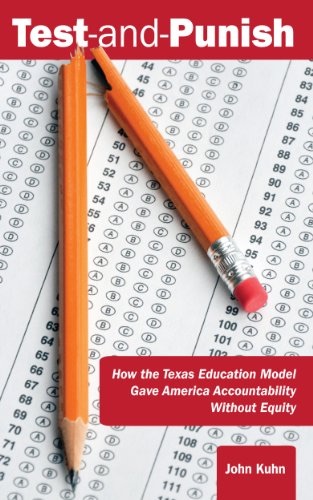
Test-and-Punish: How the Texas Education Model Gave America Accountability Without Equity by John Kuhn

Thursday, January 8th, 2015
Test-And-Punish

Test-and-Punish: How the Texas Education Model Gave America Accountability Without Equity by John Kuhn follows the history of the modern education reform movement from its roots in Texas. While the tone is strongly one-sided, John makes a compelling case for reforms that diagnose-and-support and finds a way to finance schools in a more equitable manner. If you haven’t joined his battle, it may be time. Click at the bottom of any page to purchase this powerful argument.

John Kuhn

  • John Kuhn is a public school administrator in Texas and a vocal advocate for public education. His Alamo Letter and YouTube videos of his 2011 speech at a Save Texas Schools rally went viral, as did his 2012 essay The Exhaustion of the American Teacher. He has written two education-related books, 2013’s Test-and-Punish (Park Place Publications) and 2014’s Fear and Learning in America (Teachers College Press).

Prologue

  • Although this book talks a lot about Texas, it is actually a book about national education policy. It’s focus is the test-and-punish craze that has dominated education policy-making in the United States since former Texas governor George W. Bush worked to introduce No Child Left Behind legislation. John sees this law and subsequent iterations as a series of big mistakes. This would include the use of data to punish schools, teachers, and students; the reduction of school quality to a simple menu of labels; vacating the concept of supports in favor of consequences; the misuse of test scores to force privatization; the implementation of accountability algorithms to attain political goals; the increasing investment of limited funding and time for the sake of standardized tests; and the sidelining of teachers in favor of lobbyists and politicians in designing accountability legislation. He takes heart in the fact that a band of passionate parents and feed-up teachers, board members, and administrators are fighting back, and he sees this push back to the reform movement spreading to other states.
Share this:
Share this page via Email Share this page via Stumble Upon Share this page via Digg this Share this page via Facebook Share this page via Twitter Share this page via Google Plus

The Innovators: How a Group of Hackers, Geniuses, and Geeks Created the Digital Revolution by Walter Isaacson

Tuesday, December 30th, 2014

The Innovators: How a Group of Hackers, Geniuses, and Geeks Created the Digital Revolution by Walter Isaacson tells the stories of the people most responsible for getting us to where we are in terms of technology. Each chapter focuses on a different innovation that made today’s world possible. It starts in the mid 1800’s when computers were just ideas and takes us to the present time. Click at the bottom of any page to get this very cool history book.

Walter Isaacson

  • Walter is the CEO of the Aspen Institute, has been the chairman of CNN, and the managing editor of Time magazine. He is the author of Steve Jobs; Einstein: His Life and Universe; Benjamin Franklin: An American LIfe; and Kissinger: A Biography. He is also the coauthor of The Wise Men: Six Friends and the World They Made. He lives in Washington, DC.

Introduction

  • The computer and the Internet are among the most important inventions of our era, but few people know who created them. These and other key inventions of the digital age were done collaboratively by many fascinating people who are featured in this book. The focus is on their characteristics and how they collaborated. When it comes to inventions, we tend to focus on individual genius rather than the teamwork that is almost always required. Walter also looks at the social and cultural forces that provided the atmosphere for key innovations. He notes happily that much creativity that gave us the digital age came from those who were able to connect the arts and sciences. It seems that the human-machine symbiosis that grew out of the connection between the personal computer and the Internet was largely given to us by people who stood at the intersection of the humanities and technology.
Share this:
Share this page via Email Share this page via Stumble Upon Share this page via Digg this Share this page via Facebook Share this page via Twitter Share this page via Google Plus

Excellent Sheep: The Miseducation of the American Elite and the Way to a Meaningful Life by William Deresiewicz

Friday, December 19th, 2014

Excellent Sheep: The Miseducation of the American Elite and the Way to a Meaningful Life by William Deresiewicz uses abundant qualitative research along with his own experience to paint a picture of a dysfunctional system and offer suggestions for how to fix it. There is serious advice for students and parents so they can avoid the traps the system offers. The system does a disservice to elite students who are almost uniformly wealthy as it screens out children from lower classes. While the rich have always had educational advantages, the disparity is worse than ever. Click the icon at the bottom of any page to purchase this thought provoking book for yourself and any policy makers, parents, and students you know.

William Deresiewicz

  • William was a professor at Yale until 2008. He is the author of the landmark essays The Disadvantages of an Elite Education, and Solitude and Leadership, and the book A Jane Austin Education: How Six Novels Taught Me About Love, Friendship, and the Things That Really Matter. He is a frequent speaker on campuses around the country, a contributing writer for The Nation, and a contributing editor for The New Republic and The American Scholar.

Introduction

  • William believes that our elite universities have produced students who are smart, talented, and driven, but also anxious, timid, and lost, with little intellectual curiosity and a stunted sense of purpose. They are trapped in a bubble of privilege, heading meekly in the same direction, great at what they do, but with no idea why they are doing it. His real critique in the book is aimed at the adults who’ve made them who they are. He also aims to help students rescue themselves from the system. Even though it’s aimed a college students, there are good lessons here for high school students, their parents, and educators everywhere.

1. The Students

  • The students in this book appear to be the winners of the race that adults have made of childhood. While they appear healthy, beneath the surface we often find toxic levels of fear, anxiety, and depression. Surveys indicate that emotional well-being has fallen to its lowest level in the 25-year history of the study with half reporting feelings of hopelessness, and a third saying that depression has made it difficult to function. There is also an increase in the use of antidepressants, antianxietals, and stimulants like Adderall.
  • Starting in grade school they are constantly jumping through hoops that include school work, athletics, music, and other activities that leaves them no time and no tools to figure out what they want out of life. Once they get into a selective school, they often have no idea why they are there. They have learned how to be a student, but not how to use their minds. Most are good at coloring inside the lines with little or no passion about ideas. There life is all about the accumulation of gold starts, and they can’t imagine doing something that can’t be put on a resume. Rather than learning as much as possible, they seek to do as little as possible as long as they get A’s. Most students dress, look, and act the same so what passes for diversity looks more like 32 flavors of vanilla. The selection process produces students who have only experienced success, but this hides the fact they live with a constant fear of failure. They are risk adverse and are increasingly seeking fewer and fewer different majors.
Share this:
Share this page via Email Share this page via Stumble Upon Share this page via Digg this Share this page via Facebook Share this page via Twitter Share this page via Google Plus