Archive for the ‘Book Summaries’ Category

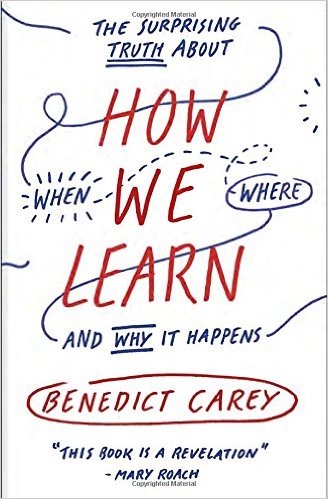
How We Learn: The Surprising Truth About When, Where, and Why It Happens by Benedict Carey

Monday, December 15th, 2014

Learn academic writing with AcademicHelp.net. See a lot of free writing guides and samples.
How We Learn

How We Learn: The Surprising Truth About When, Where, and Why It Happens by Benedict Carey summarizes research on this topic, much of which educators have yet to implement. Education’s leaders need to read this book and work to reform the system accordingly. Click the icon at the bottom of any page to get a copy for educators you know.

Benedict Carey

  • Benedict is an award-winning science reporter who has been at The New York Times since 2004. He is one of the newspaper’s most emailed reporters. He has a bachelor’s degree in math from the University of Colorado, and a master’s degree in journalism from Northwestern University. He has written about health and science for twenty-five years and lives in New York City.

Introduction

  • Benedict starts with his own story about how he got mostly A’s in school along with low SAT scores and couldn’t get in to any of his desired colleges. Along the way he discovered many of the techniques he covers in this book that allowed him to integrate the exotica of new subjects into daily life, in a way that makes them seep under his skin. He has mined the latest science to so how you can make learning part of living and less about isolated choice during his writing career.

1. The Biology of Memory

  • Benedict starts with a simplified explanation of how the brain is structured. Thanks to the study of brain injured patients, science has developed some understanding of how the brain stores and retrieves memories. At the bottom center of the brain is the hippocampus, which is vital for the formation of memories. One type of memory called episodic is used to remember events that take place over time like the first day of high school. The other type is semantic, which deals with facts rather than experiences. When we retrieve a memory of an event, we need to reconstruct it. As a result, the story is likely to change over time as one doesn’t put the story together the same way each time. The basic plot, however, should not change much if at all. In essence, using our memory changes our memory.
  • We have another kind of memory that remembers physical skills. This is called motor learning and is not dependent on the hippocampus. We also have conscious and subconscious systems and a lot goes on while we are at sleep. Thanks to surgery on patients with split brains, we know that the left side is the wordsmith while the right side is the visual expert. The left brain interprets what we experience and makes stories that we use to remember what happened. We have at least thousands of brain modules that perform skills like calculating changes in light, tone of voice, and changes in facial expression, and they all run at the same time.
Share this:
Share this page via Email Share this page via Stumble Upon Share this page via Digg this Share this page via Facebook Share this page via Twitter Share this page via Google Plus

Who’s Afraid of the Big Bad Dragon? Why China Has the Best (and Worst) Education System in the World by Young Zhao

Monday, December 1st, 2014

Who’s Afraid of the Big Bad Dragon? Why China Has the Best (and Worst) Education System in the World by Young Zhao offers and insider’s account of the Chinese school system, revealing the secrets that make it both the best and the worst. Yong was born in China and taught there. He has also maintained contact in order to tell us how China produces top scores on international tests but falls short when it comes to innovation and creativity. There are big lessons here for US policy makers. Click below to purchase this outstanding book that should be of interest to students, parents, and educators alike.

Yong Zhao

  • Yong holds the first presidential chair at the University of Oregon, where he serves as associate dean for global education, and professor in the Department of Educational Measurement, Policy, and Leadership. He has been featured in media ranging from The New York Times and USA Today to NPR and ABC. He is the author of more than 100 articles and 20 books. Check out his website and follow him on Twitter @YougZhaoUO.

Introduction – Fatal Attraction: America’s Suicidal Quest for Educational Excellence

  • The virus threatening America’s schools is the rising tide of authoritarianism. Most Americans have failed to recognize that government mandated tests are a Trojan horse containing the ghost of authoritarianism as they attempt to instill in all students the same knowledge and skills deemed valuable by the authority. All one need do is look to China to see the full range of tragic events that can happen under authoritarian rule. China indeed has produced superior test takers, but has failed to cultivate talents and creativity.
  • The damage being done takes instructional time away for testing, demoralizes teachers, and narrows educational experiences. Lost is a creative culture that celebrates diversity and respects individuality. School boards have surrendered to state and federal governments, and now in effect, only collect local taxes. Instead of learning from China’s miseries, we seen to be on the road to duplicate them. Do we want a system like China where only 10% of college graduates are deemed employable by multinational businesses because the students lack the qualities our new society needs?
Share this:
Share this page via Email Share this page via Stumble Upon Share this page via Digg this Share this page via Facebook Share this page via Twitter Share this page via Google Plus

Aspiring Adults Adrift: Tentative Transitions of College Graduates by Richard Arum and Josipa Roksa

Monday, October 13th, 2014

Aspiring Adults Adrift: Tentative Transitions of College Graduates by Richard Arum and Josipa Roksa is a follow up to their landmark Academically Adrift that made the case for how many college students end up learning very little, end up unemployed or under employed, and living at home. Now they follow this same college cohort two years after graduation and see that many found a difficult transition to adulthood. Together these works should challenge students and colleges to rethink the aims, approaches, and achievements of higher education. Click here to read my summary of Academically Adrift.

Richard Arum and Josipa Roksa

  • Richard is a professor in the Department of Sociology with a joint appointment in the Steinhardt School of Education at New York University. He is a senior fellow at the Bill & Melinda Gates Foundation and the author of Judging School Discipline: The Crisis of Moral Authority in American Schools. Josipa Roksa is associate professor of sociology and education and associate director of the Center for Advanced Study of Teaching and Learning in Higher Education at the University of Virginia.

1. The Study

  • This book is based on research that tracks more than 1,600 students (emerging adults) through their senior year at twenty-five diverse four-year colleges and universities, and approximately 1,000 college graduates from this sample for two years following their graduation in 2009. They also did in-depth interviews with a subset of 80 graduates in 2011 in order to find how post-college outcomes were associated with collegiate experiences and academic performance. Like their previous study, they used the Collegiate Learning Assessment (CLA) to measure critical thinking, complex reasoning, and written communication around the time of their graduation.
Share this:
Share this page via Email Share this page via Stumble Upon Share this page via Digg this Share this page via Facebook Share this page via Twitter Share this page via Google Plus

New Math – New Technology = Failure by Elizabeth Green

Friday, September 5th, 2014

New Math – New Technology = Failure by Elizabeth Green (no relation) deals with the Common Core’s approach to teaching math and how few schools seem to have shown teachers how to teach it. This is from the July 27, 2014 edition of The New York Times Magazine. Read the entire article here.

Be sure to check out her new book Building a Better Teacher: How Teaching Works (And How to Teach It to Everyone). Also see Behind the Cover Story: Elizabeth Green on America’s Math Crisis. This is an interview by Rachel Nolan @rachelbnolan @nytmag.

Elizabeth Green

  • Elizabeth is co-founder, CEO, and editor-in-chief of Chalkbeat, a nonprofit news organization that covers educational change efforts across the country. She has written for The New York Times Magazine, The New York Sun, and U.S. News & World Report. She was an Abe Journalism Fellow studying education in Japan and a Spencer Fellow in education journalism at Columbia University. She serves on the board of the Education Writers Association. To consider asking her to speak click here. On Twitter she is @elizwgreen
Share this:
Share this page via Email Share this page via Stumble Upon Share this page via Digg this Share this page via Facebook Share this page via Twitter Share this page via Google Plus

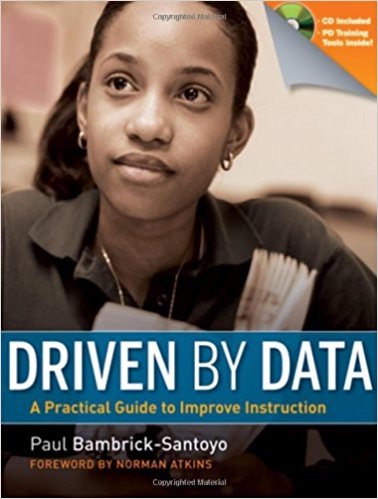
Driven by Data: A Practical Guide to Improve Instruction by Paul Bambrick-Santoyo

Thursday, August 21st, 2014
Data

Driven by Data: A Practical Guide to Improve Instruction by Paul Bambrick-Santoyo offers a step by step approach to preparing your students for high-stakes tests while students work to master standards. While you may be hoping for the current testing madness to end, Paul offers a practical way for your school to out perform other schools with similar demographics while the current tests are still with us. Part two includes specific workshop activities for data leaders.

Paul Bambrick-Santoyo

  • Paul is managing director of Uncommon Schools, leading six schools in the North Star Academy network that have achieved some of the highest results in the country. He has trained over 2,000 school leaders nationwide, and is the Data-Driven Instruction faculty member for New Leaders for New Schools, an urban school leadership training program.

Physicals or Autopsies?

  • Paul likens the analysis of end-of-year and high-stakes state testing to an autopsy where the purpose is to find out why the patient died. He prefers that educators spend their time looking at the results of interim tests and use them to inform instruction. This is similar to how a physician would use the results of a physical to determine treatment and recommend lifestyle changes. Paul also warns that data-driven instruction is not an elaborate stratagem for promoting “test prep.” While he sees many faults in the NCLB testing culture, he is happy to see educators focusing more on accountability for student achievement, and interim assessments hold them accountable throughout the year.

Excellent Interim Assessments

  • In order to be effective, interim assessments must be of high quality, which is seldom what you get when individual teachers slap something together at the end of a unit. The tests need to be in place prior to the start of the school year and be available to the teachers. Every teacher at the same grade level or subject should be using the same tests at the same time. This allows teachers to analyze the results together. Paul recommends assessments every six to eight weeks. Too seldom allows weaknesses to go unrecognized. Too often and teachers may not have time for satisfactory analysis. It is also important that teachers be involved in test creation or selection. Paul is ok with purchased tests as long a teachers get to see them. Some vendors don’t allow this in order to maintain test validity.
  • The tests are not seen as an end, but as a beginning. This is because they let the teachers know what needs to be taught and the desired level of rigor. When they are given, the results need to be available soon. (Doug: When I taught I always graded assessments the day they were given, and the students got the results as part of the next class. With some kinds of computerized testing, students can see their results immediately.)
Share this:
Share this page via Email Share this page via Stumble Upon Share this page via Digg this Share this page via Facebook Share this page via Twitter Share this page via Google Plus