The Invisible Gorilla: And Other Ways Our Intuitions Deceive Us by Christopher Chabris and Daniel Simons, (©2010, CROWN: New York, NY.) is about six everyday illusions that profoundly influence our lives. They are the illusions of attention, memory, confidence, knowledge, cause, and potential. These are distorted beliefs we hold about our minds that are not just wrong, but wrong in dangerous ways. Once you know about these illusions, you will view the world differently and think about it more clearly. You will recognize when people are taking advantage of illusions in an attempt to obfuscate or persuade. Seeing through these veils will help connect you with reality. I will soon post a summary of Cathy Davidson’s Now You See It which draws heavily on this book.
Archive for the ‘Book Summaries’ Category
Invisible Gorilla Revised Summary
Thursday, November 3rd, 2011Brain-Powered Science Reform Your Science Program
Wednesday, October 19th, 2011Reform your science program one activity at a time with Dr. Thomas O’Brien’s three volume Brain-Powered Science: Teaching and Learning with Discrepant Events effort for grades 5-12. It is a cerebral treat for science teachers, science students, and science teacher educators alike. At the heart of each activity is a hands-on discrepant-event, which provides an unexpected outcome. This generates a need-to-know that motivates learners’ to think and often makes science fun and funny. The activities are safe, simple, inexpensive, enjoyable, effective, and relevant. Teachers who use these activities should also find that they serve to open their own doors to learning. In all cases there is a deep connection to recognized national science education standards. (Brain-Powered Science, (© 2010) More Brain-Powered Science, (© 2011), and Even More Brain-Powered Science, (© 2011) are published by the NSTA Press: Arlington, VA.)
Zig Zag Principle – A Revolution in Goal Setting
Monday, October 10th, 2011InThe Zig Zag Principle: The Goal-Setting Strategy That Will Revolutionize Your Business and Your Life, Rich Christiansen (© 2012 Mountain Grabbers, a McGraw-Hill Company: New York, NY) offers a goal setting strategy that he believes will revolutionize your business and your life. This book is a step-by-step tactical book. It is not a theory or a vague concept. It offers practical application tips you can use to succeed on the job and in life. While is ostensibly a business book, I believe the concepts apply well to the field of education.
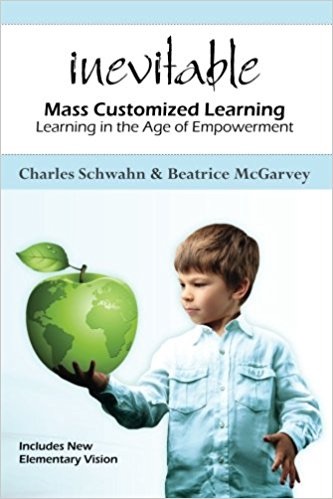
Inevitable: Mass Customized Learning in the Age of Empowerment
Thursday, September 22nd, 2011
Inevitable: Mass Customized Learning in the Age of Empowerment by Charles Schwahn & Beatrice McGarvey shares an exciting vision for education that uses today’s powerful mass customizing technology to meet the individual learning needs and interests of every learner every day. The goal is to do for learners what Apple does for music lovers, Amazon does for readers, and what Google does for seekers of information. Mass Customized Learning is necessary and doable.
Why This Book Is Necessary
- The world has left the Industrial Age of mass production and entered the Information Age of mass customization, except for education. We still presuppose that all students of the same age are ready to learn the same thing, the same way, in the same amount of time. This explains why people in general don’t think public schools are doing a good job. Technology has transformed nearly every sector of our lives and it should help enable changes toward customized learning. This is not only a book for teachers, but for everyone in the community especially students who will help show us how to do it. The models are available and there is no reason why it should cost more.
Facing Reality
- Schools are bureaucratic monopolies existing in a world of customization and service. What we teach now is not much different from a famous 1892 plan. The model was fine when dropouts could still get good jobs. It’s no longer ok to build in failure for some with a rigid time-driven system for learning. We know that not everyone learns at the same rate, but we plan as if they did. Not quite getting it is cumulative. Don’t ask if a child is ready for Kindergarten (or anything else), ask what is the child ready for.
- Policies and practices are chosen for administrative convenience and are inconsistent with basic learning research. We have expensive extra systems for those who need extra time while our fast runners are held back by the schedule and the curriculum. Averaging grades makes no sense. If someone can demonstrate learning they should move on. If they can’t, they’re just not finished yet. There also needs to be more relevance to the life students are living today and what they will face after school.
- Be sure to assess your agreement with these realities, which the authors admit may be overgeneralized, with the scale on page six. You should also take it again at the end to see if you have changed.
The Progress Principle: Breakthrough Leadership Ideas
Wednesday, September 7th, 2011The Progress Principle: Using Small Wins to Ignite Joy, Engagement, and Creativity at Work (©2011, Harvard Business Review Press: Cambridge, MA) by Teresa Amabile and Steven Kramer is based on an extensive study that tried to find out what it takes to be highly productive. What they found was that most of what matters is below the surface and not well understood by most of today’s managers. You can find a summary of their secrets here, and get the entire picture in this must have book. While it is not an education book, I find that the principles they have discovered apply well in school settings for use by teachers and administrators.