
Archive for the ‘Book Summaries’ Category

When You Come to a Fork in the Road, TAKE IT by Yogi Berra, with Dave Kaplan – Great for Educators & Parents

Friday, September 2nd, 2011
Yogi

When You Come to a Fork in the Road, TAKE IT: Inspiration and Wisdom from One of Baseball’s Greatest Heroes by Yogi Berra, with Dave Kaplan (©2001, Hyperon: New York, NY) is funny, insightful, and inspirational all at once. I have always been a big fan of Yogi as he seems like such an unlikely hero. He doesn’t look like a star athlete and at first, his speech doesn’t sound like it contains a lot of wisdom. He was the son of poor immigrants and dropped out of school after the 8th grade. In spite of this be became an MVP and winner of a record ten world series. He was a successful manager and many of his quotations have become known throughout our culture. As this book shows, they are not just amusing. The quotes along with Yogi’s philosophy contain a lot of wisdom mixed in with the humor. Many apply very well to the field of education as I try to show here. There are a lot of pages, but they are short and good.

When You Come to a Fork in the Road, TAKE IT!

  • Throughout life you come to serious forks in the road – decisions. No matter what decision you make, taking a job, getting married, buying a house, whatever it is, you shouldn’t look back. Trust your instincts. I’ve always done things that feel right. Learn from the choices you make and don’t second guess yourself.
  • On big life decisions get all the advice you can. Talk it over with parents, a mentor, a teacher, or a coach. They’ve had more life experience. They have more miles on them and can help you get on the right path. A teacher once asked me, “Don’t you know anything?” I said I don’t even suspect anything.

Enjoy The Moment

  • Nobody can help but be nervous in the World Series or at a job interview, or giving a presentation, or when you’re called on in class. You have to channel that nervousness. Enjoy the moment and make it a great experience. You need to learn to relax. You can’t be afraid of making a mistake. There’s always the next inning or the next day. Life goes on.

Nobody Did Nothin’ to Nobody

  • There were many times I had to help my teammates so that bad things didn’t happen. When you’re part of a team you stand up for your teammates. Your loyalty is to them. You protect them through good and bad because they’d do the same for you.
Share this:
Share this page via Email Share this page via Stumble Upon Share this page via Digg this Share this page via Facebook Share this page via Twitter Share this page via Google Plus

Paying Attention: Great Communication Tips

Tuesday, August 30th, 2011

Paying Attention: Thoughts on Communication in Schools by Troy Roddy, PhD (©2011, Troy P. Roddy) focuses on what might be the most important leadership topic, and the one most in need of improvement in schools and other institutions. If you ask people what needs to improve, communication will probably be at or near the top of the list. Troy packs excellent advice into 33 quick and easy pages to help anyone improve this important skill. It’s only $2.99 at Amazon. You can follow him on Twitter as @DrTroyRoddy or at his blog.

Share this:
Share this page via Email Share this page via Stumble Upon Share this page via Digg this Share this page via Facebook Share this page via Twitter Share this page via Google Plus

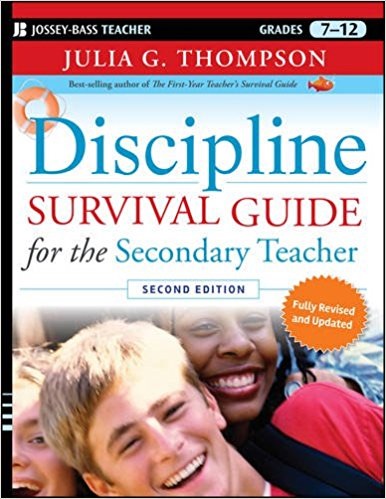
Discipline Survival Guide for the Secondary Teacher – by Julia Thompson

Thursday, August 25th, 2011
Discipline
Discipline Survival Guide for the Secondary Teacher, 2nd Ed, (©2011, Jossey-Bass: San Francisco, CA) Julia Thompson takes on what may be the most unpleasant part of the profession and a top reason why teachers leave. She draws on up-to-date research and theory that can help students become more self-disciplined, goal-oriented, and successful learners as teachers enhance leadership skills. She focuses on student motivation, classroom management, relationships, instructional techniques, safety, and high expectations. This 350-page effort is easy to read and can be used as a desktop reference. My summary contains key ideas, but there is a lot more I left out. Every student teacher, beginning teacher, and veteran teacher with discipline problems should have this at their side. Lots of advice for parents too. As a former secondary teacher and elementary principal, I can assure you most of this applies to students of all ages.

Successful Discipline Rests With You

  • It is important to take responsibility for what happens in class and to not dwell on who to blame for bad behavior. Outdated practices won’t work with modern students. Class activities should allow students to be active and involved, and let students help each other. Vary the action during a class. Ideally, you will challenge students with things they can attain. Work with students to set goals, watch for signs of trouble before it starts, and work with parents. Use questionnaires to gather interests and opinions and bring in popular culture and real-world connections when possible. Don’t hesitate to allow students to discuss their concerns and adjust your attitude to see them as joyful and vigorous rather than annoying. Be positive rather than cranky and critical. Overreacting only makes things worse. Be respectful rather than confrontational. Be sure to listen. Avoid sarcasm and present yourself as a confident leader. Give positive attention before students seek negative attention. A positive caring attitude is essential.

Take a Comprehensive Approach

  • You need to take a broad view and use a variety of methods as the job of discipline is very complex. Do what you can to make the room inviting and use the walls for student work. Work hard on getting to know each student and let them know what you expect. Prepare innovative lessons and have everything ready. Lessons should allow students to be active and usually talk more than the teacher. Focus students on being responsible for their own learning and avoid threats. A class should be a functioning community. You must manage your own stress. If students are agitated take a moment to think and stay cool. Thompson includes a list of common mistakes and ways to avoid them, a teacher self-assessment, a worksheet to develop your plan, and a section on how to put your expectations to work.
Share this:
Share this page via Email Share this page via Stumble Upon Share this page via Digg this Share this page via Facebook Share this page via Twitter Share this page via Google Plus

Alone Together: Why We Expect More From Technology and Less From Each Other

Monday, August 15th, 2011

Alone Together: Why We Expect More From Technology and Less From Each Other(© 2011, Basic Books: New York, NY) is Sherry Turkle’s third book that explores our lives on the digital terrain. Sherry has conducted hundreds of interviews to gather her data. She explores how the technology that lets us do anything anywhere with anyone can drain us as we try to do everything everywhere and are always on call. She looks at how relentless connections lead to a new solitude and impacts our emotional lives. She also sees hope as people seek to sustain direct human connection.

Share this:
Share this page via Email Share this page via Stumble Upon Share this page via Digg this Share this page via Facebook Share this page via Twitter Share this page via Google Plus

Always On: How the iPhone Unlocked the Anything-Anytime-Anywhere Future and Locked Us In

Friday, July 29th, 2011

Always On: How the iPhone Unlocked the Anything-Anytime-Anywhere Future and Locked Us In by Brian X. Chen (© 2011, Da Capo Press: Cambridge, MA), is an insightful look at technology’s all-in-one revolution and its consequences. Will we give more control to individual companies and sacrifice privacy and freedom in the process? This is the first book to take on the possible future that products like the iPhone may portend. Brian writes the regular Apple column for Wired Magazine. In order to write this book, Chen interviewed many of the top technology thinkers, innovators, and researchers.

Share this:
Share this page via Email Share this page via Stumble Upon Share this page via Digg this Share this page via Facebook Share this page via Twitter Share this page via Google Plus