Archive for the ‘Book Summaries’ Category

Free: The Future of a Radical Price – Chris Anderson

Friday, March 26th, 2010

This is a summary of Chris Anderson’s latest book. As Editor-In-Chife of Wired magazine, Chris is the guru of hipness. This book offers timely advice that can help anyone navigate the electronic world that surrounds us. If this summary grabs your interest, the details in the book offer a roadmap for survival today’s digital world.

Click here to see the summary of this book.

Share this:
Share this page via Email Share this page via Stumble Upon Share this page via Digg this Share this page via Facebook Share this page via Twitter Share this page via Google Plus

Talent is Overrated – Try hard work – Geoff Colvin

Saturday, February 20th, 2010

Geoff Colvin’s book by this title is cited often by writers in the leadership and education business. This book is based on abundant research and explains what deliberate practice is and how anyone can use it to be better even if they don’t become one of the greats. Like other books I summarize, I encourage you to purchase this one for yourself and/or your organization.

Click here to see the summary of this book.

Share this:
Share this page via Email Share this page via Stumble Upon Share this page via Digg this Share this page via Facebook Share this page via Twitter Share this page via Google Plus

Denialism – Irrational Thinking is Common – Michael Specter

Monday, January 25th, 2010

Denialism: How Irrational Thinking Hinders Scientific Progress, Harms the Planet, and Threatens Our Lives by Michael Specter deals with how large sections of our society are in denial about things that science supports. Included are topics like child immunizations, genetic engineering of our food supply, alternative medicine, and race-based medication. The following quote should give you some idea of what to expect:
“Denialism is not green or religious or anti-intellectual, nor is it confined to utopian dreamers, agrarians, or hippies. It is not right- or left-wing; it is a fear expressed as frequently and with as much fervor by Oxford dons as by bus drivers.”
Although the book is science centered, you don’t have to be a scientist to follow it.

Click here to see the excerpted summary of this book.

Share this:
Share this page via Email Share this page via Stumble Upon Share this page via Digg this Share this page via Facebook Share this page via Twitter Share this page via Google Plus

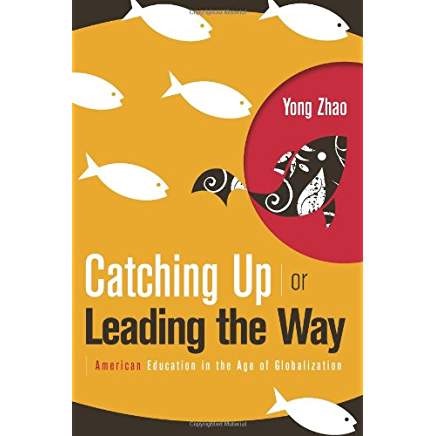
Catching Up or Leading the Way Yong Zhao

Monday, January 4th, 2010
Catching Up

Catching Up or Leading the Way: American Education in the Age of Globalization by Yong Zhao (©2009, ASCD: Alexandria, VA) tells the story of how China seems to want an education that America seems eager to throw away. This is one that respects individual talents, supports divergent thinking, tolerates deviation, and encourages creativity. At the same time, the US government is pushing for the kind of education that China is moving away from. This is one that features standardization of curricula and an emphasis on preparing students for standardized tests. He wonders why Americans who hold individual rights in high regard would let the government dictate what children should learn, when they should learn it, and how they are evaluated.

Meet Yong Zhao

  • Dr. Zhao grew up in China and immigrated to the US in the 1990’s. Yong Zhao is currently Presidential Chair and Associate Dean for Global Education, College of Education at the University of Oregon, where he also serves as the director of the Center for Advanced Technology in Education (CATE). He is a fellow of the International Academy for Education. Until December, 2010, Yong Zhao was University Distinguished Professor at the College of Education, Michigan State University, where he also served as the founding director of the Center for Teaching and Technology, executive director of the Confucius Institute, as well as the US-China Center.

Get My Kid Out of Here

  • Zhao relates a story about his son who told him that he figured out how to get a better score on Michigan’s NCLB tests. His strategy was to stop being creative and imaginative. Instead he would follow the scoring rubric, that was analyzed and taught by his teacher. His score did improve but for this and other reasons the Zhaos decided to move him to a school that was not governed by NCLB.
  • The most serious consequence of NCLB is that it leads to homogenization of talents. While the intention is to ensure every child receives a good education, the problem is that NCLB practically defines good education as being able to show good scores in a limited number of subjects. As schools conform to standardized curriculum, children are deprived of opportunities to develop talents in other areas. If it works, we will develop a group of individuals with the same abilities, skills, and knowledge. American needs a citizenry of creative individuals with a wide range of talents to sustain its tradition of innovation. Reforms aimed as saving America are putting America in danger.

The Two Gaps

  • Two gaps are commonly cited as reasons why American schools need to improve. One is the performance gap between whites and minorities, primarily blacks and Hispanics. The other is the gap between average performance of American students and students from other first world countries. Zhao cites work by Berliner (2006) in pointing out that we didn’t need NCLB testing to tell us where to find failing schools since the common characteristic they share is poverty. There is strong evidence to support the idea that even a small reduction in family poverty significantly improves school behavior and student performance. Test bias also contributes. When tested for creative and practical abilities, minorities do much better.
Share this:
Share this page via Email Share this page via Stumble Upon Share this page via Digg this Share this page via Facebook Share this page via Twitter Share this page via Google Plus

How well are you Connected? – Nicholas Christakis

Tuesday, December 15th, 2009

The Surprising Power of Our Social Networks and How They Shape Our Lives by Nicholas A. Christakis, MD, PhD and James H. Fowler, PhD is another must read for anyone who wants to understand how our social networks impact our lives. All educators should consider the implications of this work.
As the authors studied social networks, they began to think of them as human super organisms. They grow and evolve. All sorts of things flow and move within them. This super organism has its own structure and a function, and they became obsessed with understanding both. Once we see ourselves as part of a larger network, we can better understand our actions, choices, and experiences. These connections are natural and necessary and a force for good. Just as brains can do more than single neurons, so can social networks do things that no single person can do. To know who we are, we must understand how we are connected.

Click here to see the summary of this book.

Share this:
Share this page via Email Share this page via Stumble Upon Share this page via Digg this Share this page via Facebook Share this page via Twitter Share this page via Google Plus