Archive for the ‘Book Summaries’ Category
Thursday, May 6th, 2021
Be Excellent On Purpose: Intentional Strategies for Impactful Leadership by Sanée Bell shares her experience and vision as a school leader. As someone who has taught leadership for aspiring principals, I find her advice to be totally on the money. This would be an excellent book for any school leadership course. It’s also good reading for teachers who don’t aspire to the principalship, but who nonetheless lead in their own way.
Introduction
- To be excellent on purpose you need to be intentional with your time, intentional with the company you keep, and intentional about where you focus your thinking and energy. This will allow you to set a standard for success and do what it takes to close the gap between where you are and what you are striving to become. Excellence is a journey that requires effort and energy. You will see barriers as obstacles that you can overcome. This book is designed to help you develop habits that will help you lead with excellence.
1. Own Your Excellence
- As a young girl, Sanée had a vision that she wanted to compete with the boys in her neighborhood. She was clear and intentional about what she wanted to accomplish and built the steps needed to get there. Her vision was the roadmap to the end. It was her strategy for success. Later she was able to generalize her playground success to the rest of her life.
- Start by thinking about what you want to achieve. Then identify the action steps you need to take. Identify the barriers and develop a plan to eliminate them. As you move forward monitor your progress. As you develop your vision be sure you know why. This is where you will summon your motivation. Your why is what gives your vision meaning and purpose. With your why firmly in place you next have to address how you are going to accomplish your goals. Along the way be honest with others and yourself. As you venture into the unknown try to develop a level of comfort with it and with your own vulnerability. Celebrate your accomplishments rather than feeling like an imposter.
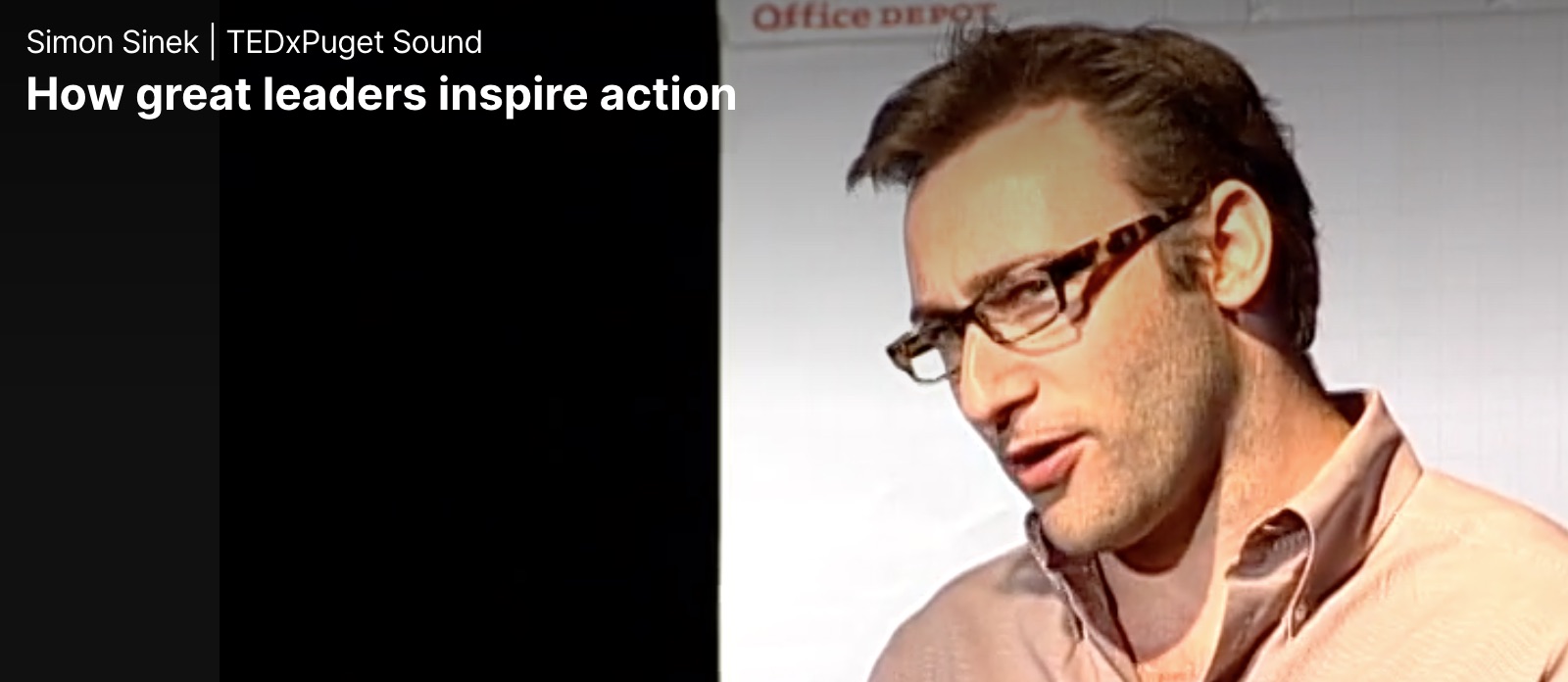
Sanée was inspired by Simon Sinek’s TED Talk How Great Leaders Inspire Action. Give it a look.
2. Understand the Power of Words and Actions
- Sanée’s mantra is “lead with purpose, intention, and excellence. Be excellent on purpose and strive for excellence in all we do.” Success is a result of intentional planning and hard work. Know that everything you do matters and that everyone is watching. Focus on what you can control. While culture work belongs to the group, the leader has the biggest responsibility. Your words need to match your actions. Work to get a commitment to continuous improvement. Ask “where can we continue to grow and improve?” Striving for excellence does not involve making excuses.
- Start with a focus on what’s strong rather than what’s wrong. Once you do this you can figure out how to make not-so-great areas better. It’s important to determine why what’s working is successful. Then it’s on to finding out why some things aren’t working well. You can give pep talks focused on your mission. Point out obstacles you overcame. Celebrate this achievement with the group and identify the challenges ahead. Speak from the heart and use emotion to inspire the group.
3. Expand Your Connections
- It is important that leaders use their abilities to connect. They need to broaden their network to include leaders outside of education and leaders around the world. This can greatly expand one’s learning. Think of it as your professional development network (PDL). This will also expose you to new opportunities. Look for people who push your thinking, not just people who always agree. Look for opportunities to meet people at conferences who you follow online.
- As you expand your virtual support team, be sure to prioritize local face-to-face connections. Sanée suggests that you schedule regular get-togethers with people who can support your work as you support theirs. You also need to manage by walking around. As you do so, check in with the people you lead. Be sure to ask “how are you doing” and as they say “I’m doing fine,” watch their body language to see if it sends the same message or a different one. Ask questions like why and don’t tell them how you solved their problems. Take time to be alone to think and write. Be sure to share what you write, which is easy today thanks to blogs like mine where you can guest post.
Posted in Book Summaries, Business Books, Education Books, Leadership Books | No Comments »
Wednesday, April 14th, 2021
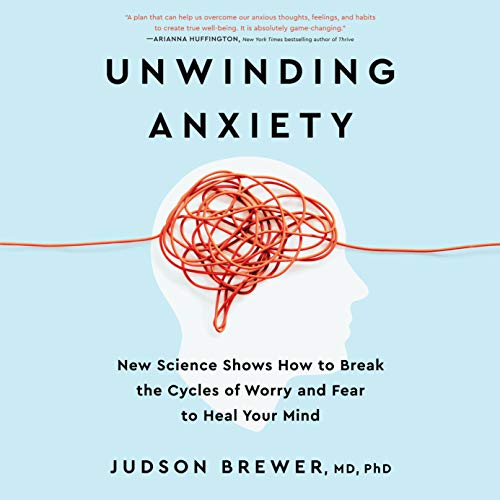
Unwinding Anxiety: New Science Shows How to Break the Cycles of Worry and Fear to Heal Your Mind by Judson Brewer offers actionable advice for anyone who suffers from anxiety. There is also a free app available that can further help make your life less stressful. Learn how you can use curiosity and kindness to your advantage. While I don’t suffer from anxiety, I know many people who do. If you are anxious, you need this book. It also makes a great gift for anxious friends and family. Thanks, Jud.
Introduction
- Judson has MD and PhD degrees which took eight years to complete. He then went on to a career as a psychiatrist doing research on anxiety. He found that anxiety is in and of itself a harmful habit. It hides in peoples’ bad habits and feeds other behaviors. When he realized this, due in part to his own panic attacks as a student, he was determined to “science the hell out of it,” to cite a Matt Damon quote from The Martian. During the last decade, his research has lead to excellent results in helping people quit smoking, overeating, and other bad habits with the help of smartphone apps. This book is intended to be a useful pragmatic guide to changing how you understand anxiety so that you can work with it effectively, and as a bonus, break your unhelpful habits and addictions.
Part 0 Understanding Your Mind: The Psychology and Neuroscience of Anxiety
1. Anxiety Goes Viral
- Anxiety is a feeling of worry, nervousness, or unease, typically about an imminent event or something with an uncertain outcome. Generalized Anxiety Disorder (GAD) is experienced by people who generally worry throughout the day. This usually results in poor sleeping habits. Other symptoms include edginess, restlessness, tiring easily, impaired concentration, irritability, and increased muscle aches. Specific phobias and obsessive-compulsive disorder also fall under anxiety diagnoses.
- Anxious parents are likely to have anxious kids. Uncertainty and lack of structure cause anxiety for many. It is tricky to diagnose as most people experience it to some degree. Worries about health, safety, finances, politics, and relationships are the top sources. COVID-19 has certainly added to our collective stress. People with GAD usually also suffer from depression or something else.
2. The Birth of Anxiety
- Anxiety and its close cousin panic are both born from fear. Ironically, fear’s main evolutionary function is helping us survive. Being afraid of dangerous situations and doing something about it is a good thing. The pre-frontal cortex (PFC) portion of our brain is where future scenarios get played out. It thinks slower than the reflexive part of our brain. When it doesn’t have enough information to predict the future it may start working on worst-case scenarios causing anxiety.
- Fear is an adaptive learning mechanism. Anxiety is maladaptive. Fear + Uncertainly = Anxiety. Without past experience or accurate information, it’s easy to turn on the worry switch. This is why fake news, which travels faster than real news, promotes anxiety. Our news media is more likely to give us stories that feed our anxiety than those that make us feel good. (Doug: If the news you watch makes you anxious, consider not watching it.) Anxiety is also contagious. Knowing this and that uncertainty triggers anxiety can help put you more at ease. It is possible to replace old habits like worry with habits that are more rewarding so stay tuned.
3. Habits and Everyday Addictions
- Most of us are addicted to something as addictions are not limited to things like hard drugs, alcohol, and tobacco. Compulsive behaviors like shopping and overeating also fall into this category. Our modern world has increased the likelihood of addictive habits as just about anything is much more available. The goal of the media is to increase clicks and eyeballs. Therefore they design not to inform, but to create addictive experiences. This starts with a Trigger, which is a thought or emotion. Next comes a Behavior like worrying. Finally, we have a Result or Reward such as avoidance or overplanning. Reinforcements and immediate availability are a dangerous formula for modern-day habits and addictions. This is how our brains work and this is important knowledge.
4. Anxiety as a Habit Loop
- Anxiety can act as a trigger that leads to the behavior of worrying. The result of this behavior can be feeling more anxious. That is the loop or cycle. While worrying usually doesn’t work, this doesn’t stop our brain from trying it again and again. Being aware of this is a good place to start. Judson and his team developed an app (Unwinding Anxiety) that they use to teach mindfulness to the subjects of their research. You can get a free trial or pay for the complete program. They used this app on doctors who do not get training on how to handle their emotions in medical school and found success with 63% of their subjects. First, you need to map out your anxiety. Then you tap into your brain’s reward system before you tap into your own neural capacities to step away from anxiety-producing habits.
Posted in Book Summaries, Business Books, Education Books, Leadership Books | No Comments »
Tuesday, March 16th, 2021
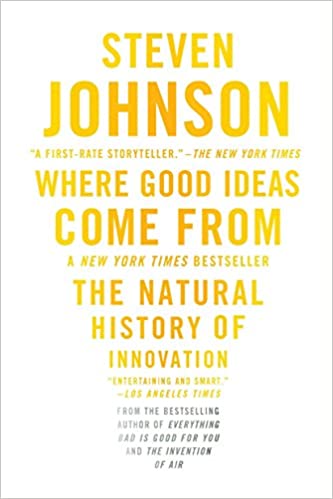
Where Good Ideas Come From: The Natural History of Innovation by Steven Johnson tracks the innovation process through history and shows what ingredients promote a creative climate. From Darwin to the World-Wide-Web we see how individuals, networks, markets, and open-source projects have forged our modern world. Anyone interested in history and/or science should add this to their bookshelf. Every school and professional development library should too.
Introduction: Reef, City, Web
- We start with Darwin discovering that coral reefs can harbor uncountable numbers of species compared to the fewer life forms found in surrounding waters. Then we visit Kleiber’s law which states that the number of heartbeats per lifetime tends to be stable from species to species. Bigger animals just take longer to use up their quota and therefore live longer. When Geoffrey West investigated whether Kleiber’s law and applied it to cities he found that as cities get bigger, creativity per capita increases. Using data like R&D budgets and patents he found that a city ten times larger than its neighbor was seventeen times more innovative and a city fifty times bigger was 130 times more innovative. This is also true for the biological diversity of coral reefs.
- Here we meet the 10/10 rule which states that it takes about ten years for a new innovation to be developed and ten more years for it to be widely accepted. Innovations like color TV, HDTV, AM radio, Video Tape players, CD and DVD players, and GPS navigation all followed that rough time lime. The same was true for the graphical user interface on computers and most software like word processors and spreadsheets. Running counter to the 10/10 rule was Youtube. It went from idea to mass market in two years creating the 1/1 rule. Like YouTube, good ideas want to connect, combine, and cross conceptual borders. They want to complete each other as much as they want to compete.
1. The Adjacent Possible
- The idea for the original baby incubator happened when someone saw how baby chicks were kept warm at a zoo. When modern incubators costing $40,000 were sent to developing counties, however, they soon broke and no one knew how to fix them. An MIT professor named Timothy Prestero got the idea of building incubators using local technology and parts. Since locals in most developing countries could repair cars, he used spare auto parts and his invention was a great success. In many ways, our good ideas are constrained by the parts and skills that surround them.
- The concept of the adjacent possible states that in a given environment there are only so many new things that can be created. In Earth’s early atmosphere, for example, the simple molecules could only create so many more complex molecules, but as they did so further expansion became possible. This fairly describes how evolution works. It also explains why big cities and reefs are more innovative as there are more adjacent possibles. Throughout history, major inventions have happened in multiple places. This is because they couldn’t happen until the parts were available. The trick to having good ideas is to get more parts on the table.
2. Liquid Networks
- A good idea is a network of novel nerve connections and they wouldn’t happen if the nerve connections in our brain weren’t plastic and capable to changing. The new idea also has to be part of the adjacent possible. Since all you have to generate ideas are your genes and your environment, this explains why some environments generate more good ideas than others.
- After explaining why life is based on the connections of the carbon atom and the necessity of water, Steven extends the ideas of why cities produce innovations. A graphic shows the key innovations that occurred prior to the rise of cities and after and there is no contest even though cities haven’t been around that long compared to humans. The Italian Renaissance is an example of how cities and trade promote innovation. The excess wealth they created also promoted the arts.
- The studies of Kevin Dunbar in the early 1990s showed that ideas are more likely to emerge during meetings than in isolation. The results of one person’s reasoning out loud can become the inputs for another person’s reasoning. When people realized this they started designing buildings that would promote more interaction between people. Total open environments don’t seem to work as people don’t like them. The current idea is to have flexible environments where people can get together (conference rooms) and where people run into each other (water coolers). It’s also good to have multiple disciplines in the same building as innovations often happen at disciplinary boundaries.
Posted in Book Summaries, Business Books, Education Books, Leadership Books | No Comments »
Monday, February 8th, 2021
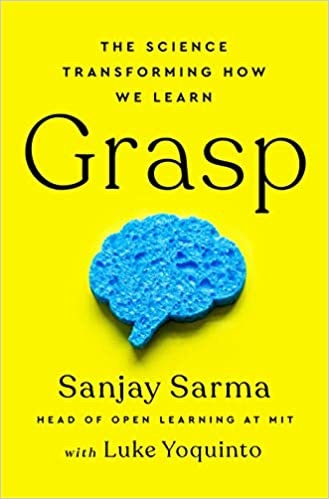
Grasp: The Science of Transforming How We Learn by Sanjay Sarma with Luke Yoquinto tells the story of teaching and learning during the last hundred plus years. They explain what works and what doesn’t. They make it clear that learning should be spaced rather than crammed at the last minute, that different concepts should be interleaved, and that the effort one uses to retrieve memories helps reinforce them. While we need to teach hard facts, we also need to let students use their hands to wield them. This book is a must-read for teachers and learners alike and would make a great textbook for any introduction to education course.
Introduction: The Adventure Begins
- The big metaphor used here is the educational winnower. From the beginning, education is designed to sort students into gifted programs and elite schools. We think we are testing aptitude when we are mainly testing a student’s environment and experiences. At the end of the trail is the opportunity to innovate, which mostly ends up in the hands of males from wealthy homes (patent-holding inventors). In addition to gender, the great winnowers include poverty, expectations, and environments that lack access to language and feature lots of stress. In our efforts to standardize education we have made it too damn hard. We need to shed the myth that serious learning must be difficult and use what we know about the brain to make it more user friendly so we can save more students from the winnowing process.
Part One: Learning Is Science and Science Is Learning
1. The Learning Divide
- Through the lens of a robotics course at MIT we learn that any education scheme worth its salt must not only deliver knowledge but do so in a way that is highly engaging. It must activate that knowledge so its owner can do real work in the world. Next Sanjoy plots the path that education took from the beginning of the twentieth century away from the holistic approach of John Dewey towards the reductionist path of Edward Thorndike. This lead to standardized education where repetition ruled based to an extent on behaviorism. IQ tests were used to sort students into tracks and if you weren’t sorted into the college track, you weren’t going to be prepared for college. Not only is this approach racist and classist, but it also conflicts with how people really learn.
2. Layer One: Slug Cells and School Bells
- It is well established that spacing out your study rather than cramming all a once leads to more retention. This is even true for invertebrates without brains. Here we encounter Eric Kandel’s work with the large neurons in sea slugs. This lead to a Nobel prize for describing the connection between memory and the action of individual neurons. Repetition creates more connections known as synaptic strength. The concept of interleaving suggests that while you are putting space between learning efforts on the same content, you should work on learning another subject. It seems that universities feature a few high-stakes tests each semester with no return to the content in subsequent semesters in many disciplines. This goes against what we know about the spacing effect. Corporations, however, seem to know better as they teach and test frequently. This is due to the fact that their employees must understand the key concepts.. It’s clear that frequent low-stakes quizzes that continually call back earlier material promote efficient learning.
Posted in Book Summaries, Education Books, Leadership Books | No Comments »
Tuesday, January 12th, 2021
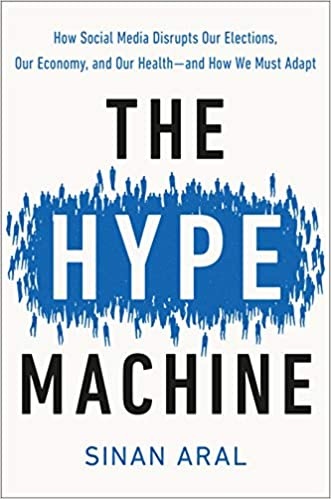
The Hype Machine: How Social Media Disrupts Our Elections, Our Economy, and Our Health and How We Must Adapt by Sinan Aral takes an in-depth look at the impact that social media has had on our society. He covers the positive and negative aspects and offers advice for how scientists, industrial leaders, and policymakers can collaborate to clean up issues associated with things like fake news, election tampering, and free speech. This is a book that every consumer of modern media needs to read so click here to get your copy now.
Preface: Pandemics, Promise, and Peril
- Sinan’s Hype Machine is the real-time communications ecosystem created by social media. We start by seeing how COIVD pushed billions of more people to laptops and smartphones as many digital Luddites were forced on to various online platforms. Even routine users found themselves using it more and young people who were given limited screen time by parents prior to COVID started spending the entire school day online. People responded by organizing Zoom meetings to brainstorm problems old and new. As automated “bot” software along with cyborg and troll networks spread misinformation about things like COVID and elections, others got to work to fight these new digital enemies. As we have seen there is potential for great promise and peril. This book takes a look at both and offers suggestions for how we can make the most of the Hype Machine.
1. The New Social Age
- Humans have always been social animals. The Hype Machine has simply poured gas on our campfires. It is designed to inform, persuade, entertain, and manipulate us. It learns from our choices and location to improve its persuasive leverage. The motivation of course is money. It can rightly be considered the social media industrial complex
- We start with the story of how Russia used social media as a key part of their armed takeover of Crimea in 2014. Every time a pro-Ukrainian message was posted it was swarmed by messages from Russian bots and subsequently taken down. Most people were left with the idea that the people of Crimea wanted to be part of Russia.
- During his PhD work, Sinan realized that statistics required observations to be independent while modern networking made everything interdependent. His epiphany at the time was that digital social networking was going to turbocharge how information, behavior, economic opportunity, and political ideology flowed between people. His thesis was on how information flows through digital social networks and as he now evaluates hundreds of companies each year, he gets to see what is coming. He knows that we don’t know enough and advocating for more research is a theme of this book.
2. The End of Reality
- Fake news isn’t new, but the speed at which it can spread can cause real consequences. Rumors of gas shortages and a shooting at the White house caused long gas lines and a brief stock market crash. Some put out positive fake news about stocks they own and sell when the price goes up (pump and dump). We know that Russia made an effort to impact the 2016 election using the Hype Machine, but we don’t know the impact that effort had. Using social media in an effort to impact elections is a global problem.
- Another area where fake news distributed by social media has had an impact is the world of vaccines. Anti-vaxers have used it and caused some communities to decrease vaccination percents below the point where they offer heard immunity. This has caused an increase in cases of measles, a disease that the US declared conquered in 2000. Another problem is that several studies show that false news spreads faster than real news. Political false news travels faster than any other category.
- Social bots are software controlled social media profiles. They pounce on fake news and retweet it broadly. Real people then pick it up and do most of the spreading. They often mention influential humans who can give them a greater reach. Novelty attracts attention (the novelty hypotheses) and as a result, false news is more novel. Big repetition causes belief. (Doug: This is something that Hitler took advantage of.) People also believe what they already think (confirmation bias) so when you try to convince them that what they believe is false they tend to dig in even harder. Since fake news attracts more readers it makes more money by posting Google ads. This makes it a big business. Generative adversarial networks (GANs) pit two neural networks against each other. One learns from the other’s decisions and optimizes its efforts to fool the other. They can also be used for good. Deepfaked audio can allow one person to sound like another, which has been used to defraud companies.
3. The Hype Machine
- The Hype Machine is an information processor regulating and directing the flow of information in society. It is comprised of the network itself, the interaction between people and machine intelligence, and the input/output device, which is most commonly the smartphone. In addition to these three components, there are the four levers of Money, Code, Norms, and Law. Networks learn about us by looking at who we are connected to, what we read, and what we buy. People tend to cluster and similar people connect. This causes echo chambers that spread fake news. If one person has strong connections to two others, the others are likely to have at least a weak connection. The small-world phenomenon also shows up in social media as the average distance between any two people is about 4.7 degrees, not six.
- Sinan describes what he calls the Hype Loop. It starts with machine algorithms sensing who we are by what we say, what we consume, and what we do. It then offers suggestions for things like who to friend and what to buy. We then consume content based on the suggestions and finally, we take action such as making a purchase, sharing content with others, or voting.
- Connections via social media platforms are much more likely to happen via suggestions offered by algorithms than by people searching. This may also contribute to political polarization as similar people get connected faster. Algorithms also recommend the content we consume. Facebook is now the largest news outlet. Its goal is to attract more likes and more viewership. Some things are best done by the machine. Spam filters and newsfeed ranking are examples. More reflective people tend to want their news recommended for them. Since our smartphones are always with us the Hype Machine is constantly learning about us. Apps constantly share data with five to ten other apps. The next big thing is likely to be the brain-computer interface so we can control things with our thoughts. Think of using your “brain mouse” to click on something you see in an augmented reality space.
Posted in Book Summaries, Business Books, Education Books, Leadership Books | No Comments »