Archive for the ‘Book Summaries’ Category
Monday, December 7th, 2020
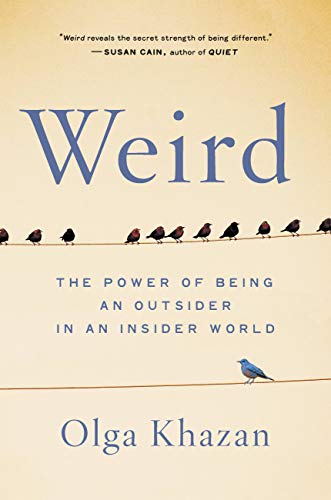
Weird: The Power of Being an Outsider in an Insider World by Olga Khazan is for anyone who has felt like they were different from typical people in their culture. Since we are all unique, we probably all feel different or weird from time to time. There are a number of research-based coping methods here that just about anyone can use. While this book is aimed at the general public, it is especially good for anyone doing counseling.
Part One: Being Weird
1. Weird
- Olga was a Russian Jewish immigrant who grew up in West Texas. The rest of the people in her town were either white evangelical Christians or immigrants from Mexico. Since Russian Jews were forced to be atheists, they don’t even fit in with American jews. Her feeling of weirdness was also fostered by the fact that her parents moved a lot and always to different school districts. At home, her parents watched only Russian television and ate only Russian food. She attended American University in Washington, D.C., which didn’t help her feel any less weird. After interviews with over three dozen successful “weird” people, she concluded that it can be good to be weird as it confers a hidden advantage. It also behooves you to live and work among weirdos. Groups are smarter and more powerful when their members hold a diversity of views and backgrounds.
2. The Realization
- Cultural norms are unwritten rules that make us think that “right” is what everyone else is doing. There is even a gene that predisposes people to be rule followers. People like it when others follow norms as they don’t like being surprised. Norms are inherently conservative and can get in the way of innovation and creativity. They also may not make sense, think neckties. Olga presents a review of how swimwear reveals the randomness of social norms.
- Next, we have short stories of two “weirdos.” The first is a gay male kindergarten/preschool supervisor. Only 2% of kindergarten teachers are men and a female NASCAR driver who represents a microscopic fraction of the total. Their problems aren’t the same, but they both have many more challenges to face than their peers.
- Friends are for comfort, taking it easy, relaxing, and not being challenged. By hanging out with people who are just like you, you can be out of touch with the big, beautiful, diverse world. Unfortunately, it’s difficult to find acceptance and friendship in an environment where you are the different one.
- Cultures can be tight or loose. In tight cultures, norms are strict and formal, and the punishments for breaking them can be severe. Loose cultures permit a wider range of behaviors. Weird people have an easier time in loose cultures. Tight countries like Russia are autocratic and have less free media. As you go from tight to loose cultures you go from orderliness to creativity. Rural cultures tend to be tight while urban cultures tend to be loose. The LGBTQ folks definitely need to find a loose culture to live in. People who travel between tight and loose cultures in either direction tend to be disoriented and feel weird. The stories of three more weirdos conclude this chapter.
3. The Exclusion
- Once humans formed groups intergroup conflict was sure to start. Rather than being inborn, prejudice is a reflection of the dynamics between groups. In our hunter-gather days, social relationships were the only wealth a person had. That predisposed them to take care of other group members. Successful groups look out for each other. Rulers, money, and organized religion created subgroups and pitted them against each other. Groups are based on their differences even when they are laughably minor (think protestants and Catholics in Northern Ireland). The idea that diversity can be a source of strength and advantage is a relatively recent concept.
- When it comes to differences, gender is a big one. Historically, women have had to put their own interests after their mate’s. They needed to take their cues from their husband’s mood in order to prosper. We can thank our brains for our ability to recognize differences as it seems to be automatic. The brain also stores stereotypes. Our instincts set us up to avoid or alienate people who don’t look like us. One outsider is a deviant. As the number grows they become a threat and cause a fear of losing status. Americans are more accepting of immigrants who speak English, while the Swiss are more accepting of people who get to work on time.
- People who have a problem with someone from a different group tend to generalize the issue to the entire group. Peripheral group members tend to marginalize someone else as pushing someone weirder to the side can make you feel normal. People who are more offended by norm violators are not likely to think outside of the box and be more creative. As a result, looser cultures are more creative. They are also sick less. Tight nations have fewer natural resources, worse air and water, more deaths from communicable diseases, and more natural disasters. Such collective threats foster tightness. Stories here include an Amish girl and an African Muslim immigrant girl.
Posted in Book Summaries, Business Books, Leadership Books | No Comments »
Sunday, November 8th, 2020
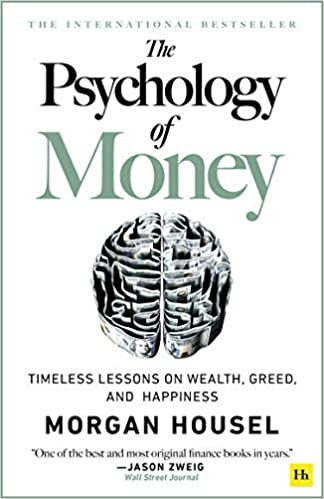
The Psychology of Money: Timeless Lessons on Wealth, Greed, and Happiness by Morgan Housel explains the psychology of spending and saving for anyone who has to deal with money and life. This is an excellent nontechnical study of this most important topic for high school students on up. If you want to acquire enough wealth to feel independent this book is for you. You can skip to chapter 20 to learn what Morgan and I do with our money.
Introduction
- We start with stories of a janitor who invested what he could in blue-chip stocks and died with an estate worth $8 million dollars and a successful businessman who went bankrupt by overspending on houses and wasting money. The premise of this book is that doing well with money has little to do with how smart you are and a lot to do with how you behave. It’s more about psychology and not so much about physics.
1. No One’s Crazy
- The decisions we make about money depend heavily on our experiences and the environment we grew up in. Although the first currency dates back to about 600 BCE, most of our current financial instruments only arrived after World War II. Prior to that time, most people worked until they died. Now we all expect to retire and have to save and invest for that day. Since modern instruments are so new, we aren’t crazy, we are just essentially newbies at it.
2. Luck & Risk
- Bill Gates attended a high school that had better computer access than most graduate schools. This allowed him to become an expert who wrote a program to do the school’s schedule among other things. Were it not for this unprecedented access he claims there would be no Microsoft. Meanwhile, his best friend who also became a computer wiz died in a mountaineering accident before he finished high school. The point here is that luck and risk are siblings. He shares other stories of people who took risks and made it big like Vanderbilt and Rockafellar who felt they had enough power to ignore some laws and indeed they did. Not all success is due to hard work and not all poverty is due to laziness. Keep this in mind when judging people. (Doug: Better yet, don’t judge people.) The world is too complex to allow 100% of your actions to dictate 100% of your outcomes.
3. Never Enough: When Rich People Do Crazy Things
- When you are young taking some modest financial risks makes sense as you have time to recover. At some point, you may need to decide that you have enough and scale back your risk. Morgan cites Bernie Madoff and Rajat Gupta as very successful investors who didn’t know when to say enough and ended up in prison after running a Ponzi scheme and engaging in insider trading. The ideas that the best games to play in a casino are none of them and that the Lotto is a tax on the poor are also instructive.
Posted in Book Summaries, Business Books, Education Books | No Comments »
Saturday, October 31st, 2020
The Educator And The Oligarch: A Teacher Challenges The Gates Foundation by Anthony Cody shows how the Gates Foundations’ efforts to reform education have had a mostly negative impact. By spending a small fraction of the total education budget, people like Gates can buy politicians, muzzle the media, and control many special interest groups and non-profit organizations with grant money aimed at advancing their agenda. Please purchase this book and spread the word. (Note: Like every other book summarized here, this one was written prior to the COVID-19 pandemic.)
Preface and Introduction
- The thrust of this book is that something is seriously wrong with our system when one of the richest men in the world can spend a few billion dollars and seize the reins of education policy. By funding almost everyone who does advocacy, including teacher unions, Gates can call the tune. The tune is Common Core and associated tests that are designed to yield wide-spread failure. Like tobacco companies in the 1960s, their sponsored research tells them what they want to hear. This undermines the public’s democratic control of education and devalues the teaching profession. There is nothing generous in using the power of wealth this way.
- Unlike previous grant efforts by wealthy foundations, the Gates Foundation’s approach was different. Their starting point was “we know what is broken and we know how to fix it.” They invite proposals by directly contacting organizations. They then collaborate with the organizations to develop proposals that align with their agenda. With their vast wealth, an entire sector of organizations became dependent on their funds.
Part I: The Assault on Public Education by Bill Gates
1. Bill Gates’ Big Play: How Much Can Money Buy in Education?
- Gate’s vision starts will the total reliance on standardized tests that were already required by federal law (NCLB). These tests were flawed and NCLB was bound to fail so it was necessary to develop a new generation of tests based on new standards known as the Common Core. It also helped to get staff from the Gate’s Foundation transferred to the Federal Department of Education. Gates held that the field of education didn’t know much about teaching. He started by funding research that defined effectiveness as high test scores. This means that teachers get paid for these results. Next, he donated to advocacy groups to the extent that he became their largest donor. The final step was to donate to the media’s efforts to cover education.
2. Circular Reasoning at the Gates: Education Nation Off to a Confusing Start
- Here are excerpts from a Teacher Town Hall from 2011 on NBC moderated by Brian Williams. He tells the audience that they will be using facts provided by the Gates Foundation as they are the largest single funder of education in the world. (Doug: I think the US government is the largest single funder.) On this show, Melinda Gates claims that there are multiple measures that they are using along with test scores such as administrator and peer observations along with student questionnaires. But, the only models of these other measures that she wants to use are those that improve test scores. Here the author suggests that many of the strategies used to boost scores are harmful to our students.
3. Teachers Face Good Cops or Bad Cops in Push for Evaluations
- The bad cop is the New York Post, which published the names of teachers with the worst scores. The good cops are Bill Gates and Michelle Ree who said this is wrong and that multiple measures should be used in addition to tests. Their other measures, as we have seen, are correlated to test scores. These good cops also push value-added ratings (VAR), which research has shown to be highly unstable for individual teachers. Translation: VARs are garbage and should never be used as part of a teacher rating system. There is also the false assumption that there are a significant number of crummy teachers who need to be weeded out. (Doug: From what I’ve seen as an educator since 1969, crummy teachers weed themselves out as being a bad teacher really sucks.) As it stands, 50% of teachers leave the profession within five years and turnover rates in high-poverty schools are 20% each year.
4. Cui Bono? The Question Rarely Asked, Let Alone Investigated
- Cui bono means who benefits. Journalists should be asking this question, but they don’t seem to be doing so. They are, however, repeating false ideas that the reformers put forward such as our public schools are failing due to the ineffective teachers that need to be fired. They also tout the success of charter schools, which overall is not the case. The winners here are the testing companies, curriculum designers and publishers, consultants, technology and software companies, and various leadership organizations.
5. Bill Gates Discovers Money Cannot Buy Teachers
- The main idea here is that people, in general, can sense when they are being manipulated and coerced. When this happens they resent it and resist. Here we are talking specifically about teachers. They aren’t opposed to being evaluated based on student work such as portfolios, but they resist being evaluated by invalid standardized tests that are closely correlated with the socioeconomic background of their students. Teachers, therefore, are justified in being ungrateful for all the money Gates has poured into education to remake it in his own image.
6. Bill Gates Goes to College. Has He Learned From His k12 Project?
- Gates is also determined to change higher education with a focus on tests that measure specific skills that employers want. His focus is also on online courses, which have been shown to be less effective for all save the brightest. (Doug: We are seeing that now as well with remote learning) The approach sends the message that education is only for job preparation, which the author rejects. Blended learning, which offers a mix of online and in-person instruction appears to be effective, but 100% online doe not appear to be.
7. Is ASCD Embracing Market-Driven Education Reform?
- Organizations like ASCD are being directly paid to support the implementation of Common Core, which converts them into advocates for the controversial standards. Along with it comes “market-driven” systems, which feature a push for charter schools, private schools, and vouchers at the expense of public schools. In 2011, the Gates Foundation awarded ASCD a grant of $3 million to help implement the Common Core. If you just read ASCD’s journal you wouldn’t know that the Common Core is controversial.
8. Is Gate’s Money Going to Influence the National Board?
- While Gates claims that teachers participated in the creation of the Common Core Standards they were not involved. He also tries to convince us that since the schools can create the curriculum, teachers can still teach as they wish. He negates this when he says that he will know that his efforts have succeeded when the curriculum and the tests align with the standards. He pushes for control of schools by mayors as when just one person is in charge, change can be made more efficiently. It also means that he only has one person he needs to influence or buy off. Note that cities, where mayors are in charge, have fared worse. Other organizations know that if they want his money they have to sing this tune.
9. Gates and Duncan Seek to Use Trust in Teachers to Promote Common Core.
- If Gates and the Department of Education under Duncan (appointed by Obama) trusted teachers, they would not have had Common Core standards drafted by test makers instead of educators. They would not have created the pseudoscience of VAM to try to hunt down bad teachers. If leadership organizations were true leaders, they would not have allowed themselves to be co-opted and bought off. Gates seems to operate by bad analogies. One mentioned here is “standardization is important to allow for innovation… like the standardized outlets we have in our houses.” He sees innovation as the domain of the creators of mass-produced tools and the teachers as consumers. He accuses teachers of not knowing much about effective teaching, which is why he came up with the Common Core and its testing to define excellence.
Posted in Book Summaries, Business Books, Education Books, Leadership Books | No Comments »
Saturday, October 10th, 2020
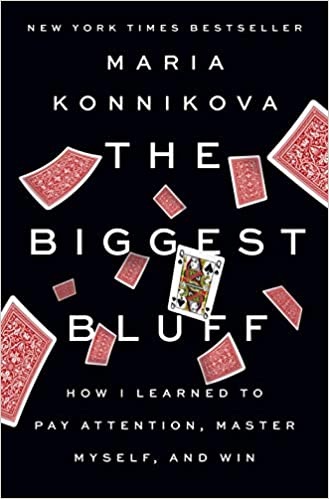
The Biggest Bluff: How I Learned to Pay Attention, Master Myself, and Win by Maria Konnikova chronicles her journey as a PhD psychologist and journalist into the world of professional poker. She starts with zero knowledge and experience and with the help of mentors and lots of hard work becomes a poker champion. While the framework for this book is the game of poker, each chapter features generalizations that we can all draw on to add quality to our lives.
A Prelude – Las Vegas, July 2017
- We start with a story from the World Series of Poker, which is The World Cup, The Masters, and The Super Bowl for poker players. Anyone can enter as long as they put up the $10,000 entry fee. This can be a lifetime dream for many. As play continues Maria’s seat sits empty while the dealer takes the anti for each hand from her piles of chips and tosses her cards into the discard pike known as “the muck.” She is in the bathroom curled up in a fetal position on the floor after barfing her brains out due to eating some bad guacamole. At the time she understood the line between skill and luck. The message is that you can’t calculate for dumb bad luck and you can’t bluff chance.
Ante UP – New York, Late Summer 2016
- Here we meet Erik Sidel, one of the top poker players of all time. Maria approaches him to see if he will mentor her for her experiment, which involves seeing if a psychologist with zero knowledge of poker can have success after spending only a year learning the game. Eric knows that most people who get serious about the game come at it thinking a deep knowledge of math is the most important attribute. He knows that a deep understanding of psychology is more important as the necessary math his not that hard to master. He also sees Maria’s language skills as another key attribute. (She is fluent in English and Russian, was fluent in Spanish and French, and can get by in Italian.) Eric accepts the challenge and it’s game on. You don’t play poker, you play the world.
The Birth of a Gambler – Boston, Fall 2016
- Life is a gamble. It may not seem like playing poker, but in some sense, much of life features less control than you have as a skilled poker player. Here we have a conversation with Maria’s grandmother (Baba Anna) who is very disappointed that Maria is taking up poker rather than a “real job.” Skilled stock pickers do no better than chance in the long run while professional poker players routinely outplay amateurs. In poker, the best hand doesn’t always win. This sets it apart from other games. The process of betting gets your full attention unlike making a decision where no bet is involved. This allows you to benefit from life’s decisions as well. Accurate probabilistic thinking is rare, but it is necessary for success in poker. Like people who predict the weather and horse races, poker players get immediate feedback and have no one to blame but themselves.
The Art of Losing – New York, Fall 2016
- Eric’s step one is to read the poker books by Dan Harrington, cousin to the golfer Padraig Harrington. Next, you need to watch streams with real hands being played by the best players. Sign up for the Run It Once a poker coaching site. Then start playing for real online for tiny stakes that can gradually get bigger. From there you can proceed to small tournaments and then move up to bigger ones. You need a balance between aggressive and conservative playing so that your opponents can’t figure you out. You also need to keep track of everyone’s stack size.
- Here we encounter the importance of learning from losing. (Doug: The concept of learning from failure is found in many of the other books I have summarized.) You have to constantly think, analyze, and stay objective. This is hard to do. This means that you never take things personally as you treat triumph and disaster the same. Disaster can bring true objectivity. Eric teaches Maria that there is no certainty, only thought. There are no right answers regarding any situation without a greater context. Self-awareness and self-discipline should be your twin goals.
The Mind of a Strategist – New York, Late Fall 2016
- Maria starts practicing online, but in order to do so, she has to take a train from Manhattan to New Jersey as online poker is illegal in New York State. She picks a puppy as her avatar and “psychchic” as her screen name. She describes a hand she loses and finds that she made a mistake by trying to copy a hand Eric had once and acted aggressively so as not to look weak. Time is an issue online and in real tournaments as it is in real life. In both cases, you want to use the time you have to think things through, but not act impulsively as time starts to run out. When playing you want to be the last one to act as that will give you maximum information.
- The military analogy applies here. You need to know the enemy and survey the nature of the board in each hand. Like a general, you need to decide just how many of your troops you need to deploy. Everything from a scout to every soldier you have is in play. Your strategy cannot be predetermined. Another analogy is that of a jazz band where once it’s your turn you have to decide what to play.
- If you only bet when you have top cards your opponents will figure that out and you won’t win much. You will lose more as you won’t often have top cards. This is why you have to bluff on occasion. Maria tells the story of getting an offer to write an article about what she was doing. She said no several times until she got an offer of $3/word. Like sometimes in poker, she got more out of her hand then she thought she could.
Tags: Eric Sidel, Maria Konnikova, Phil Galford, Poker, Texas hold 'em
Posted in Book Summaries, Business Books, Leadership Books | No Comments »
Monday, September 21st, 2020
This is my most read book summary and I think it is timely for our current environment. Enjoy and be sure to get the book.
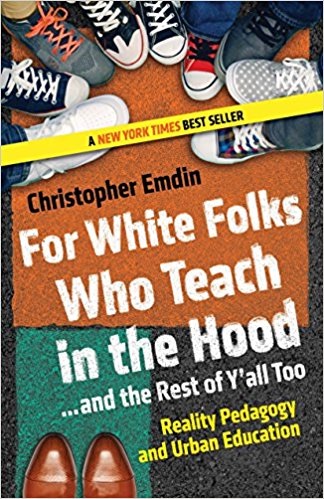
For White Folks Who Teach in the Hood…and the Rest of Y’all Too by Christopher Emdin explains how teachers from different cultures can connect and foster success when teaching black students in poor urban schools. While aimed at black cultures found in the inner city, the advice here applies to anyone teaching students from a cultural background that is not their own. In addition to the targeted audience, I strongly recommend this book to all teachers and their administrative leaders. Leaders of teacher preparation programs should also seriously consider this book.
Introduction
- Chris compares the urban poor black students to indigenous people like native Americans, who have suffered from the impact of colonization. He invented the term neoindigenous to describe his target population. The key idea in the book is how do we help white teachers better understand the culture of the black students they teach rather than spending their time trying to take their culture away from them. Strong discipline seems oppressive to many students and gives them the feeling that school is not for them. Harsh treatment is unlikely to produce academic success.
- The behavior students bring can make white teachers uncomfortable unless they are prepared for what they will face. They should become familiar with student culture including clothing, music, and speech. Viewing hip-hop as vulgar, for example, is a good way to make sure a teacher fails to connect. Students see a curriculum that is not connected to their culture and school rules that seek to erase that culture.
1. Camaraderie: Reality and the Neoindigenous
- Teachers in urban schools are usually from different neighborhoods and classes and don’t look much like their students. Unfortunately, they don’t see this as an impediment when it comes to engaging students. They can come in to save the students, which can make student experiences, emotions, and communities invisible. Teachers need to visit the community where students live and leaders need to facilitate visits. These students are often traumatized so it’s vital to get an idea of the nature of the traumas they face.
- Teachers can’t expect students to leave their experiences and emotions at the door. Even poverty comes with complexity. While you don’t have to use student vocabulary, it is important to know it. Teachers need to see students as individuals and meet them on their own cultural and emotional turf.
2. Courage: Teach Without Fear
- Watch out for code words like “these kids” and “those kids.” Black youth see white teachers as enforcing rules that are unrelated to teaching and learning. They often respond negatively to structures that teachers value at the expense of their academic success. Chris tells of his days as a student and rookie teacher when he was urged to take emotion from learning and teaching. This mantra served to mask fears.
- Too often white teachers become test-prep machines. Even teachers with good stories are apt not to tell them for fear of getting too personal. They also may avoid hands-on activities for fear of what students might do. Even Chris had an initial fear of students, which kept him from moving beyond fear and getting to know them.
Posted in Book Summaries, Education Books, Leadership Books | 2 Comments »