Archive for the ‘Book Summaries’ Category

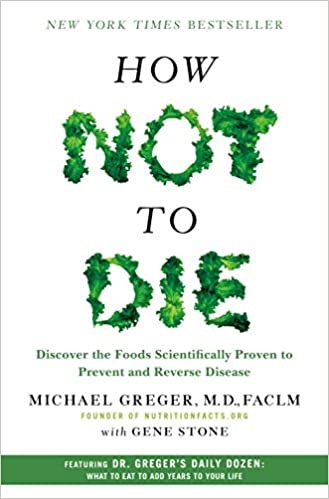
How Not to Die: Discover the Foods Scientifically Proven to Prevent and Reverse Disease by Michael Greger, M.D. with Gene Stone

Monday, June 15th, 2020
How Not to Die

How Not to Die: Discover the Foods Scientifically Proven to Prevent and Reverse Disease by Michael Greger, M.D. with Gene Stone explains what you can do to avoid dying from the 15 most common causes. It can also serve as a reference for current research on health and wellness with a focus on nutrition. Consider listening to it on Audible as I did and good luck living up to the title.

Doug’s Introduction

  • At 405 pages of reading plus 157 pages of notes and index, this is more of a reference book than an easy read. I listened to it first on Audible and then ordered it so I could look up things when I wanted to. As a result, this summary will be less detailed than my usual efforts, but it should still be valuable in its own right. How Not to Die can be summed up in three phrases: don’t Smoke (duh), exercise regularly, and eat plants. These are all things I do. Prior to listening to this book I had been gradually cutting animal products from my diet. Now I am a total vegan, at least at home. I’m also well ahead of my goal of running 1,000 miles this year, and I feel great. I hope this works for you and your family too.

Dr. Greger’s Introduction

  • Most deaths in the US are preventable, and they are strongly related to what we eat. Diet is the number one cause of death and disability. However, only a quarter of medical schools offer a single course in nutrition. When California tried to require nutritional training for doctors the California Medical Association was successful in stopping it. This is because the medical system is set up to financially reward prescribing pills and procedures. They don’t profit from lifestyle medicine. The one thing medical schools do require is pain management and end-of-life care.
  • Our genes only account for about 10 to 20 percent of death risk. The rest is essentially our diet. Rates of heart disease and major cancers differ up to 100 fold among various populations around the world who have different diets. There is wide agreement in the research that healthy diets are plant-based and non processed. By this measure, the Standard American Diet with the ironic acronym SAD, scores pretty low. Although life expectancy has increased there are fewer functional years at the end. Some indicators suggest that life expectancies will decrease. In the early 1900s, the main causes of death were infectious diseases. Now we are likely to die from lifestyle diseases like heart attacks and cancer. Diseases run in families because diets run in families.

Part I – How not to die from each of the 15 most common causes of death

  • This part of the book features a chapter on each disease. While every chapter deals with plant-based nonprocessed diets as the primary way to not die, each has its own details. Here is a list of the 15 top killlers.
  • 1. Coronary heart disease
  • 2. Lung diseases (cancer, COPD, and asthma)
  • 3. Iatrogenic diseases (diseases that result from doctor errors, drug side effects, and hospital-born infections)
  • 4. Brain Diseases (stroke and Alzheimer’s)
  • 5. Digestive cancers (colorectal, pancreatic, and esophageal)
  • 6. Infectious (respiratory and blood)
  • 7. Diabetes
  • 8. High blood pressure
  • 9. Liver disease (cirrhosis and cancer)
  • 10. Blood cancers (leukemia, lymphoma, and myeloma)
  • 11. Kidney disease
  • 12. Breast Cancer
  • 13. Suicide
  • 14. Prostate cancer
  • 15. Parkinson’s disease

Introduction to Part 2

  • Until he read Dr. Dene Ornish’s Lifestyle Heart Trial in 1990 Dr. Gerger’s diet was full of animal fat, salt, and sugar. He, therefore, speaks from experience regarding how a healthy diet can keep one healthy. To help you know what to eat more of, he created the Traffic Ligth system. Green foods are unprocessed plant foods, Yellow foods are processed plant foods and unprocessed animal foods. Red foods are ultra-processed plant foods and processed animal foods. USDA guidelines tell us to eat less added sugar, calories, cholesterol, saturated fat, sodium, and trans fat. That’s code for eating less junk food, less meat, less dairy, fewer eggs, and less processed food. They can’t say that for political reasons as the people who make unhealthy foods donate and lobby the government to prevent it.
  • For the purposes of the Traffic Light model Dr. Greger thinks of “unprocessed” as nothing bad added, nothing good taken out. Tomato juice might be better than tomatoes as all of the good things are still there. The removal of fat from cacao beans to make cocoa powder is a good thing, but try finding something to eat that contains cocoa powder with no added sugar. It may be difficult for most people to eat only plants, but the closer you can get the better, and your body can recover from the occasional insult like when you visit friends who kindly serve you animal products. It’s the day to day stuff that matters the most. Like most people, I eased into a plant-based diet by gradually removing meat, dairy, and eggs from what I thought was already a healthy diet. While some go “cold turkey” on these foods, most don’t.
  • Doug: Although he doesn’t focus on it, eating plants is also good for the environment as a it takes roughly ten pounds of plants to create a pound of meat. This saves water, cuts down on pesticides and fertilizers, and greatly reduces the production of greenhouse gasses. Animal lovers can also feel good as no animals are slaughtered for the sake of their diets. Dr. G also recommends organic foods and foods that are grown locally as they are also better for the environment.

Dr. Greger’s Daily Dozen

  • This second half of the book shifts from why to how. There is a chapter for each of Dr. Greger’s Daily Dozen, which are the things you need to eat and do every day. Here you find specific information for each along with suggestions for preparation. The number of daily servings is in parentheses.
  • 1. Beans (3)
  • 2. Berries (1)
  • 3. Other Fruits (3)
  • 4. Cruciferous Vegetables (1)
  • 5. Greens (2)
  • 6. Other Vegetables (2)
  • 7. Flaxseeds (1 Tbl/day)
  • 8. Nuts (1)
  • 9. Spices (1) (Dr. G is big on tumeric, but just about all spices except salt and suger are good for you.)
  • 10 Whole Grains (3)
  • 11. Beverages (5) (Water, various teas, and coffee are good, but you are better off eating whole fruit than drinking sugar laden fruit juice.)
  • 12. Exercise (1) (If all you can do is walk, that’s just fine.)

Conclusion

  • No matter how closely you adhere to the advice in this book, you can always get hit by a bus (metaphorically or literally. You should take precautions when possible like wearing your seat belt and bicycle helmet. Make each day count with fresh air, laughter, and love for yourself and others. People get great pleasure from eating calorie-dense foods that contain lots of sugar and fat. (Think icecream) With effort, the same pleasures can be had from eating calorie-sparse plants.
  • Once you finish this book it’s time to go to Nutritionfacts.org. It’s free but it does accept tax-deductible donations. It continuously keeps track of the thousands of research articles published on nutrition each year. The goal here is to give you the information you need to empower and inspire you to make healthy changes in your life. I know it has done that for me. The idea is not to “go on a diet” but to permanently change your diet. Living a long and healthy life is a choice. We are all going to die, but we don’t want it to be our fault. Thanks Dr. G.

Dr. Michael Greger

  • Michael is a physician, author, and internationally recognized speaker on nutrition, food safety, and public health. He runs a popular Web site NutritionFacts.org, a nonprofit, science-based public service providing free daily videos and articles on the latest nutrition research. He is the director of Public Health and Animal Agriculture at the Humane Society of the United States.

Gene Stone

  • Gene has written many books on plant-based nutrition, including the #1 New York Times bestseller Forks Over Knives. He has also cowritten the bestsellers The Engine 2 Diet and Living the Farm Sanctuary Life.
Share this:
Share this page via Email Share this page via Stumble Upon Share this page via Digg this Share this page via Facebook Share this page via Twitter Share this page via Google Plus

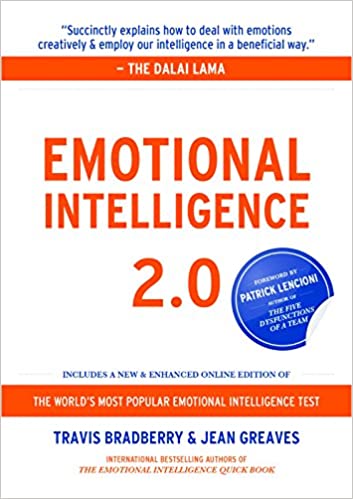
Emotional Intelligence 2.0 by Travis Bradberry & Jean Greaves (the book can be found here)

Monday, June 8th, 2020
Emotional Intelligence 2.0

Emotional Intelligence 2.0 by Travis Bradberry & Jean Greaves (the book can be found succinctly explains how to deal with emotions creatively and how to employ your intelligence in a beneficial way. There is strong evidence that EQ can be improved with effort and this book can direct that. Higher EQ leads to success on the job and at home so this is a book that everyone can use to forge a better life.

1. The Journey

  • All information from your senses has to pass through the emotional part of your brain (the limbic system) before it gets to the rational or thinking part of your brain (the frontal cortex). It’s the communication between your emotional and rational brains that is the physical source of emotional intelligence or EQ. It is emotional intelligence that explains why people with high IQs don’t consistently outperform people with average IQs.
  • The purpose of this book is to help you increase your EQ. You start by taking the Emotional Intelligence Apprasal online. To see your scores you will need the code at the end of the book, which is only good for one person. This appraisal provides a baseline against which you can judge your improvement. This is a new feature in version 2.0. You can also retake the test after you finish the book to see how much you have learned.

2. The Big Picture

  • Emotional awareness and understanding are not taught in school, but self-knowledge and emotional mastery are required to make good decisions on the job and in life. We have many words to describe our feelings yet all emotions are derivations of five core feelings: happiness, sadness, anger, fear, and shame. Here we find twenty different words to describe each. When emotions are intense they can highjack your rational thinking and cause you to react reflexively. Your reaction to these trigger events is shaped by your personal history. Enhanced EQ can help you recognize triggers and let you respond in a rational manner.
  • We all possess the qualities of personality, EQ, and IQ. Of the three, EQ is the one most amenable to improvement. It is also the foundation of a host of critical skills like time management, decision-making, and communications. It is the strongest driver of leadership and personal excellence. It is highly correlated with high-performance and salary regardless of the job. The rest of the book will help you improve your EQ.

3. What Emotional Intelligence Looks Like: Understanding the Four Skills

  • The four EQ skills come in two pairs known as personal competencies and social competencies. The first includes self-awareness and self-management. This is where you stay aware of your emotions and manage the resulting behavior and tendencies. Social competencies include social awareness and relationship management. This is where you work to understand other people’s mood, behavior, and motives. Emotions always have a purpose as they shape your reactions to the world around you.
  • Self-awareness is a foundational skill; when you have it the other skills will be easier to use. Self-management is dependent on your self-awareness as it gives you information that you can act on rationally rather than reflexively. Social awareness is also foundational as you need to pick up on the emotions of others so you can better manage your relationships. You need to listen well rather than thinking about what you are going to say next when another person stops talking. Relationships require you to understand others and are based on how you treat them over time. This chapter also contains positive and negative examples of all four skills.
Share this:
Share this page via Email Share this page via Stumble Upon Share this page via Digg this Share this page via Facebook Share this page via Twitter Share this page via Google Plus

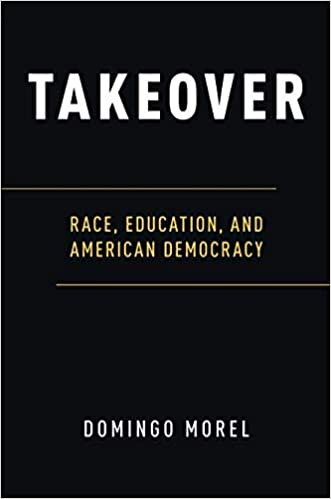
Takeover: Race, Education, and American Democracy by Domingo Morel

Wednesday, May 20th, 2020
Takeover

Takeover: Race, Education, and American Democracy by Domingo Morel tells the story of how state takeovers of urban school districts have tended to coincide with blacks gaining majorities on urban school boards. While the takeovers are based on poor academic performance and corruption, they don’t seem to improve academic results but they do take political power away from the local community. They also tend to result in a lack of collaboration, which is an essential contributor to school success in general. Although this book takes a political side in this argument, it does make a compelling case.

1. Schools, State, and Political Power

  • From the first takeover in 1989 (Jersey City, NJ) to 2017 there have more than 100 takeovers. This book examines takeover politics, their impact on communities, and what they teach us about democracy in America. In addition to at least 33 states and the district of Columbia, the 2001 No Child Left Behind (NCLB) legislation authorized state takeovers. What seems puzzling is that studies on the effects of takeovers do not show markedly improved outcomes in test scores, attendance, and graduation rates. They are seen by many as an assault on local autonomy. Since they usually abolish elected school boards, they appear to violate the 1965 Voting Rights Act. Takeovers, therefore, are about political power and they are often about race as racialized communities have historically relied on education policies as a way to enter the political sphere. The road to the mayor’s office and the city council has often gone by way of the school board.
  • There has been tension between states and cities ever since cities emerged. Beginning in the 1960s, federal grants to states were used to address issues of education and other issues. Although state funding was a small part of the budget at first, it gave states great leverage when it came to controlling the schools. States have also been slower than the federal government when it comes to advancing civil rights. Most takeover laws were passed in Republican-controlled states. This seems odd as the concept of local control has been central for Republicans and conservatives. Domingo sees takeovers as a systematic disempowerment of black communities and as state-sanctioned political inequality.

2. A View from Two Cities

  • Here we have case studies of two school districts that were taken over by their respective states. The first is Newark, New Jersey. Prior to the 1970s, Newark was run by whites even though they were a minority. Then the black and Hispanic voters organized and started to win seats on the school board. They also elected the first black mayor. When state funding shifted due to court decisions, the white-controlled state government demanded accountability from urban schools which included district governance and student accountability. With minorities in charge, the number of jobs in the district expanded. This was seen as patronage among other sources of corruption by the state. In 1988 the state passed one of the first Takeover Laws. When state monitoring exposed nearly 100 complaints, the state took control of its largest district in 1995.
  • The elected board was replaced by an “advisory board” along with a black superintendent. In 1996 the superintendent fired over 600 employees stating that the district had become a source of jobs rather than an educational institution. Nearly 2000 part-time jobs were also cut. Test scores and graduation rates worsened during the next five years. This was a shock to the community that had fought to gain political empowerment.
  • In 1991 the state of Rhode Island took over the Central Falls School District. This district was almost half Hispanic and included many other immigrant groups. They set up an appointed board with no Hispanic representation. In 2006 an enlightened commissioner started appointing Hispanics. In 2012 the election of a Hispanic mayor improved the relationship between the schools and the mayor’s office. In 2015 the district got a Hispanic superintendent. The cooperation and support resulted in better test scores, a higher graduation rate, and a lower dropout rate. In Newark, the takeover was hostile. In Central Falls, the takeover helped create a path for Hispanics to gain political empowerment and forge stronger ties to local and state elected officials. The conclusion: states have the capacity to disrupt or support local schools.

3. State Takeovers and Black and Latino Political Empowerment

  • Schollars generally agree that decentralization is the best way to empower minority groups. An astounding 85% of takeovers have happened in districts where blacks and Latinos make up a majority of the student population. When it comes to how political power for different groups is impacted by takeovers, Newark is representative. The state considered taking over the district when whites ran the school board in the 1960s but never did. They took it over, however, in 1995 when blacks controlled the school board. Latinos made out much better as they went from no power on the elected board to proportional power on the appointed board. Blacks and Latinos are well represented on appointed boards as state officials are concerned with being perceived as “colonizers.” When states go as far as abolishing school boards, it happens mostly in black districts.

4. What Take Over? State Centralization and the Conservative Education Logic

  • Between 1973 and 2000 there were school funding court cases in 18 states aimed at increasing state funding in poor districts after which the 14 states with the highest black populations passed takeover laws. As a result, black students are much more likely to attend a school supervised by state authorities. The main reason given for takeovers puts improving academic performance first, but takeover districts have not shown any improvement. The second reason is to improve education so as to improve the state’s economy. Another puzzle is that when takeovers are hostile, the collaboration that promotes good schooling is disrupted.
  • “White Flight” to the suburbs resulted in a greater degree of segregation in urban areas. The people who left with their money and wanted to keep as much as they could. As we saw in the case of Newark, state takeover resulted in lower spending on the schools. Eighty percent of takeover laws were passed under Republican governors who generally draw a small percentage of black voters. It seems clear that race, economics, and politics are all important factors that contribute to the likelihood of a state takeover, not just educational outcomes and concerns.

5. The Implications of State Takeovers for Urban Politics: Cohesive and Disjointed State-Local Regimes

  • The bulk of this chapter details the relationship between the Newark, NJ school district, and the New Jersey Governors from 1990 to the present. In general, the democrat governors were more in favor of increased financial support and decreased oversight. In 2006 Corry Booker, a black man raised in a white suburb became mayor with weak support from the black community. He backed charter schools, vouchers, and merit pay, which the black community resisted. He got along with the Republican governor Chris Christie who was elected in 2009. During Christie’s term, relations between the state and the people in Newark were fraught with disagreements.

6. Takeovers and American Democracy

  • The history of urban politics is one of corruption and patronage regardless of the race in power. It wasn’t until blacks gained power in schools and city governments, however, that states began to take over school districts. State officials also believe that they know better what is best for students in the districts they takeover even though it’s unlikely that they really care more. Domingo feels that the federal government can help by first providing increased financing to poor school districts. The feds can also push the states to make sure that local populations have more control over their schools.

Epilogue

  • On April 1, 2019, the last state-appointed superintendent departed ending the 22-year state takeover of Newark, NJ’s schools. The book reports the beginning of this process, but it was published (2018) prior to this event. The beginning of this process began in 2015 by the Republican governor Chris Christie just prior to his announcement that he was running for president. It seems clear that this was part of his effort to show how well he could govern a blue state. Two student protests helped bring this effort to pass. It ended a time where locals were blamed for things that they couldn’t control and began a time where they were now responsible for district outcomes. Domingo expects serious scrutiny from the state as a result.

Domingo Morel

  • Domingo is an Asst. Prof at the University for Rutgers, Newark. (@Rutgers_Newark) In addition to authoring Takeover: Race, Education, and American Democracy, he is co-editor of Latino Mayors: Political Change in the Postindustrial City. In 2019, he was a Visiting Scholar at the Annenberg Institute for School Reform and an affiliate with the Taubman Center for American Politics and Policy at Brown University. His website is DomingoMorel.Com. His email is domingo.morel@rutgers.edu. You can reach him on Twitter @DomingoMorel.
Share this:
Share this page via Email Share this page via Stumble Upon Share this page via Digg this Share this page via Facebook Share this page via Twitter Share this page via Google Plus

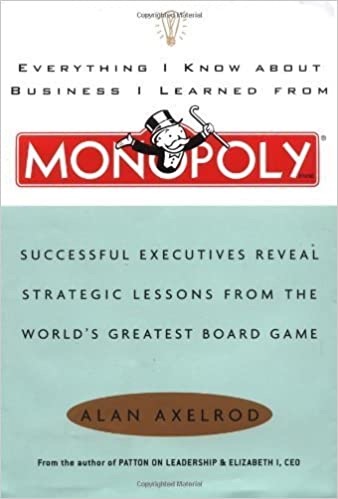
Everything I Know About Business I Learned From MONOPOLY: Successful Executives Reveal Strategic Lessons From the World’s Greatest Board Game by Alan Axelrod

Monday, May 11th, 2020
MONOPOLY

Everything I Know About Business I Learned From MONOPOLY: Successful Executives Reveal Strategic Lessons From the World’s Greatest Board Game by Alan Axelrod is a handbook on how to use the world’s most popular board game to think about, explore, and rethink the nature of business and the doing of business. It offers insight and provocation, which is a good starting place. If you are finding more time for board games, be sure to dust of your MONOPOLY board after you read this book.

Introduction

  • Parker Brothers introduced MONOPOLY in 1935 and within one year it became the best seller in the US. This was in the heart of the great depression when business wasn’t working too well. Then a game that modeled capitalism struck a chord. It allowed people to experience success and failure in their own living rooms. The game is just complicated enough to be realistic and fun. It was developed from business school simulations for the general public by Charles Darrow who was turned down the first time it offered it to Parker Bros. He kept selling it himself and Parker Brothers got wind of his success. Ask any business person what got them interested in business and they are likely to say MONOPOLY. Like the rest of the book, this chapter contains quotes from famous business people.

Part I: There Are Rules – 1.The Object of the Game

  • The objective of MONOPOLY is to become the wealthiest player through buying, renting, and selling property. You need to be aggressive when it comes to acquiring property. Being cautious might keep you in the game longer before you go bankrupt. Caution is not a winning strategy.

2. All Things Being Equal

  • Unlike the real world, each MONOPOLY player starts with the same amount of money ($1,500) at the same place. Beyond that things are unequal based on each player’s abilities. In real life, there are great disparities regarding where we start. A combination of innate ability, ambition, parental wealth and parenting skills, and luck determine where we end up. Like the real world, luck is also a factor in MONOPOLY via the roll of the dice and the luck of the draw (Community Chest and Chance cards).

3. A Roll of the Dice

  • Luck implies some controlling power. Chance implies randomness. Confident people anticipate success. If you feel like a winner, you will behave like a winner, you will make moves that winners make, you will, therefore, improve your luck. It’s your attitude and self-confidence that will predispose you to make your own luck. Our lives are full of familiar events mingled with a few surprises. In MONOPOLY there is a lot of familiar territory accompanied by chance. You can’t control the dice, but it’s good to know the odds. Out of 36 possible combinations. Six give you a seven. Five give a six or an eight. Four give you a five or a nine. Three give you a four or a ten. Two give you a three or an eleven, and only one gives you a two or a twelve.

4. Passing GO

  • Passing Go and collecting $200 is like working and collecting a salary. Ideally, you make enough to meet your needs and maybe enough to save some. In MONOPOLY you can’t live on your salary alone and you have to put the money you take in at risk. Unless you pull the go-to jail card, collecting your GO salary should be part of your strategy.

5. The Rule of Opportunity

  • The big idea here is unless you have a positive, purposeful, affirmative reason to say NO, say Yes to every opportunity that presents itself. In MONOPOLY you need a very good reason not to buy an unowned property you land on. The rules state that if you don’t choose to purchase an unowned property you land on, the Banker is supposed to sell it at auction. Many people don’t follow this rule, but you should as it makes the game much more dynamic.

6. Facing Reality and Paying Your Debts

  • The key point is not to learn to avoid risk but to accept risk as necessary to success. Having accepted the necessity of risk the object becomes making a choice of what risks to take and how far to take them. Accepting a risk should not require abandoning fiscal responsibility. Putting all your chips on a single number is a risk, but not a wisely calculated risk. Stretching intelligently but aggressively to the edge of your means is often necessary to win. Aggressive but intelligent risk is part of living, working, doing business, and making deals. In a sense, MONOPOLY is a kind of financial flight simulator that lets you try out the lessons of value, responsibility, and prudence.

7. Mortgaging the Future

  • Your only credit option in MONOPOLY is to mortgage properties you own. Doing so you collect half their listed value from the Bank and can no longer collect rent. Ideally, you would mortgage single properties to develop a monopoly you own. Unlike real mortgages, there are no regular payments and you can un-mortgage a property any time by paying back the loan with 10% interest. Don’t do this until you have at least three houses on all of your monopolies. Mortgage single properties first followed by utilities and railroads as the latter command higher rent.

8 Vigilance

  • The key rule here is “The owner may not collect the rent if he/she fails to ask for it before the second player following throws the dice.” You have no obligation to remind someone that you have just landed on their property and you shouldn’t. Part of the success in this game is being vigilant throughout. This includes keeping track of who owns what as property deeds need to be clearly displayed in front of each player. Being vigilant for other players doesn’t help them learn vigilance.

9. The Random Walk

  • Moves around the MONOPOLY board may seem random, but they are not. Thanks to the probability of rolling different die combinations the moves are just complex. You can consult The MONOPOLY Companion by Philip Orbanes for details. Here you will find a list of the chance of landing on each type of property each trip around the board, and there is a surprising range. The fact that Jail is the most common starting place for a move is part of the reason. The key idea is that knowledge itself is useless unless it is applied.
Share this:
Share this page via Email Share this page via Stumble Upon Share this page via Digg this Share this page via Facebook Share this page via Twitter Share this page via Google Plus

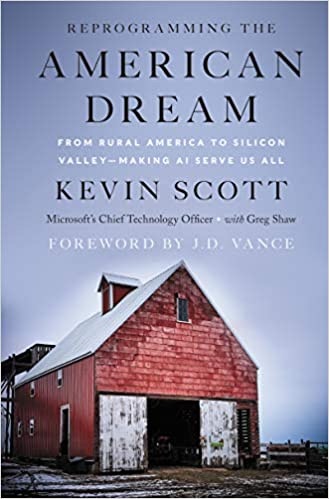
Reprogramming the American Dream: From Rural America to Silicon Valley – Making AI Serve Us All by Kevin Scott

Monday, April 27th, 2020
American Dream

Reprogramming the American Dream: From Rural America to Silicon Valley – Making AI Serve Us All by Kevin Scott finds a balance between “the robots are coming for our jobs” and “AI is great, nothing to worry about.” Like Kevin, I believe that all citizens need to educate themselves regarding the promises and perils of AI. That is clearly the purpose of this book. It won’t make you an expert in AI, but it will give you many clues. In addition to citizens, AI experts, policymakers, and executives are also Kevin’s intended audiences.

Introduction

  • There are two prevailing stories about AI. For low and middle-skill workers, we hear a grim tale of steadily increasing job destruction. For knowledge workers, we hear an idyllic tale of enhanced productivity and convenience. But neither captures the whole story. The story we need is AI’s potential to create abundance and opportunity for everyone as it helps solve the world’s most vexing problems. Kevin’s story is based on his upbringing in rural Virginia and his life as executive vice president and chief technology officer for Microsoft.
  • We know AI will radically impact economics and employment and we are already seeing it perform very specific, narrow tasks like selecting the ads you see, turning speech to text, and translating languages. He sees a future where workers at all skill levels are served. While AI was invented in the US, China’s goal is to become the leader and thus dictate policy regarding this technology. In order to have a voice in the debate you need to be informed, which is the goal of this book.

PartI: Where We’ve Been – 1. When Our Jobs First Went Away

  • Kevin returns to his rural home and visits old friends who are using simple versions of AI to harvest sod, monitor nursing home patients, and manufacture specialized plastic parts. The latter demonstrates how technology is allowing some manufacturing jobs to return to the US. In the case of the sod farmer, drones using AI are saving human jobs. In essence, AI can empower people rather than replacing them. He also visits a large Microsoft data center that replaced an obsolete prison. The local college even started a program to train workers. The challenge is to convince high school graduates that there is a better future in a technology job than in oil and gas jobs which might pay $60,000 to start, but are heavy labor jobs that over time, pay little more than the initial offer.

2. The Career Choice I Made

  • This chapter is largely autobiographical. Kevin tells his story from home to college to a small engineering company in Lynchburg, VA, to graduate school at the Univerity of Virginia where he met his future wife. When she was accepted to a PhD program in Götingen, Germany he was able to get a job there too. From there he went from Google to AdMob, to Google, to LinkedIn. LinkedIn was acquired by Google in 2016 and ultimately he was chosen by Saya Nadella the CEO to be Microsoft’s chief technology officer (CTO).
  • Along the way Keven stresses the importance of his supportive family and community in rural Virginia. While they were not rich he never lacked for food or housing and hand mentors and role models that supplemented his education. He didn’t have health care until he got to Google but never got sick either. While he doesn’t think you should base all of your career decisions on income, you should consider the economics of the choices you make. Get as much data and good advice as you can and reflect prior to making important life choices. For companies, he stresses the importance of stories. They need to be stories that employees can make their own and they need to be connected to how their work can somehow make the world a better place.

3. Stories of Revival

  • The stories here focus on rural life and opportunities. In 2016 75% of venture funding went to Silicon Valley, New York, and Boston. Kevin tells the success story of Memphis that now has the world’s largest cargo airport. AI is making inroads in agriculture with robots that do precision irrigation and drones that apply fertilizer and pesticides in just the right quantities and locations. Kevin offers some ideas of how the government can incentivize rural entrepreneurship. His big idea is to have an Apollo type program for AI. The Apollo program only cost $200 billion in the 1960s to get to the moon so it should be possible to do the same for AI.
  • We need a system to make rural people better at tech so they can run and debug drones, robots, and other high tech farm equipment. There is some effort in this direction. We also need to break down the stereotypes that urban and rural people have of each other. The media that people currently consume is part of the problem as many people binge on unhealthy information. He switched his consumption to 75% refereed journals like Science and Nature, 25$ to learning something new and different not related to his job, and 5% for everything else. Doing so made him less anxious, irritated, and much better informed.
Share this:
Share this page via Email Share this page via Stumble Upon Share this page via Digg this Share this page via Facebook Share this page via Twitter Share this page via Google Plus